


BY SIFISO NHLABATSI
MBABANE– Prime Minister Russell Mmiso Dlamini has taken a firm stand for Eswatini when it comes to global affairs by indicating that the country will not be a spectator.
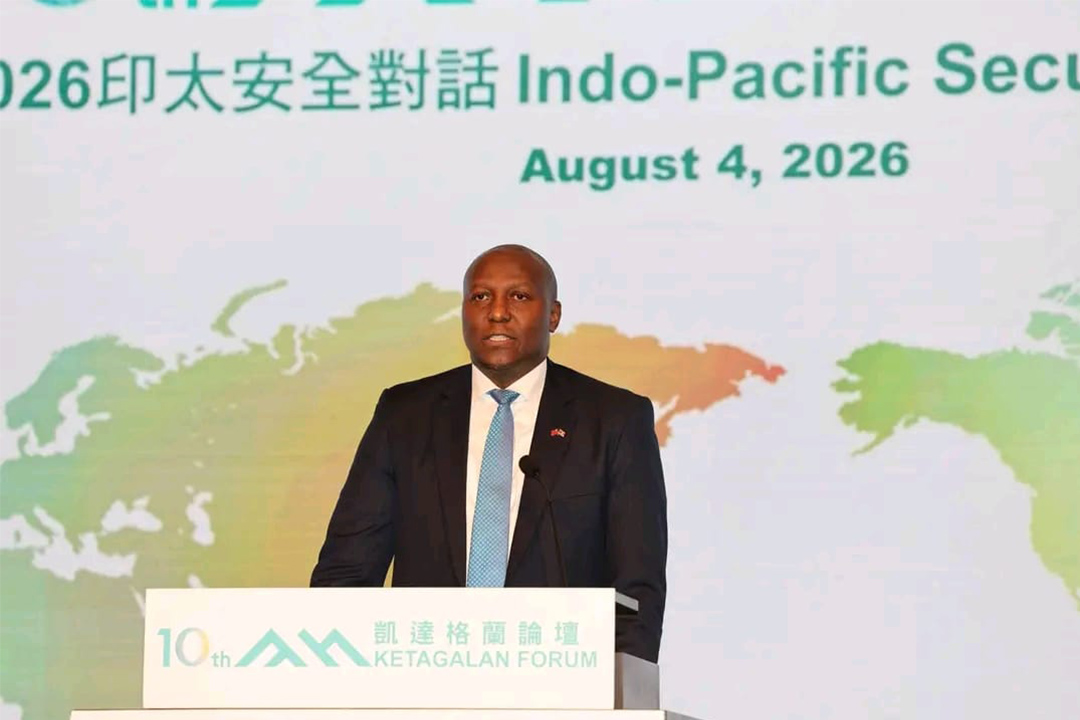
The Prime Minister made the remarks while delivering the keynote address on behalf of His Majesty King Mswati III at the 10th Ketagelan Indo-Pacific Security Forum in Taipei, Republic of China (Taiwan), where he said every nation, regardless of its size, has an important role to play in shaping the international community.
Addressing delegates, Dlamini said the Kingdom of Eswatini rejected the long-held perception that smaller nations should merely observe global developments from the sidelines.
“Throughout history, smaller nations have too often been regarded as spectators in global affairs. The Kingdom of Eswatini respectfully rejects that notion,” he said.

The Prime Minister said the Charter of the United Nations recognised the sovereign equality of all member states, adding that the principle was not symbolic but fundamental to the international system.
“The legitimacy of the international system derives not from the influence of the powerful, but from the equal dignity of every sovereign nation. No State is too small to contribute. No nation is too insignificant to matter. No people are too distant to deserve peace, prosperity and justice,” he said.
He said respect for sovereignty, territorial integrity, political independence and the principle of non-interference in the internal affairs of states should remain the foundation of international peace and stability.
Dlamini further stressed that disputes should be resolved through dialogue, diplomacy and adherence to international law.
“Equally indispensable is our collective commitment to resolving disputes through dialogue, diplomacy and faithful adherence to international law. These principles are not obstacles to progress. They are its guarantors. The Kingdom of Eswatini remains resolute in its commitment to them,” he said.
The Prime Minister expressed appreciation to President Lai Ching-te, the Government and people of the Republic of China (Taiwan) for hosting the Eswatini delegation.
He said every visit to Taiwan reaffirmed the longstanding friendship between the two countries, which has endured for more than five decades.
“Every visit to this remarkable nation serves to reaffirm a friendship that has endured for more than half a century, a friendship not measured by the passage of time, but by the depth of mutual trust, shared values and solidarity,” he said.
The Prime Minister said the bilateral relationship had withstood changing geopolitical circumstances because it had been built on mutual respect and a shared commitment to improving the lives of the two countries’ citizens.
“Our relationship has endured changing geopolitical landscapes because it has never rested upon convenience or expediency. It has been sustained by mutual respect, common purpose and the shared belief that international partnerships must ultimately improve the lives of our peoples,” he said.
Turning to the changing global landscape, Dlamini said the world was experiencing one of the most significant shifts since the end of the Cold War.
He said strategic competition among major powers was reshaping geopolitical alignments while technological innovation was transforming economies, societies and systems of governance at an unprecedented pace.
The Prime Minister also cited climate change, armed conflicts, disruptions to global trade and supply chains, and economic uncertainty as some of the defining challenges facing the international community.
“History occasionally presents moments that compel humanity to reconsider long-held assumptions. We are living through one of those moments. The international order is undergoing one of its most consequential transformations since the conclusion of the Cold War,” he said.
According to Prime Minister, the interconnected nature of these challenges meant that countries could no longer afford to pursue isolated approaches.
“In such a world, no nation, however powerful, can prosper in isolation. Nor can any nation, however small, be regarded as insignificant. These realities call not for narrower interests, but for broader cooperation; not for fragmentation, but for renewed solidarity,” he said.
He said many African countries had long faced economic vulnerabilities arising from factors beyond their borders but had continued to strengthen their resilience while pursuing sustainable and inclusive development.
“For many African nations, economic vulnerability is not a recent phenomenon. Our economies have long been shaped by forces extending beyond our borders. Yet adversity has also strengthened our resolve, deepened our resilience and reinforced our determination to pursue sustainable and inclusive development,” he said.
The Prime Minister also outlined Eswatini’s broader understanding of national security, saying it extended beyond military capability to include several critical sectors.
“For the Kingdom of Eswatini, security cannot be defined solely by military capability. Food security is national security; energy security is national security; water security is national security; health security is national security; cybersecurity is national security; economic resilience is national security,” he said.
He added that because global challenges were interconnected, partnerships between nations should also be comprehensive and forward-looking.
“The challenges confronting humanity are interconnected. Our partnerships must therefore be equally interconnected, comprehensive and forward-looking,” he said.
#Eswatini#RussellMmisoDlamini#Taiwan #KetagelanForum #IndoPacific #ForeignPolicy #InternationalRelations #EswatiniPositiveNews
(Courtesy Pic)