


BY THEMBA ZWANE
EZULWINI – Parliamentary Accounts Committees (PACs) sub committees from across the Southern African Development Community (SADC) region have examined three critical dimensions shaping the future of public accountability, with a strong call for oversight institutions to become more proactive in identifying risks before they develop into crises.
The discussions formed part of Commission Two of the Southern African Development Community Organisation of Public Accounts Committees (SADCOPAC) 18th Annual Conference that took place in the Kingdom of Eswatini.
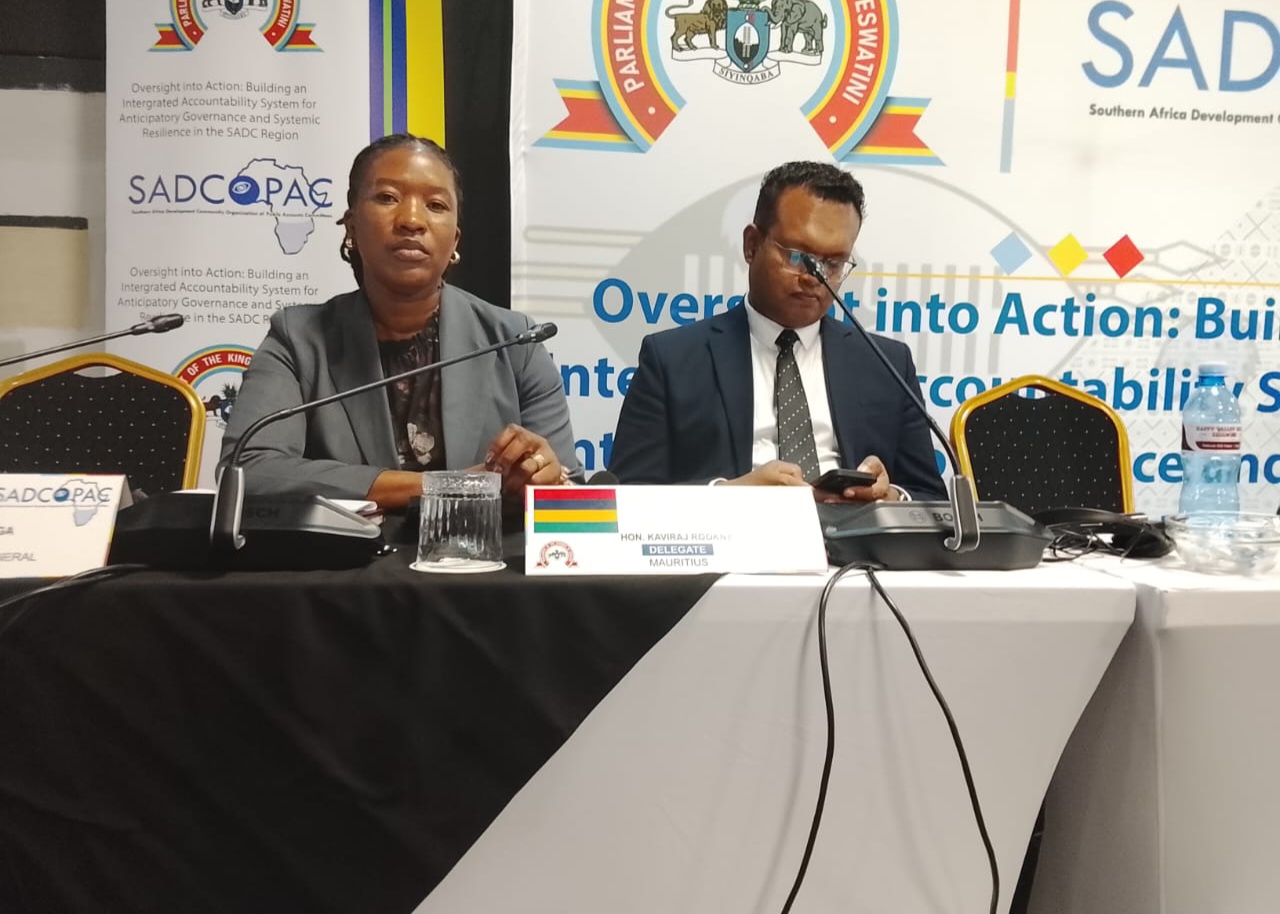
Commission Two, chaired by Mauritius’ Honourable Kaviraj Rookny, examined the future of public accountability through three key areas: climate finance and greenwashing, digital transformation in public financial management (PFM), and parliamentary oversight during times of crisis.
Reporting back to the plenary, Rookny said the three discussions ultimately centred on one fundamental question: whether accountability can arrive early enough to make a difference.

He said the commission’s deliberations pointed towards a new approach in which accountability should not only investigate what went wrong, but also anticipate risks, strengthen systems and prevent failures before they occur.
“The commission’s discussions on climate finance called for a shift from simply accepting labels attached to climate projects to following the evidence of what is actually delivered,” he said.
The legislator added that Tanzania presented what was described as a “chaining evidence” approach, tracking the process from commitments and resources through action, outcomes and impact, before subjecting the results to independent verification.
“The commission noted that expenditure should not automatically be regarded as an outcome, while an activity should not necessarily be regarded as impact,” said Rookny.
Tanzania’s audit experience was cited as an illustration, with claims of about 40 million tonnes of carbon credits annually contrasted with less than 2.1 million tonnes reportedly actually traded.
The commission also heard that global climate finance reached approximately US$1.9 trillion in 2023, while less than two per cent could be verified as reaching local Indigenous, community and smallholder organisations directly.
Delegates said fragmentation between donors, governments, financial institutions, procurement systems and communities could create opportunities for different forms of greenwashing.
The commission therefore supported regular climate audits based on verified outcomes, greater civil society participation in PAC climate-finance hearings and public tracking of audit recommendations.
Digital transformation was the second major area examined by the commission.
Mauritius demonstrated how Treasury, procurement, taxation, customs and other public financial activities are increasingly generating digital audit trails, while Tanzania shared its experience of implementing public financial management reforms progressively over several decades.
However, delegates identified a growing information gap between the Executive and Parliament.
The commission noted that governments may have access to financial information almost in real time, while parliamentary oversight can sometimes take place 12 or 24 months after expenditure has occurred.
Traditional manual auditing was also highlighted as being incapable of covering the full volume of transactions generated by increasingly digital public financial systems.
The commission consequently considered the potential of data analytics and artificial intelligence to screen much larger volumes of transactions, identify anomalies and direct human auditors towards areas carrying the greatest risk.
Among the areas discussed were secure access for oversight institutions to relevant financial systems, continuous automated auditing, interoperability between systems, electronic procurement, stronger analytical capacity and cybersecurity.
However, delegates cautioned that technology should not be viewed as a substitute for human judgement.
“Poor-quality data, cybersecurity threats, privacy concerns, incompatible systems and inadequate skills could result in existing weaknesses simply being transferred into digital systems.”
The commission’s message was therefore that governments cannot become digital while accountability remains analogue.
The third dimension focused on oversight during crises and disasters.
Drawing on experiences from Uganda, Zimbabwe, Namibia and Eswatini, the commission developed what was described as a Crisis Oversight Playbook, emphasising that parliamentary oversight must operate before, during and after a crisis.
Before a crisis, PACs should examine whether risks have been identified and costed, whether contingency financing is sufficient, whether suppliers and framework agreements are ready, whether beneficiary registers are reliable and whether previous recommendations have been implemented.
Delegates also cautioned that not every urgent situation should automatically be treated as an emergency.
Years of neglected maintenance or poor stock planning, they argued, should not become justification for bypassing procurement rules simply because the consequences have become urgent.
Where a genuine emergency exists, the commission acknowledged that speed can save lives, but maintained that emergency procurement should remain a lawful “fast lane” rather than a process without rules.
Necessity, authority, price, delivery and the audit trail must remain demonstrable, delegates said.
The experiences presented during the session illustrated the risks involved when emergency oversight fails.
Uganda reported close to US$22 million in COVID-19-related procurement affected by unjustified direct awards and undocumented deliveries.
Zimbabwe highlighted the loss of more than 33 tonnes of relief supplies following Cyclone Idai, while Namibia demonstrated how weaknesses in targeting could result in government employees receiving assistance intended for unemployed informal workers.
Eswatini, however, provided an example of how emergency expenditure could be linked to measurable outcomes during COVID-19, including 140,000 laboratory tests and the training of 6,273 health workers.
Rookny told the plenary that emergency money must ultimately be followed from appropriation, through procurement and delivery, to the citizen and finally to the outcome.
The three areas of discussion converged around the broader concept of anticipatory accountability.
The commission concluded that traditional auditing remains necessary because wrongdoing must be identified and responsibility established, but argued that oversight must increasingly look forward by identifying vulnerabilities and preventing repeated failures.
“Accountability must remain capable of looking backwards,” Rookny said, while emphasising the need for institutions to also become capable of looking forward.
He said anticipatory accountability does not weaken traditional auditing but completes it by moving oversight beyond explaining failure towards preventing it.
The Commission Two report will form part of the recommendations to be considered as the SADCOPAC conference proceeds towards its 22nd Annual General Meeting (AGM) tomorrow, where resolutions arising from the commission deliberations are expected to be considered for adoption.
The broader discussions at the conference have therefore placed the future of parliamentary oversight firmly around a more proactive accountability model – one that can verify climate-finance outcomes, detect financial risks in real time and maintain effective oversight when countries face emergencies.
For SADC PACs, the emerging challenge is no longer simply how to account for yesterday’s expenditure, but how to ensure that oversight is timely enough to protect tomorrow’s public resources and citizens.
#SADCOPAC #SADC #PublicAccountability #ParliamentaryOversight #PACs #Eswatini #PublicFinance #ClimateFinance #DigitalTransformation #AnticipatoryAccountability