


BY TANDZILE DLAMINI
MBABANE – Africa must urgently shift from exporting raw materials to selling ideas, innovation and technology if it is to achieve meaningful economic transformation, Kenya has said, calling for stronger South South cooperation between African nations.
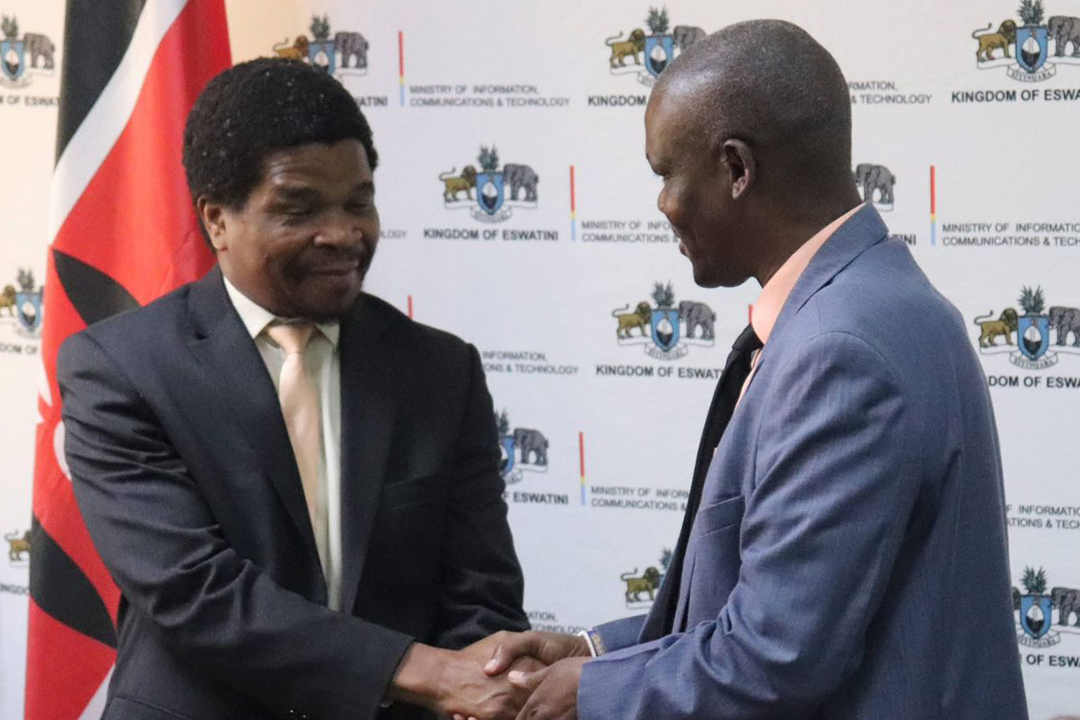
This was the central message from Kenya’s Deputy High Commissioner Ambassador Sunya Morongei Orre during a courtesy visit to the Ministry of Information, Communication and Technology on 26 May 2026, where he led a delegation on a three day engagement programme in Eswatini.
Ambassador Orre said Africa already possesses the education systems, knowledge and human capital needed to compete globally, but continues to underutilise its potential due to weak collaboration and limited investment in innovation driven economies.
“We have the knowledge, we have education, the same education that the Western countries have,” he said. He argued that Africa’s development trajectory must be anchored on science, research and technology, warning that continued reliance on agriculture and raw commodity exports would slow long term growth.

The ambassador said countries that are now global leaders achieved progress through collaboration, knowledge sharing and innovation ecosystems that allow ideas to be commercialised.
He said Africa’s youthful population, projected to make up a significant share of the global population by 2050, should be a major driver of innovation if properly supported. “Africa, which is projected by 2050 to be one third of the world’s population, and with its youthful population, is supposed to be driving innovation,” he said.
Ambassador Orre cited emerging global models where young entrepreneurs generate wealth through ideas rather than physical production, saying Africa must build similar systems to address unemployment and unlock economic growth.
“At the age of 18 or 19, young people are selling ideas. They have not produced anything, but they market the idea and companies buy it,” he said. He also noted that Kenya and Eswatini already cooperate in practice across various sectors, despite not yet finalising a formal Memorandum of Understanding on science and technology. “Our scientists actually do collaborate, our military is collaborating, and we are collaborating because we are brothers and sisters,” he said.
The ambassador added that the proposed MOU would be pursued through relevant government structures in Kenya, depending on required approvals, but stressed that the partnership remains a priority.
He said the cooperation should not be limited to science and technology but should also expand into culture and youth development, pointing to shared African values such as Ubuntu and the “Bantu spirit”.
Speaking during the same engagement, Principal Secretary in the Ministry of ICT Prince Mshishimba said Eswatini first initiated discussions with Kenya in 2018 after recognising its advancement in science, research and innovation. He said Eswatini views Kenya as a strategic partner that can help broaden collaboration beyond the Southern African region into East Africa and the wider continent.
Prince Mshishimba said African countries must strengthen South South cooperation and reduce overdependence on external partners. He also emphasised the importance of developing local human capital, saying Africa must become a producer of innovation rather than a consumer.
“We must cultivate and nurture our own potential and make sure that we develop our human capacity, our human capital,” he said.
The Kenyan delegation is expected to continue its engagements with government institutions and ICT parastatals over the three day visit, focusing on digital transformation, research and innovation cooperation.