


…. Exports climb 9.38% to E3.86 billion
…. SACU trade posts E248.27 million surplus
…. Africa takes 96.14% of Eswatini exports
BY MBONGENI NDLELA
EZULWINI – Eswatini’s merchandise trade bounced strongly into positive territory in August, recording a preliminary surplus of E194.09 million as exports rose and imports declined, according to the latest Eswatini Revenue Service (ERS) figures.

The performance marks a significant turnaround from the E253.74 million trade deficit recorded in July 2026 and the E261.94 million deficit registered in August last year.
In practical terms, the country’s trade position improved by about E447.83 million in just one month, moving from a deficit in July to a healthy surplus in August.
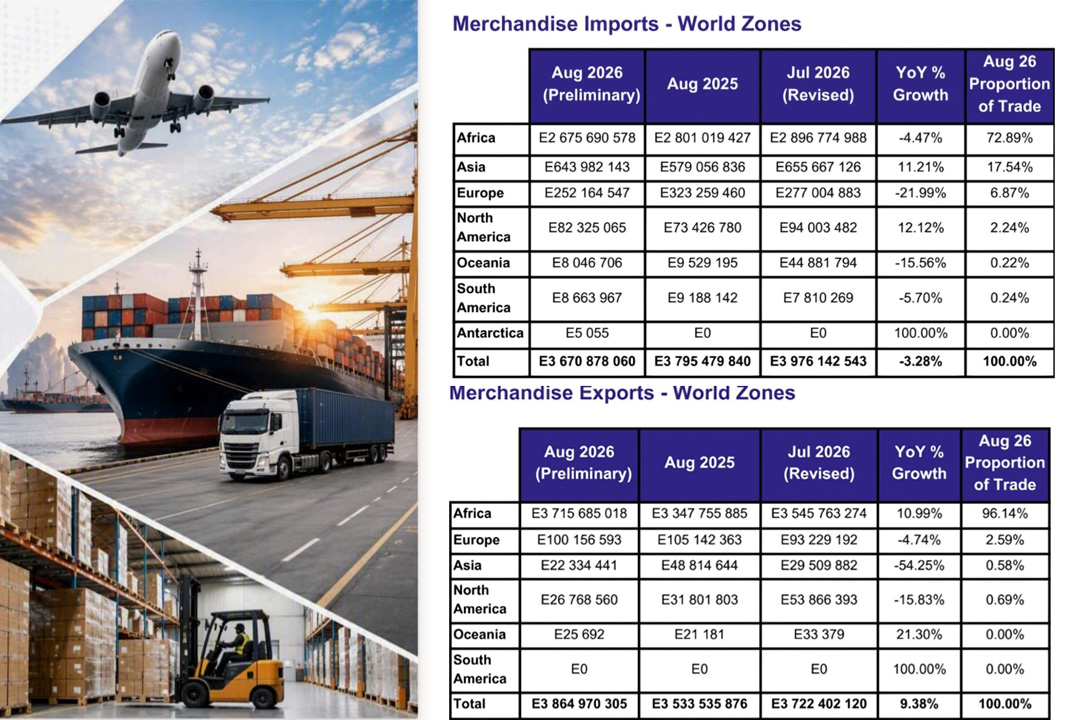
The ERS Merchandise Trade Report for August 2026 shows that Eswatini exported goods worth E3.86 billion, up from E3.72 billion in July and E3.53 billion in August 2025.
Imports, meanwhile, dropped to E3.67 billion, from E3.98 billion in July and E3.80 billion during the same month last year.
The combination of stronger exports and reduced imports left the country selling more merchandise abroad than it bought from external markets during August.
On a year-on-year basis, exports increased by E331.43 million, or 9.38 per cent, while imports fell by E124.60 million, or 3.28 per cent.
ERS attributed the strong export performance primarily to increased exports of concentrates and sugar, while the decline in imports was mainly linked to reduced imports of electrical energy and concentrates.
The figures provide an encouraging picture of Eswatini’s external trade performance, particularly because the August surplus follows two comparative periods in which imports exceeded exports.
SACU TRADE DELIVERS E248M SURPLUS
The report further shows that Eswatini’s trade with its Southern African Customs Union (SACU) partners was a major contributor to the improved August position.
Trade with Botswana, Lesotho, Namibia and South Africa produced a E248.27 million surplus during the month.
Exports to SACU countries reached E2.83 billion, increasing by 15.25 per cent from E2.46 billion in August 2025.
SACU imports declined by 5.19 per cent, from E2.72 billion last year to E2.58 billion in August 2026.
This represents a dramatic turnaround from the E267.80 million SACU trade deficit recorded in August 2025.
It was also an improvement from July this year, when trade with SACU resulted in a deficit of E119.27 million.
The numbers underline the importance of the regional market to Eswatini’s economy, with a substantial share of goods produced locally finding buyers within neighbouring African economies.
AFRICA TAKES 96% OF ESWATINI EXPORTS
Africa remained overwhelmingly Eswatini’s biggest export destination during August.
According to the report, merchandise exports to African markets were valued at E3.72 billion, accounting for a massive 96.14 per cent of all Eswatini exports during the month.
This was 10.99 per cent higher than the E3.35 billion exported to Africa in August last year.
Europe emerged as the second-largest destination, receiving exports worth E100.16 million, equivalent to 2.59 per cent of total exports.
North America received E26.77 million worth of goods, while exports to Asia amounted to E22.33 million.
The dominance of African markets reflects Eswatini’s strong regional trade links and the advantages provided by proximity, established supply chains and regional economic arrangements.
Africa was equally important on the import side.
Eswatini imported E2.68 billion worth of merchandise from African countries in August, representing 72.89 per cent of total imports.
Asia supplied E643.98 million worth of goods, or 17.54 per cent of imports, while Europe accounted for E252.16 million.
CHEMICAL PRODUCTS LEAD EXPORT EARNINGS
A closer look at the merchandise categories provides an even clearer picture of what is generating Eswatini’s export earnings.
Products classified under chemical and allied industries were the largest broad export category during August, generating approximately E1.57 billion.
They were followed by prepared foodstuffs, beverages, spirits, vinegar, tobacco and manufactured tobacco substitutes, which contributed approximately E1.21 billion.
Together, these two broad categories accounted for about 72 per cent of the country’s merchandise exports during August.
Textiles and textile articles generated E395.73 million, while wood and related products contributed E278.81 million.
Several smaller export categories also recorded strong year-on-year growth.
Exports of mineral products increased by 92.41 per cent to E93.38 million, while machinery and electrical equipment exports almost doubled, rising 94.31 per cent to E52.30 million.
Exports of vehicles, aircraft, vessels and associated transport equipment recorded particularly strong growth of 223.25 per cent, rising from E13.83 million in August 2025 to E44.69 million this year.
IMPORT BILL FALLS
On the import side, mineral products remained the country’s biggest broad merchandise category at E791.76 million, although this was 8.86 per cent lower than the E868.73 million recorded in August last year.
Products of chemical and allied industries accounted for E515.90 million, while machinery, mechanical appliances and electrical equipment amounted to E370.61 million.
Prepared foodstuffs, beverages and related products contributed another E366.44 million to the import bill.
The overall reduction in imports is significant because Eswatini spent about E305.26 million less on merchandise imports in August than it did in July, when imports stood at E3.98 billion.
At the same time, exports increased by about E142.57 million month-on-month.
These two movements combined to produce the sharp improvement in the country’s monthly trade balance.
YEAR-TO-DATE DEFICIT NARROWS
Despite the strong August performance, Eswatini remains in a cumulative trade deficit for the first five months of the 2026/27 financial year.
From April to August, total merchandise exports stood at E18.24 billion, compared with imports of E19.12 billion.
This produced a cumulative deficit of E878.39 million.
However, this is an improvement on the E1.02 billion deficit recorded during the same period of the previous financial year.
The cumulative deficit has therefore narrowed by approximately E137.20 million, or about 13.5 per cent.
Exports during the five-month period increased by 6.69 per cent, adding E1.14 billion compared with the corresponding period last year.
Imports grew at a slower 5.56 per cent, increasing by E1.01 billion.
That difference in growth rates helped narrow the overall fiscal year-to-date trade deficit.
The improvement is even more pronounced within SACU trade. The cumulative SACU deficit dropped from E741.49 million during April to August last year to E412.78 million this year.
That represents an improvement of approximately E328.71 million.
EXPORT MARKETS SHOW NEW GROWTH
While Africa remains by far Eswatini’s biggest market, the cumulative figures also show encouraging growth in some markets beyond the continent.
Between April and August, exports to Europe rose by a substantial 74.90 per cent, from E505.32 million to E883.79 million.
Exports to North America almost doubled, increasing by 97.62 per cent from E98.57 million to E194.80 million.
These figures are important as Eswatini seeks to diversify markets for locally produced goods while strengthening its established regional trade base.
Over the five-month period, Africa still received E16.99 billion, or 93.15 per cent, of the country’s total merchandise exports.
The August numbers therefore present a positive monthly picture for the economy: exports are growing, the import bill has fallen and Eswatini has moved from consecutive comparative deficits into a E194.09 million trade surplus.
The challenge going forward will be to sustain export growth, broaden the range of products sold abroad, expand into additional international markets and strengthen domestic production so that improved trade figures translate into investment, businesses and employment opportunities for emaSwati.
(Courtesy Pic)