


BY GCWALISILE MHLABANE
NHLANGANO – For more than four decades, thousands of teachers who first walked through the gates of Ngwane Teachers College as students have gone on to stand in classrooms across Eswatini, shaping generations of children.
That contribution reached another milestone on September 15, 2026, when the institution celebrated its 40th Graduation Ceremony and revealed that it has produced approximately 7200 teachers since its establishment in 1983.
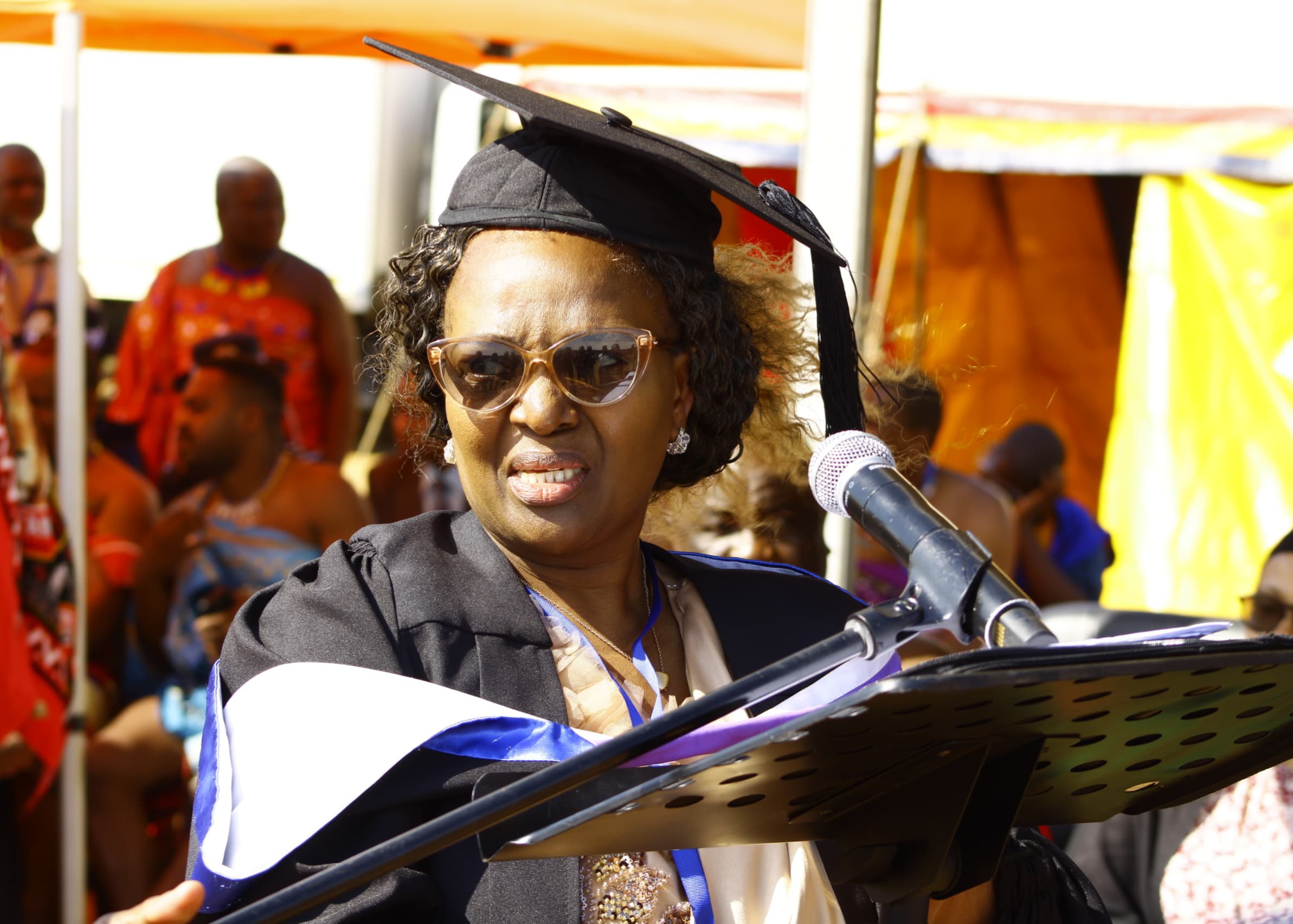
College Principal Celiwe Khumalo said the institution had become an important contributor to Eswatini’s education system, producing teachers who have gone on to serve schools and communities throughout the country and beyond its borders.
The milestone was marked as another 159 newly trained teachers graduated from the institution, adding their names to a growing legacy stretching back more than 40 years.

According to Khumalo, the College has produced approximately 6750 Primary Teachers Diploma graduates as well as 450 Early Childhood Care and Development teachers since it officially opened.
“These graduates represent a significant contribution to the education sector,” Khumalo said.
The latest group of graduates reflects the broad range of skills being developed at the institution.
Of the 159 graduates, 47 specialised in Sciences, Information and Communication Technology and Mathematics, while 30 graduated in Languages, including French, SiSwati and English.
Another 30 specialised in Social Studies, covering Geography, Religious Education and History, while 52 graduated in Applied Sciences, including Consumer Science and Agriculture.
The ceremony was attended by Their Majesties, alongside senior government leaders, education officials, families and other distinguished guests, adding significance to the institution’s landmark celebration.
However, even as the College celebrated its achievements, Khumalo stressed that teacher training could no longer remain unchanged in a rapidly evolving world.
She said modern educators needed far more than knowledge of the subjects they teach.
“The teacher of today must be equipped not only with subject knowledge, but also with practical competencies, digital skills, problem-solving abilities, entrepreneurial awareness and the capacity to adapt to changing circumstances,” she said.
To respond to these changing demands, Ngwane Teachers College is reviewing its curriculum with support from the European Union, with the aim of aligning its programmes with Competency-Based Education.
The review is expected to strengthen the ability of future teachers to think critically, use technology effectively, solve problems and apply what they learn in practical situations.
It also seeks to develop entrepreneurial abilities among graduates, positioning teachers not only as classroom instructors but as adaptable professionals capable of responding to the changing needs of pupils, schools and communities.
COLLEGE PREPARES FOR UNIVERSITY STATUS
Ngwane Teachers College is also strengthening its academic capacity as it prepares for its planned transformation into a university.
Khumalo revealed that three more members of staff had attained doctorate degrees since last year, increasing the number of PhD-qualified staff members from 11 to 14.
The institution also has 25 staff members with Master’s degrees in Education and another 12 with Bachelor’s degrees, strengthening the academic foundation on which its future development is being built.
Infrastructure development is also receiving attention.
Through collaboration with the Ministry of Education and Training and Micro-Projects, the institution has improved its water reticulation system, including replacing an ageing plumbing network.
The College is also pursuing the development of boreholes to establish a more sustainable water supply, which would serve the institution while supporting agricultural activities on campus.
Agriculture is increasingly becoming part of the practical training offered to students.
Ngwane Teachers College is working with NAMBOARD, in partnership with the Ministry of Agriculture, to expose students to modern farming methods while strengthening practical skills linked to food security and entrepreneurship.
The initiative is expected to give future teachers practical knowledge that can be transferred into schools and communities, particularly at a time when education is increasingly expected to equip young people with skills that can be used beyond the classroom.
HISTORIC FIRST FOR HEARING-IMPAIRED GRADUATES
Among the most significant moments of the 40th graduation was a milestone in inclusive education.
For the first time in the College’s history, two students with hearing impairments graduated from the institution.
Their achievement gave the ceremony an additional human dimension, demonstrating that barriers to education can be overcome when institutions create opportunities for learners with different needs.
Khumalo said their graduation demonstrated the importance of removing barriers to education and creating opportunities for inclusive learning.
Since opening its doors in 1983, Ngwane Teachers College has steadily expanded its programmes, facilities and academic capacity.
Its impact can now be measured not only through the buildings and programmes it has developed, but through the approximately 7200 teachers who have passed through the institution and gone on to educate children in classrooms across the country.
As another 159 graduates begin their own journeys as educators, the College enters its next chapter carrying both a proud legacy and a growing responsibility: to prepare teachers capable of responding to modern challenges while shaping the future of Eswatini’s children.