


BY MBONGENI NDLELA
NEW YORK, USA – A child who can sleep without fear. A young person able to find decent work. A family capable of putting food on the table. A developing country able to finance its future.
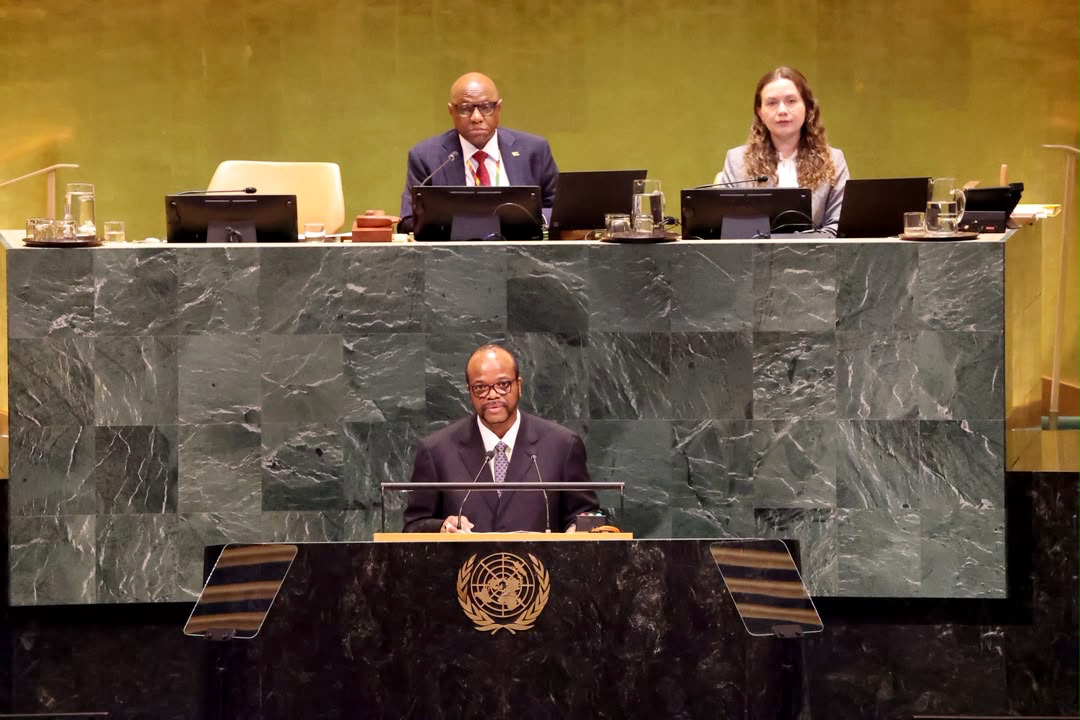
His Majesty King Mswati III used those everyday realities to set what he described as the true test of international cooperation when he addressed the 81st Session of the United Nations General Assembly.
“To ordinary people across the globe, this assembly must not be perceived merely as a forum where the world discusses its problems, but as an organisation that actively solves them,” the King said.
His Majesty argued that the credibility of the international system would ultimately depend on whether global commitments produced visible results in people’s lives.

“The true test of international cooperation is whether a child in a conflict-affected community can live without fear, a young person can find decent employment, a family can afford food, and a developing nation can access the finance required to build its future,” he said.
That people-centred theme ran through major parts of the King’s address, from food security and agriculture to jobs, health, technology and international inclusion.
On food security, His Majesty said Eswatini’s national objective was to ensure that every family had access to sufficient, safe and nutritious food.
“This is a matter of basic human dignity and sustainable development,” he said.
The King said the country was increasing investment in agriculture, modern farming technologies, research, infrastructure and support for smallholder farmers.
He also referred to subsidies for farming inputs and implements, as well as major dam construction projects intended to expand irrigation and transform agricultural production, particularly in the Lowveld.
The message brought a global debate directly to the household level.
For His Majesty, sustainable development was not an abstract collection of targets; it had to be reflected in whether families could eat, whether young people could work and whether farmers had the means to produce.
He said partnerships with the United Nations had been instrumental in advancing Eswatini’s national development aspirations and implementing the Sustainable Development Goals, with cooperation spanning health, tourism, education, agriculture and renewable energy.
His Majesty said Eswatini remained committed to a strong and enduring UN presence in the country, including the establishment of a permanent UN home in Eswatini.
The King then extended the principle of inclusion from national development to participation in the international system.
He said Taiwan played an important role in global supply chains and had expertise to contribute to the international community.
“The United Nations should seek appropriate ways to facilitate Taiwan’s substantive participation in UN meetings and activities, enabling it to share its expertise and actively engage with international partners,” His Majesty said.
The position formed part of the King’s wider argument that international institutions should create space for meaningful participation and practical cooperation.
“The world does not require perfect consensus on every issue. It needs the courage to identify areas where cooperation is possible and the will to act upon them,” he said.
His Majesty called on world leaders to restore faith in diplomacy, rebuild trust in international cooperation and protect the dignity and sovereignty of states.
He said Eswatini was ready to work with UN member states, regional organisations and international partners in pursuit of peace, sustainable development, dialogue and human dignity.
The address ultimately set a practical standard for judging those efforts: not simply the number of resolutions adopted or meetings held, but what international cooperation eventually means to a person far from New York.
For a family worried about food, a youth looking for work, a farmer needing reliable water or a country seeking development finance, the King’s message was that the United Nations must be able to move from debate to delivery.
If trust in multilateralism is to be restored, its success must ultimately be visible where people actually live.
(Courtesy Pic)