



BY MBONGENI NDLELA
NEW YORK, USA– Africa’s development should no longer be measured simply by how much raw material leaves the continent, but by how much value, industry and employment are created before those resources cross its borders.
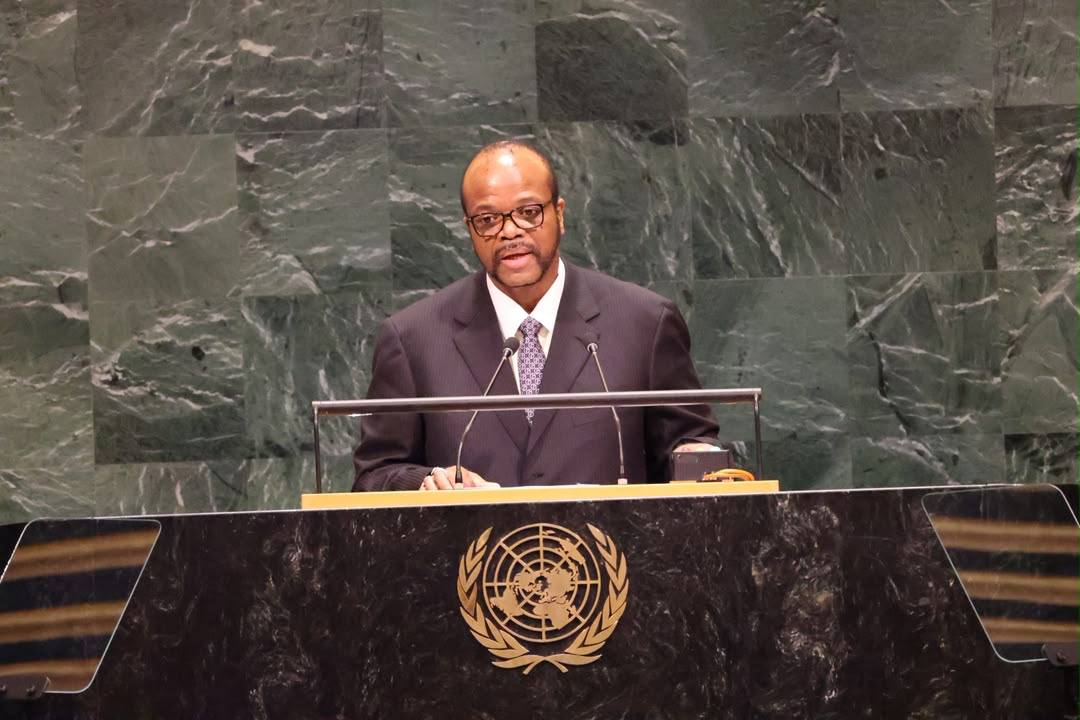
His Majesty King Mswati III used his address to the 81st Session of the United Nations General Assembly to make a case for a different economic model for developing countries, calling for value addition, local industrialisation, technology and stronger participation in regional and global value chains.
“We need to shift from the exportation of unprocessed raw materials to value addition, local industrialisation, and the creation of decent jobs within our own borders,” the King said.
That statement formed the centre of an economic message that moved from natural resources to artificial intelligence, youth employment and intra-African trade.

His Majesty said developing countries continued to face limited access to finance, technology, infrastructure, health care, education and productive investment.
The Sustainable Development Goals, he said, would remain difficult to achieve unless economies were structurally transformed in ways that created opportunities at home.
The King said Eswatini was pursuing a more resilient, diversified and inclusive economy, with investment in human capital, infrastructure, health care, education, agriculture, tourism, industrialisation, digital development and mining.
He said the country’s objective was to generate decent employment, attract sustained investment and expand opportunities for young people, women and marginalised groups.
The address also pushed the value-addition debate beyond individual countries.
His Majesty appealed for United Nations support to help African states strengthen their ability to process natural resources and develop trading hubs for minerals and other commodities.
He identified the African Continental Free Trade Area as an important platform through which countries could move away from dependence on raw-material exports and expand industrial processing and intra-African trade.
For the King, however, economic transformation was no longer only about factories, mines and physical infrastructure.
It was increasingly linked to the rapid growth of digital technologies and artificial intelligence.
“The transformation brought about by digitalisation and artificial intelligence presents enormous opportunities for humanity,” he said.
His Majesty said these technologies could expand access to education, health care, financial services and economic opportunities.
But he warned that innovation had to be accompanied by responsibility and accountability.
“Emerging technologies, particularly artificial intelligence, are advancing faster than our current capacity to govern them while retaining human agency and control,” the King said.
He said this raised questions about safety, accountability, environmental impact and the danger of a wider digital divide between those able to shape new technologies and those excluded from their benefits.
The speech therefore placed two transformations side by side: Africa’s need to move from raw exports into value-added production, and the world’s move into an economy increasingly influenced by artificial intelligence.
His Majesty also argued that ordinary citizens had to be active participants in economic growth rather than passive recipients of jobs or development programmes.
“Our citizens must not be viewed merely as beneficiaries of employment. They must be full participants as key pillars of our sustainable growth,” he said.
The King said Eswatini had sought to create an inclusive environment for its people irrespective of gender or religion, placing participation at the centre of its growth strategy.
His economic message to the General Assembly ultimately centred on ownership: ownership of resources, ownership of productive capacity and meaningful participation in the technologies shaping the next generation of economic activity.
For African countries rich in minerals and other commodities, the question raised by His Majesty was whether the continent will continue exporting much of its value in raw form or build the industrial and technological capacity to convert those resources into jobs, businesses and wider prosperity at home.
(Courtesy Pic)


