



BY PHUMELELE GAMEDZE
MBABANE – Government is preparing its workforce for one of the biggest changes in the way public services are delivered, with about 40 change agents undergoing training ahead of the rollout of the E1.06 billion Digital Eswatini Project.
The officials are being equipped to help fellow Government employees adjust to new digital systems, as the country moves towards making more public services accessible through technology.
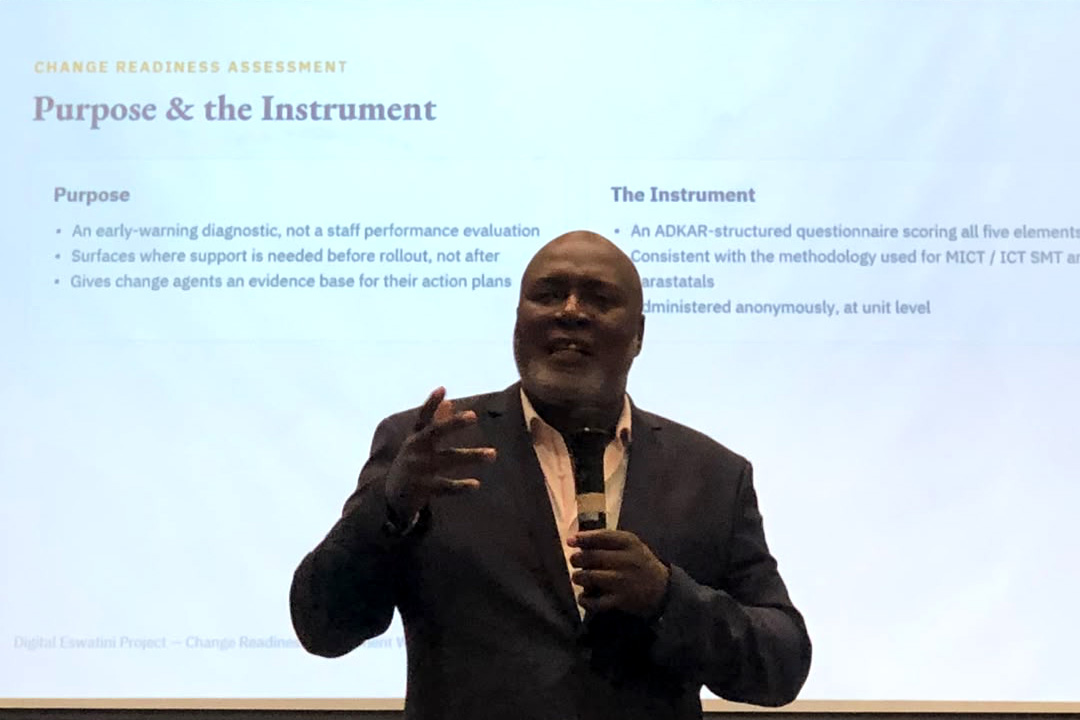
On Thursday, September 24, 2026, change agents from different ministries and parastatals gathered at the Hilton Hotel in Mbabane for a Change Readiness Assessment Workshop aimed at determining whether Government institutions and their employees are ready for the changes ahead.
Officials taking part came from the Ministry of Information, Communications and Technology (MICT), Ministry of Home Affairs, Ministry of Education and Training, Ministry of Tinkhundla Administration and Development, Ministry of Health and participating parastatals.

At the heart of the exercise was a simple but important reality: investing billions of Emalangeni in technology will achieve little if the people expected to use the systems are not properly prepared.
PEOPLE AT THE CENTRE OF DIGITAL CHANGE
Government’s approach has therefore placed employees alongside technology in the country’s digital transformation programme.
The change agents were initially trained earlier this year to help colleagues understand and adapt to the transition towards digital Government services.
That training led to the establishment of the Digital Eswatini Change Agent Network, through which officials have been given the responsibility of supporting transformation within their respective ministries and institutions.
Thursday’s workshop moved the process another step forward.
Instead of simply introducing new systems and expecting employees to adjust, the change agents were taught how to assess whether their colleagues were ready for the transition and identify areas where more support may be required.
They were introduced to the Theory of Change methodology as well as the ADKAR model, which focuses on five elements considered important when managing change: awareness, desire, knowledge, ability and reinforcement.
During an afternoon practical exercise, participants assessed the readiness of their own directorates and parastatals before analysing the findings and identifying possible interventions.
E1.06 BILLION DIGITAL INVESTMENT
The training comes as the Digital Eswatini Project prepares to enter a major implementation phase.
The World Bank approved the project on June 15, 2026, with financing of US$65 million, equivalent to approximately E1.06 billion using the September 24 exchange rate cited in the project material.
The investment is intended to expand access to affordable broadband, strengthen the country’s digital public infrastructure, improve Government’s digital services and build digital skills.
Among the planned interventions are connectivity initiatives covering *859 schools, 134 health centres and 38 Tinkhundla centres*.
The programme forms part of Government’s broader *Government in Your Hand* vision, which seeks to bring essential public services closer to Emaswati through digital platforms.
For citizens, that could eventually change something as ordinary as applying for a Government service.
Instead of travelling long distances to an office, spending money on transport and waiting in queues, some services could become accessible from home or through a mobile phone.
TECHNOLOGY ALONE NOT ENOUGH
However, building the infrastructure is only one part of the challenge.
Government must also ensure that workers know how to operate the new systems and that citizens are able to access and use the services being introduced.
The World Bank’s 2025 Eswatini Economic Update noted that although about 95 per cent of the population was covered by 4G, actual internet use remained considerably lower, with affordability among the barriers affecting wider adoption.
That gap underlines why digital transformation cannot be treated purely as a technology project.
A Government employee confronted with an unfamiliar digital platform will need training and support. In the same way, digital services intended for the public will have to take into account the everyday realities facing the people who are expected to use them.
This places the change agents at an important point between the technology being introduced and the employees who will eventually work with it every day.
Government’s change-management programme has been developed in stages — beginning with the preparation of senior leaders, followed by the training of change agents and creation of a support network.
The latest phase now requires those agents to go back into their institutions, measure readiness and identify where additional assistance may be necessary.
Ultimately, the success of the E1.06 billion Digital Eswatini Project will not only be determined by the number of systems installed or institutions connected.
For an ordinary LiSwati, its impact could be measured in much simpler terms: fewer unnecessary trips to Government offices, shorter queues, easier access to information and the ability to receive selected public services without repeatedly travelling from one office to another.
That is the transformation Government is preparing for — and Thursday’s workshop was about making sure the people behind those services are ready for it.


