



…Partners commit E2.6m as Eswatini faces E558m bill to prepare for health emergencies
BY SIFISO NHLABATSI
EZULWINI– Government has pledged E19.71 million towards Eswatini’s National Action Plan for Health Security, while development partners have committed E2.57 million, leaving a funding gap of bout E518 million for the five-year programme.
The commitments are aimed at strengthening the country’s ability to prevent, detect and respond to disease outbreaks and other public health emergencies that could threaten the lives and livelihoods of emaSwati.
The National Action Plan for Health Security (NAPHS) 2026–2030 was launched by Minister of Health Mduduzi Matsebula at the Royal Villas Hotel on Wednesday.

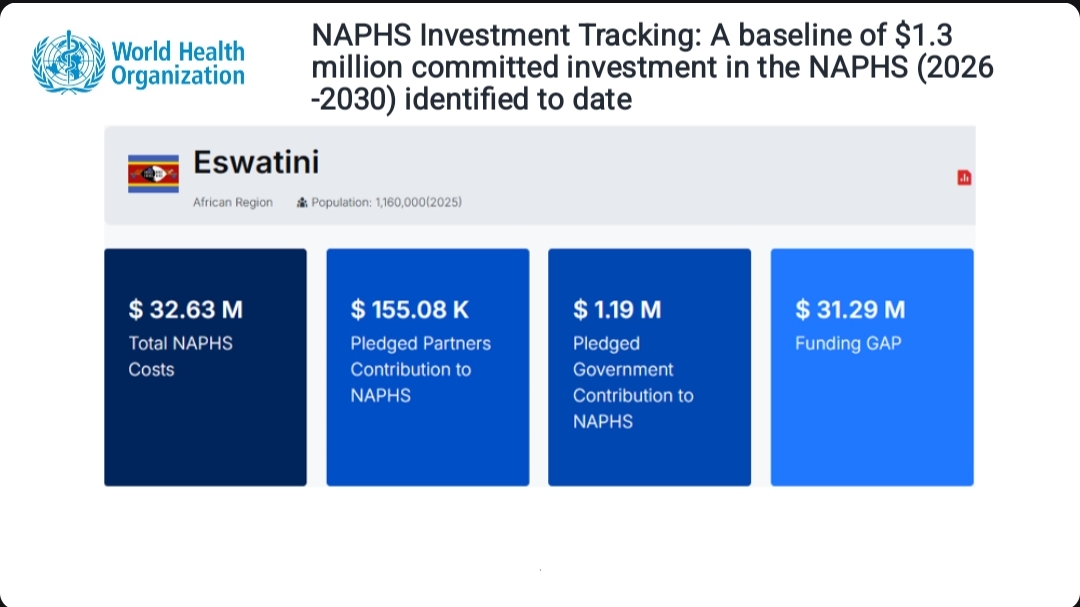
According to the plan’s presentation, government has pledged US$1.19 million, while development partners have committed US$155,080. Together, these commitments amount to US$1,345,080, equivalent to approximately E22.28 million.
The five-year plan is estimated to cost US$32.63 million which translates to E558 million
The conversion reflects the exchange rate available on October 10, 2026. The emalangeni equivalents are calculated for reporting purposes and may differ from the amounts ultimately received or spent because exchange rates and transaction costs can vary.
At the same rate, the remaining funding gap of US$31,284,920 translates to approximately E518.02 million.
This means that the identified pledges cover only a small portion of the resources required to implement the plan over the next five years.
E518m funding gap
The funding shortfall presents a major challenge for a programme intended to strengthen the country’s preparedness for health emergencies.
The costing exercise covered activities across 19 technical areas, while a two-year operational plan was developed to guide implementation during 2026 and 2027.
Additional resources will be needed to ensure that the planned activities can be implemented, including improvements to disease surveillance, laboratory services, emergency response systems and the training of health professionals.
The plan seeks to strengthen the systems that help authorities identify dangerous diseases early, investigate suspected outbreaks and respond before infections spread widely.
A disease outbreak can place pressure on hospitals and clinics, disrupt people’s daily activities and increase the cost of providing healthcare. Effective preparedness can help authorities respond more quickly and limit the consequences for communities.
The plan’s development followed a Joint External Evaluation conducted in 2024, which assessed Eswatini’s health security capacities and helped identify areas requiring improvement.
It is aligned with the International Health Regulations (2005), a legally binding international framework requiring countries to develop minimum capacities to prevent, detect and respond to public health threats.
Early detection and response
One of the plan’s main priorities is strengthening disease surveillance and laboratory systems.
These systems are essential because the quicker a dangerous infection is identified and confirmed, the sooner health authorities can take measures to contain it.
The plan seeks to improve the monitoring and reporting of priority diseases, strengthen laboratory networks and ensure that samples can be referred for testing promptly.
It also proposes greater use of digital tools to support information sharing and improve the detection of public health threats.
Another priority is strengthening emergency response teams and coordination between government ministries and other institutions.
The plan provides for improved emergency management mechanisms, including public health emergency operations centres, better coordination during crises and systems for deploying essential supplies and resources.
It also emphasises risk communication and community engagement so that people can receive accurate information about health threats and understand the measures recommended to protect themselves and their families.
Human, animal and environmental health
The NAPHS adopts a One Health approach, recognising that human health is closely connected to animal health and the environment.
This requires cooperation between the health, agriculture and environmental sectors, alongside institutions responsible for disaster management and security.
Some diseases can spread between animals and humans, making cooperation across these sectors important for preventing and controlling outbreaks.
The plan also prioritises immunisation, infection prevention and control, biosafety, biosecurity and efforts to address antimicrobial resistance.
Antimicrobial resistance occurs when microorganisms become resistant to medicines designed to kill them or stop their growth, making some infections more difficult to treat.
Other planned interventions include strengthening health protection at airports and ground border crossings, improving screening and referral systems, and enhancing cooperation with neighbouring countries.
The plan further provides for preparedness against chemical and radiation emergencies through specialised training, response protocols and public awareness.
Accountability will be key
The plan identifies governance, workforce development, research, financing and monitoring as essential to sustainable health security.
It proposes strengthening the skills of health professionals and expanding field epidemiology training to improve the country’s ability to investigate and respond to public health threats.
Implementation is expected to be monitored through annual joint reviews, performance indicators, simulation exercises and assessments following emergencies.
These measures are intended to identify weaknesses, improve coordination and guide decisions on resource allocation.
However, the funding figures underline the work still required to turn the plan into practical improvements.
With approximately E22.28 million in identified pledges against a converted five-year cost of E558 million, the country will need to mobilise additional resources to address the E518.02 million shortfall.
#Eswatini #HealthSecurity #NAPHS2026 #MinistryOfHealth #PublicHealth #DiseasePrevention #HealthPreparedness #OneHealth
(Courtesy Pics)