


BY MBONGENI NDLELA
TAIPEI, TAIWAN– Prime Minister Russell Mmiso Dlamini has called on the international community to ensure that artificial intelligence (AI) remains a tool that serves humanity rather than controls it, warning that technological advancement must never come at the expense of human dignity, ethics and accountability.
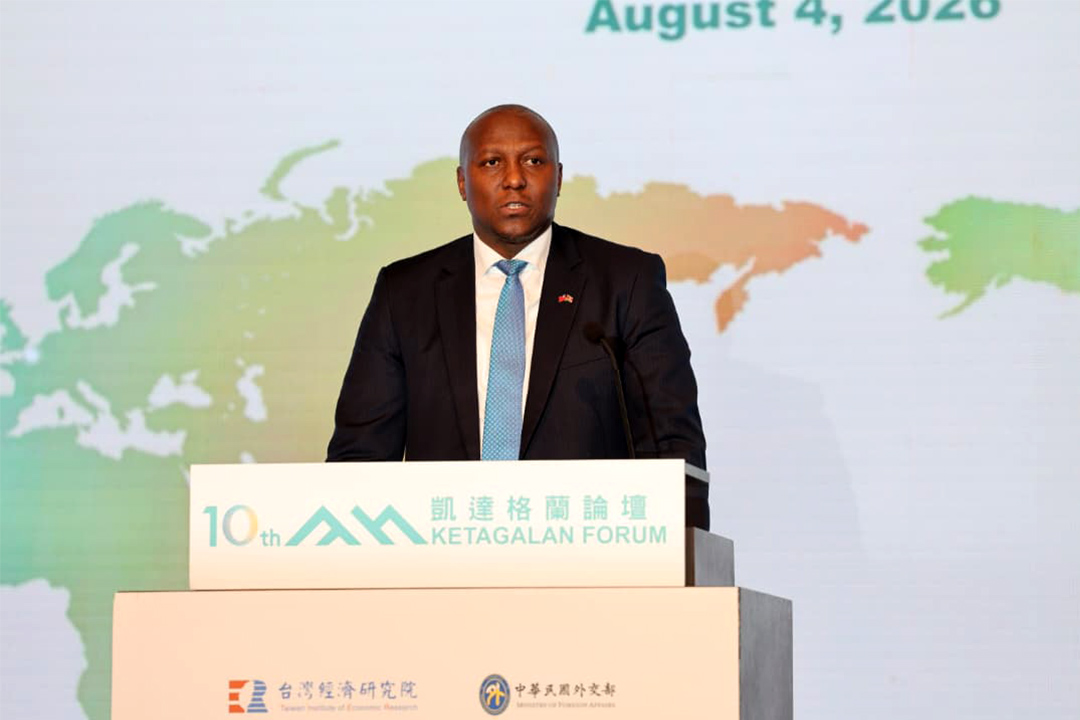
Addressing global leaders, policymakers, academics and business executives at the Ketagelan Forum in Taipei on behalf of His Majesty King Mswati III yesterday, Dlamini delivered a powerful message on the future of artificial intelligence, declaring that innovation should always advance humanity instead of replacing or diminishing it.
As countries race to develop increasingly sophisticated AI technologies, the Prime Minister urged the world to adopt a people-first approach that balances innovation with responsibility.
“Artificial Intelligence must remain a servant of humanity and never become its master,” declared Dlamini, drawing attention to one of the defining challenges facing the modern world.

He said the rapid growth of artificial intelligence presents enormous opportunities to transform economies, improve healthcare, strengthen education and accelerate development, but warned that the technology also raises profound questions about governance, accountability and ethics.
“Technology should expand opportunity, not diminish freedom. Innovation should unite humanity, not deepen division,” he said.
The Prime Minister stressed that governments, technology companies and international institutions have a shared responsibility to ensure AI develops within a framework built on transparency, accountability and internationally accepted legal standards.
“Our challenge is therefore not simply to regulate emerging technologies,” he said.
“Our greater responsibility is to ensure that technological advancement remains firmly anchored in values, ethics, human dignity, transparency, accountability and respect for universally accepted international norms.”
Dlamini said Eswatini firmly supports a human-centred approach to artificial intelligence that places people, rather than machines, at the centre of technological progress.
He warned against allowing digital transformation to widen inequalities between nations and communities.
Instead, he said technology should be used to bridge development gaps and create greater opportunities for all.
The Prime Minister also cautioned against the misuse of domestic legislation to undermine the sovereignty of other nations through digital technologies, saying international law must remain the guiding principle in the governance of emerging technologies.
Beyond artificial intelligence, Dlamini painted a broader picture of a rapidly changing global landscape shaped by geopolitical competition, climate change, technological disruption and economic uncertainty.
He argued that these interconnected challenges require unprecedented international cooperation rather than confrontation.
According to the Prime Minister, modern national security extends far beyond military strength.
He told delegates that countries must equally prioritise food production, reliable energy supplies, water resources, healthcare systems, cybersecurity and economic resilience.
“Food security is national security; Energy security is national security; Water security is national security; Health security is national security; Cybersecurity is national security; Economic resilience is national security.”
The Prime Minister also reaffirmed Eswatini’s unwavering support for Taiwan’s meaningful participation in international organisations, describing Taiwan as a trusted partner whose expertise and innovation continue to contribute significantly to global development.
He praised the Kingdom’s decades-long partnership with Taiwan, saying it has delivered tangible benefits in healthcare, agriculture, education, industrial development, vocational training and digital innovation.
“For this reason, Eswatini will continue to stand firmly and consistently for Taiwan’s meaningful inclusion in global governance and international discourse, recognising the proven expertise, innovation and constructive contribution Taiwan brings to the advancement of humanity.”
Turning to Africa, Dlamini said the continent is emerging as one of the world’s most important frontiers for investment and innovation, driven by its youthful population, abundant natural resources and expanding digital economy.
However, he emphasised that Africa’s greatest asset is neither its minerals nor its agricultural land.
“Africa’s greatest asset is neither beneath its soil nor upon its land. It is the ingenuity, resilience and aspirations of its people.”
The Prime Minister concluded his address by urging world leaders to reject division and instead embrace dialogue, cooperation and principled partnerships.
He said history would ultimately judge today’s generation not by the challenges it inherited, but by the courage it demonstrated in solving them.
“The future belongs to those who choose cooperation over confrontation; dialogue over division; innovation over isolation; and hope over fear.”
The keynote address positioned Eswatini among the growing number of nations advocating for ethical artificial intelligence, responsible technological governance and inclusive global cooperation, while reinforcing the Kingdom’s commitment to ensuring that innovation remains firmly in the service of humanity.
(Courtesy Pic)