



BY THEMBA ZWANE
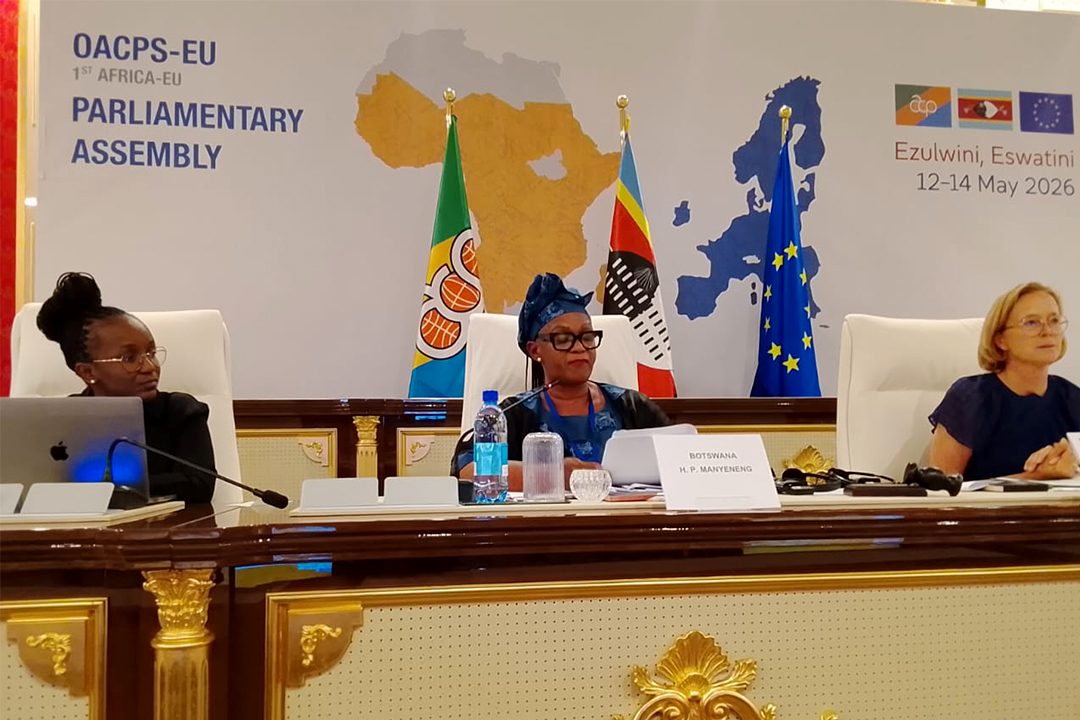
EZULWINI- Deputy Speaker of the National Assembly of Botswana is Hon. Helen Pushie Manyeneng is calling for solar electrification of rural communities.
Solar electrification is the process of generating electricity directly from sunlight using photovoltaic (PV) cells—semiconductor materials that convert solar radiation into direct current (DC).
Making her remarks as co-chair of the OACPS-EU 1st Africa-EU Parliamentary Assembly Women’s Forum, Manyeneng said they must invest in renewable energy solutions such as solar-powered systems for rural communities.
“Many of us here are Members of Parliament representing rural constituencies. Our people are looking to us for solutions. Grid electricity remains expensive and inaccessible in many areas, but solar power offers a practical and sustainable alternative that can transform agricultural production and rural livelihoods,” she said.

The MP said they should also give particular attention to young women, women with disabilities, and marginalized women, ensuring that they were supported to take up leadership roles in agriculture and agribusiness.
She said empowering women economically in rural communities will also help curb migration to urban areas. She added that when people are able to earn a living from the resources available in their own communities, they were more likely to remain, invest, and build sustainable local economies.
On another note, she highlighted that value chains were a key driver of economic development, particularly in a year of such global significance: the International Year of Women Farmers 2026, declared by the United Nations.
“This discussion comes at a time when cooperation and policy alignment between Africa and the European Union are more important than ever — not only to respond to immediate pressures, but also to address long-term challenges related to food security, climate resilience, economic development, and gender equality,” she said.
The deputy speaker mentioned further that it also builds on the momentum of the OACPS Women’s Forum, held on the margins of the 11th Summit of OACPS Heads of State and Government in Malabo. That forum, she said, placed strong emphasis on women in agriculture and highlighted the need to strengthen women’s role in food security, resilience, and economic empowerment.
“Honourable Members, we now have an opportunity to carry that discussion forward within the parliamentary space and to reflect on how Africa–EU cooperation can better support women across agricultural value chains,” she said.
The MP said women were central to agriculture and rural economies. They produce, process, trade, manage household food security, and sustain community resilience. Yet, in many cases, she said, they continue to face difficulties in accessing land, training opportunities, storage facilities, financing, and decision-making spaces.
In some communities, the MP said, women still cannot independently decide how land is allocated or how resources are used for business and agricultural development.
From the perspective of Botswana, she said, this issue is particularly relevant. Women play a critical role in agriculture and rural development, especially in dryland areas where climate change demands resilience, innovation, and practical solutions.
“Women are actively engaged in crop production, cultivation, and the processing of drought-tolerant crops such as sorghum, lablab, millet, and maize. They also manage non-timber forest products such as morula, musuku-jane, and mopane worms — a delicacy and an important alternative source of protein for rural communities in northeastern Botswana.”
These activities contribute not only to household incomes, but also to food security, local economic growth, and environmental sustainability according to the MP.
At the same time, she alleged that women continue to face barriers, including limited access to technical knowledge, financial literacy, processing facilities, stronger market linkages, and decision-making authority over land and resources such as borehole drilling.
“Many of our countries are dry and heavily dependent on rainfall. However, with the growing impact of climate change, it is becoming increasingly difficult to rely solely on rain-fed agriculture. Our women farmers therefore need stronger support. They need access to affordable financing, climate funds, and investment mechanisms that can help them drill boreholes, improve irrigation systems, and sustain agricultural production.”
This forum, she said, should help them identify practical ways to support women farmers, processors, traders, and entrepreneurs through better access to finance, technology, training, and climate-smart agriculture.
The deputy speaker said she looked forward to a focused and constructive exchange. Her hope was that their discussions will move women from participation to genuine empowerment.
Too often, she said, they spoke about women’s empowerment in theory. She said the time had come for them to translate those commitments into practical action, measurable outcomes, and lasting opportunities for women across their agricultural value chains.
#OACPS #DeputySpeaker #WomenForum #Eswatini #Botswana #SolarElectrification


