



BY TANDZILE DLAMINI
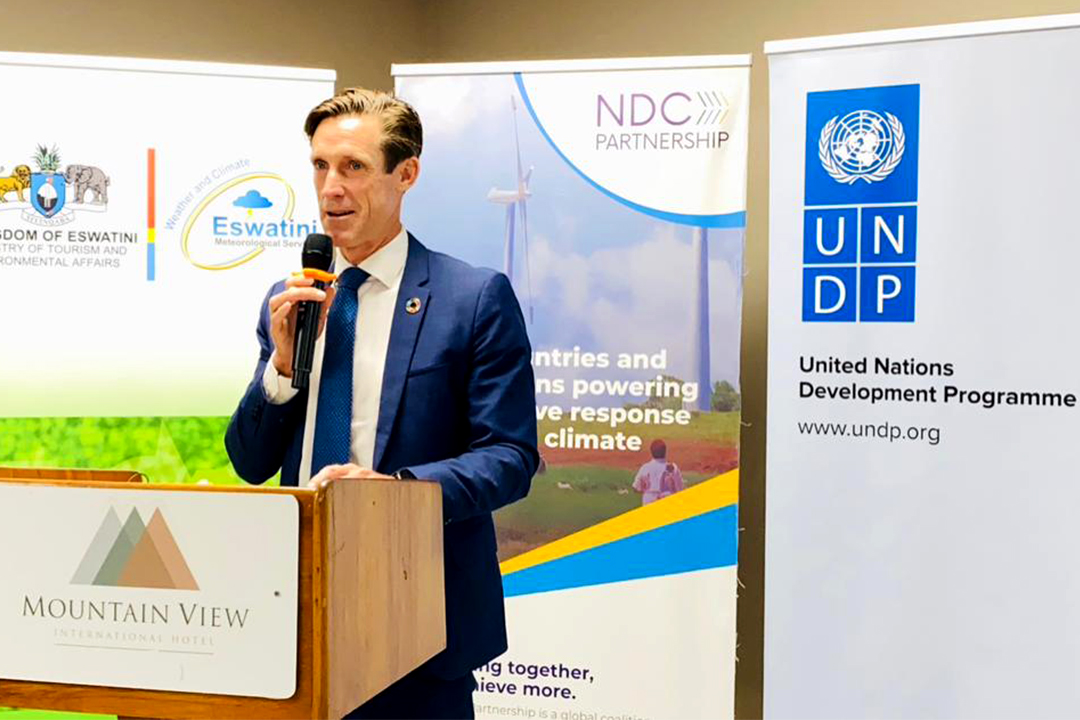
MBABANE— Eswatini has officially launched its Long-Term Low-Emission Development Strategy (LT-LEDS), positioning climate action as a bold blueprint for nation-building, United Nations Development Programme (UNDP) Resident Representative Henrik Franklin said at the launch held at the Mountain View Hotel on Tuesday, January 20, 2026.
Franklin warned that climate change is part of what he described as a “triple planetary crisis” — climate change, biodiversity loss and pollution — which threatens to reverse decades of development gains. He cautioned that the cost of inaction is severe, with increasingly frequent droughts, floods and economic shocks undermining livelihoods, straining public resources and posing risks to national stability.
He emphasised that Nationally Determined Contributions (NDCs) are not merely technical policy documents, but “lifelines” that demonstrate how countries are affected by climate change and what support is required to build resilience. He added that NDCs also function as “investment blueprints”, helping countries attract climate finance and forge partnerships for sustainable growth.
Eswatini’s NDC 3.0, which extends to 2035, sets ambitious mitigation and adaptation targets aligned with national development priorities. Franklin urged the country to think beyond the short term and look ahead to 2050, envisioning “a carbon-neutral economy that is innovative, inclusive and resilient”.
He highlighted UNDP’s Climate Promise initiative — which supports more than 120 countries worldwide — as a key partner in advancing climate ambition. According to Franklin, the initiative is anchored on three pillars: acceleration, inclusivity and finance. These pillars focus on strengthening institutions, ensuring that vulnerable groups are included in climate planning, and mobilising the financial resources needed to translate commitments into tangible investment.
Franklin also commended the NDC Partnership and the Government of the United Kingdom for their support in the development of Eswatini’s NDC 3.0 and the launch of the LT-LEDS.
Challenging both leaders and citizens, Franklin said the LT-LEDS should be used to shape the country’s long-term future. He posed a critical question: what kind of economy does Eswatini envision by 2050? He suggested possibilities such as robotics and automation, climate-smart agriculture, green cities, electric mobility, sustainable housing and circular economies.
He concluded by calling for unity and collective action across government, the private sector, civil society and development partners to turn plans into measurable progress. “Together, we can build a future that is low-carbon, inclusive and prosperous,” he said, reaffirming UNDP’s commitment to support Eswatini throughout its climate journey.
With the LT-LEDS now underway, Eswatini is aligning Vision 2050 with investment, innovation, job creation and resilience, signalling a clear intention to shape the nation’s future by taking bold and decisive action today.