


BY SIFISO NHLABATSI
EZULWINI – The inaugural Africa Seed Summit has produced an emerging continental declaration calling for stronger seed systems, greater protection of Africa’s genetic resources and increased capacity for countries to secure their own food supplies.
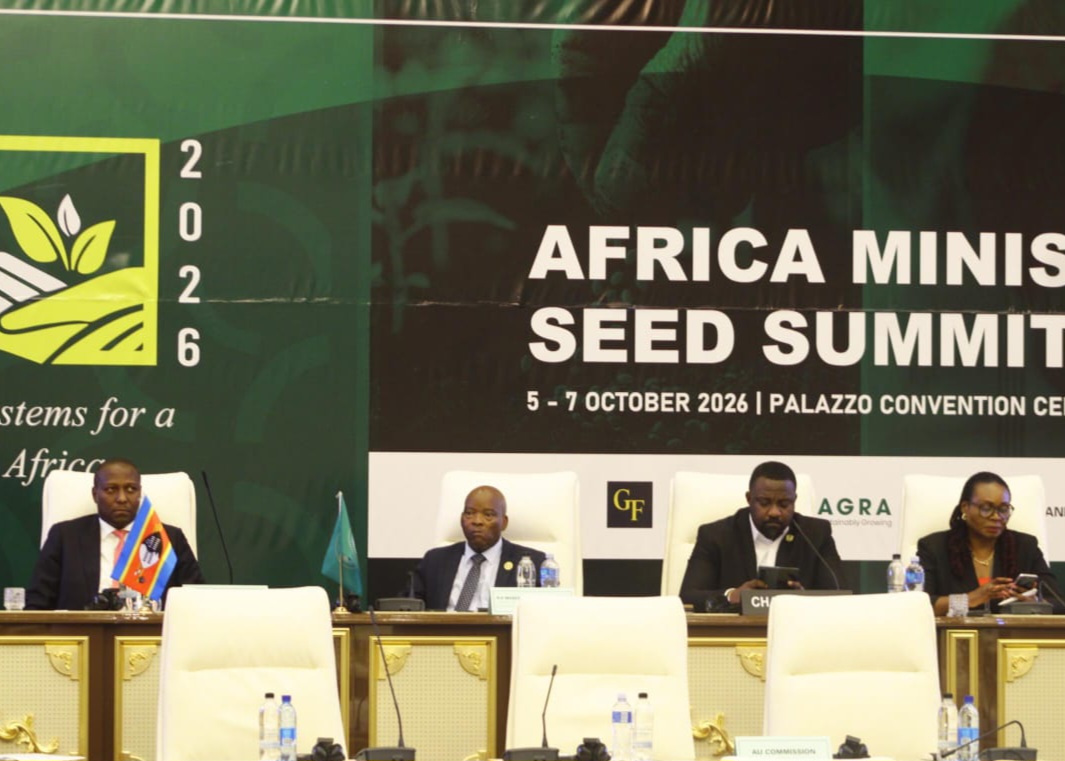
The three-day summit, held at the Ezulwini Palazzo ICC from October 5 to 7, brought together African ministers, agricultural experts, scientists, researchers, farmers, development partners and representatives of continental and regional institutions to deliberate on the role of seed in Africa’s food security and agricultural transformation.
The summit concluded on Wednesday with the presentation of the Ezulwini Declaration on Seed Sovereignty and Resilience, a document that is still being refined and improved following the deliberations, but which has already received alignment from participating countries, including Ghana.
Closing the summit, Prime Minister Russell Mmiso Dlamini said the declaration represented an opportunity for Africa to move from discussions about seed security to concrete action.

“It is therefore fitting that from this same valley should emerge a declaration on seed sovereignty and resilience,” Dlamini said.
He said the significance of the summit extended beyond agriculture, arguing that control over seed was closely linked to food security, national sovereignty and resilience.
“A continent cannot speak convincingly of sovereignty if it cannot feed its people. A nation cannot be truly secure if the foundation of its food system lies beyond its control,” he said.
The summit was held in Ezulwini, a location with historical significance for the continent because of the adoption of the Ezulwini Consensus, which articulated Africa’s common position on reform of the United Nations and its representation in the global security architecture.
The Prime Minister drew a connection between that earlier continental position and the discussions on seed, saying Africa had returned to Ezulwini to address another dimension of security, the security of its food systems.
The emerging declaration seeks to place seed sovereignty and resilience at the centre of Africa’s agricultural agenda, with emphasis on protecting indigenous varieties, strengthening seed banks, supporting farmers and investing in African research and breeding programmes.
The Prime Minister said African seed must remain accessible to African farmers and that the continent should retain sovereign capacity over the genetic resources on which its food systems depend.
He acknowledged the role of private enterprise, biotechnology and innovation in improving agricultural productivity, but cautioned that commercial interests should not undermine food security.
“Profit must serve food security; food security must never become captive to profit,” he said.
The Prime Minister also called for greater investment in science and technology, including agricultural research, laboratories, universities and biotechnology.
However, he said scientific advancement should be accompanied by efforts to reduce dependency on external seed suppliers.
“Africa must embrace science without surrendering sovereignty,” he said.
One of the issues highlighted during the summit was the gradual disappearance of indigenous seed varieties cultivated by African communities over generations.
The PM said these varieties represented more than agricultural resources, as they also carried genetic diversity, traditional knowledge and cultural identity.
“Every indigenous seed that disappears takes with it a fragment of Africa’s biological inheritance,” he said.
He called for stronger national, regional and continental seed banks, support for community seed systems, increased investment in African agricultural research and greater participation by farmers in preserving indigenous seed varieties.
The call for stronger seed systems was echoed by Ghana’s Deputy Minister of Agriculture and Vice Chairperson of the African Union Specialized Technical Committee on Agriculture, Rural Development, Water and Environment, John Dumelo.
Speaking on behalf of the Government and people of Ghana, Dumelo said Africa’s response to climate variability, economic pressures and geopolitical changes had to begin with the foundation of agriculture – the seed.
“Without resilient, climate-smart, and high-yielding seeds, our aspirations for agricultural self-reliance remain out of reach,” he said.
Dumelo said Ghana aligned itself with the emerging declaration and identified three priorities for continental action, including harmonising seed regulations and quality assurance systems to facilitate intra-African seed trade.
He also called for formal recognition and support of farmer-managed seed systems, particularly highlighting the role of women and young people in local seed stewardship.
Another priority, he said, was greater investment in public agricultural research and plant breeding to enable African institutions to develop crop varieties suited to changing climate conditions and local pest threats.
“Let this Declaration serve not merely as a statement of intent, but as a binding pact to empower our farmers, safeguard our biodiversity, and feed our continent from our own soils,” Dumelo said.
The discussions during the three-day summit therefore placed the issue of seed within a broader conversation about Africa’s agricultural transformation, with participants examining the need for resilient seed systems, climate adaptation, research, trade, biodiversity conservation and farmers’ rights.
The summit’s outcome also calls for African governments to review policies and legislation dealing with seed ownership, plant breeders’ rights, biodiversity, genetic resources, indigenous knowledge and farmers’ rights.
The Prime Minister urged governments represented at the summit to take the emerging declaration back to their respective countries and translate its principles into policies, legislation, budgets and institutions.
“Do not allow this Summit to become another conference whose declaration is adopted and then forgotten,” he said.
“Take the Ezulwini Declaration home. Place it before Cabinets and Parliaments. Translate it into laws, policies, budgets and institutions.”
Among the measures he urged countries to pursue are the establishment of national seed reserves, strengthening of community seed banks, protection of indigenous varieties, funding for African research institutions, support for farmers and the development of resilient domestic seed industries.
The Prime Minister said the declaration should ultimately become the basis for a wider continental movement aimed at preserving, protecting, multiplying and responsibly improving Africa’s seed heritage.
The Prime Minister highlighted that the significance of the summit lies not only in the document emerging from Ezulwini, but in whether countries act on the commitments contained in it.
He said Africa’s young and growing population should inherit productive land, knowledge, technology, viable seeds and institutions capable of defending the continent’s agricultural interests.
“Africa’s future is bright, but that future must be deliberately built,” he said.
He urged participants to leave Ezulwini with more than resolutions, calling for conviction, responsibility and determination to build a food-secure, sovereign and prosperous Africa.
As the inaugural summit ended, the Ezulwini Declaration remained a work in progress, with further refinement expected as countries and stakeholders continue to shape its final form.
Its emergence nevertheless marks the principal outcome of the three-day gathering, with participating countries signalling support for a continental approach that places seed security, resilience, biodiversity and farmers at the centre of Africa’s food-security agenda.
The Prime Minister said the ultimate measure would be whether the commitments made in Ezulwini translated into action across the continent.
“May the seed planted here in Ezulwini grow, multiply and bear fruit across every nation of our continent,” he said.
“And may generations yet unborn look back upon this inaugural Summit and say: There, in Ezulwini, Africa planted the seed of its food sovereignty.”
#AfricaSeedSummit #EzulwiniDeclaration #SeedSovereignty #SeedSecurity #FoodSecurity #AfricanAgriculture #AgriculturalTransformation #Farmers #FoodSovereignty #Ezulwini #Eswatini #Africa #AU #ClimateResilientAgriculture