



BY GCWALISILE MHLABANE
MANZINI – What many people see as useless chicken feathers and discarded leaves could soon carry Eswatini’s name onto one of the world’s biggest stages for student entrepreneurship.
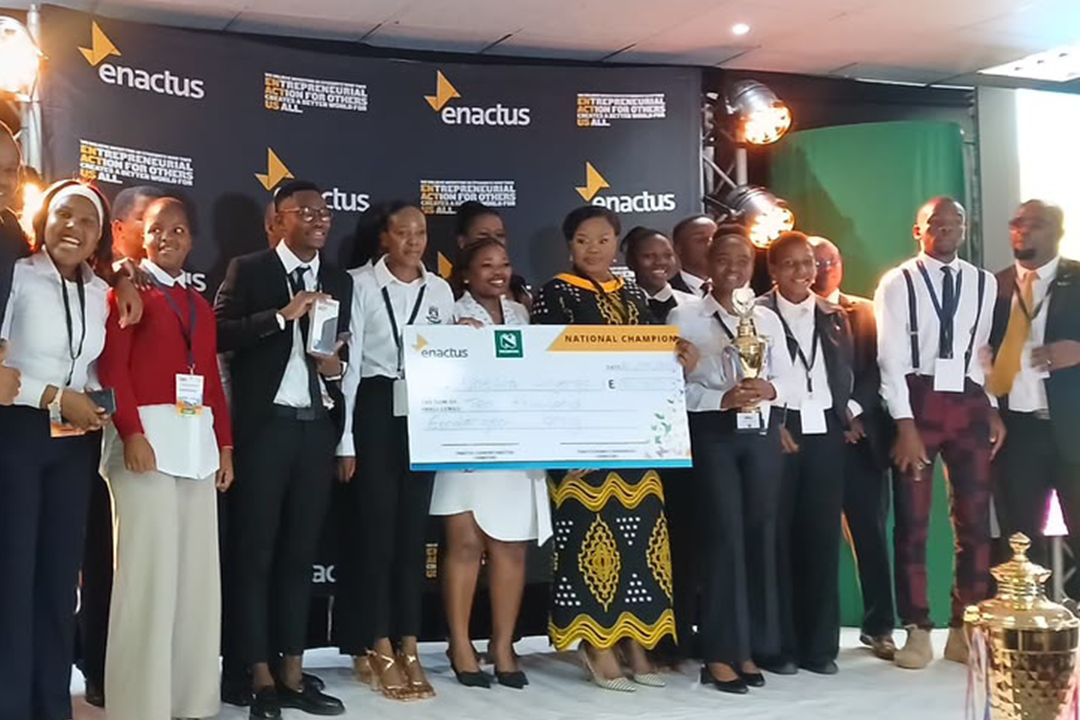
A team of young innovators from the University of Eswatini’s Luyengo Campus has turned agricultural waste into an environmentally friendly farming solution, earning the institution the 2026 Enactus Eswatini National Championship and a ticket to represent the Kingdom in Brazil.
The students emerged victorious during the Enactus Eswatini 2026 National Expo Finals held at The George Hotel in Manzini on Friday, August 21, after impressing judges with an innovation that converts agricultural waste into organic manure and fertiliser.
Through their Green Guard initiative and Nutri-Plume innovation, the students demonstrated how broiler chicken feathers, leaves and other materials normally regarded as waste can be transformed into useful agricultural inputs.

Their innovation combines entrepreneurship, environmental protection and agriculture — showing how young Emaswati can build businesses around some of the country’s everyday challenges.
The victory earned UNESWA Luyengo Campus E20 000 in prize money, while Minister of Information, Communications and Technology Savannah Maziya added another E10 000 in recognition of the team’s achievement.
More importantly, the young innovators have now earned an opportunity to fly the Eswatini flag at the 2026 Enactus World Cup in São Paulo, Brazil, from November 16 to 19.
There, their home-grown innovation will be presented alongside projects developed by university students from around the world.
The competition brought together four teams from tertiary institutions, namely Limkokwing University of Creative Technology, Southern African Nazarene University’s Faculty of Health Sciences, SANU’s Faculty of Theology and UNESWA Luyengo Campus.
Beyond determining a national champion, the Expo became a platform to demonstrate how young people can turn classroom knowledge into practical businesses capable of solving real community problems.
Prime Minister Russell Mmiso Dlamini, who attended as Guest of Honour, challenged young Emaswati to stop seeing the country’s challenges purely as problems and instead recognise the business opportunities hidden within them.
“Every environmental challenge facing Eswatini — from land degradation to water stress to energy poverty — is not an obstacle to your ambition. It is your market,” Dlamini said.
His message placed agriculture, clean energy, waste management, food security and climate resilience among areas where young entrepreneurs could develop solutions while creating employment and contributing to economic growth.
The Prime Minister also challenged tertiary students to look beyond simply obtaining certificates and qualifications.
“Eswatini does not need more people holding qualifications. It needs people holding capability,” he said.
He encouraged students to make maximum use of laboratories, workshops, mentors and academic projects while still at university so that they leave tertiary institutions equipped to solve practical problems.
“Excellence is not a talent. It is a habit, repeated until it becomes character,” Dlamini said.
For the young innovators gathered in Manzini, the message was clear: entrepreneurship does not always begin with a large factory, huge capital or a sophisticated imported idea. Sometimes it can begin with something as ordinary as waste lying on a farm.
Enactus Eswatini Board Chairperson Fikile Nkosi applauded Government for continuing to support the organisation and its work with young entrepreneurs.
She said the partnership was helping young people develop entrepreneurial skills and transform ideas into practical solutions.
“Government’s continued support and steadfast partnership with Enactus Eswatini is important in creating opportunities for our young people to develop their entrepreneurial skills and turn innovative ideas into practical solutions,” Nkosi said.
She said the National Expo allowed students to demonstrate how entrepreneurship could be used not only to generate income but also to respond to challenges affecting communities.
The Prime Minister stressed that developing successful youth-owned enterprises would require cooperation between Government, universities, the private sector, financial institutions, development partners and communities.
He said young entrepreneurs required more than money to succeed, pointing to mentorship, technology, access to markets and business networks as equally important ingredients.
He also urged young people not to postpone their dreams while waiting for ideal economic conditions.
“Do not wait for a perfect economy to begin,” he said.
That message is already being demonstrated by the UNESWA Luyengo students.
By looking at agricultural waste and seeing an opportunity instead of rubbish, the team has developed an idea capable of supporting farming, reducing waste and potentially creating economic opportunities.
Their achievement also illustrates the growing potential of Eswatini’s young people to develop locally conceived solutions that can compete internationally.
From the farms and lecture rooms of Luyengo, the next destination is now São Paulo.
And when the students step onto the Enactus World Cup stage in November, they will not only be presenting an agricultural innovation. They will be carrying with them a powerful example of what can happen when young Emaswati are given the opportunity to transform ideas into solutions — and local challenges into global opportunities.


