


– Annual Performance Report records progress in food production, roads, water, health, education and social protection
BY MBONGENI NDLELA
MBABANE – From completing 132 houses for vulnerable EmaSwati to deploying 26923 fibre passes, producing more than 12308 tonnes of maize and maintaining almost 2900 kilometres of feeder roads, Government says its latest performance review is beginning to translate national plans into visible services on the ground.
Prime Minister Russell Mmiso Dlamini released the Government Annual Performance Report on Wednesday, 12 August 2026, providing a detailed scorecard of how ministries and departments have performed against Government’s priorities.
The report paints a mixed but increasingly tangible picture of delivery across infrastructure, information and communications technology, agriculture, health, education, social protection, security and governance.
Among the strongest results were the completion of housing for vulnerable people, nationwide fibre expansion, health-system integration, food production, factory infrastructure, rural water facilities and a number of legislative and social-protection reforms.

At the same time, the report openly identifies areas where Government still has considerable work to do, particularly roads, education reforms, smart-city expansion, health financing, cyber security, innovation and some major infrastructure projects.
The assessment therefore provides not only a record of achievements but also a roadmap of where Government says implementation must now accelerate.
132 houses completed for vulnerable people
One of the most human-centred achievements recorded in the report is the completion of 132 houses for vulnerable people.
Government had targeted the construction of 160 decent houses and the programme was awarded an annual progress score of 100% based on the deliverables achieved during the reporting period.
For the families receiving the houses, the programme goes beyond statistics. It represents safer shelter, greater dignity and relief for households that previously faced difficult living conditions.
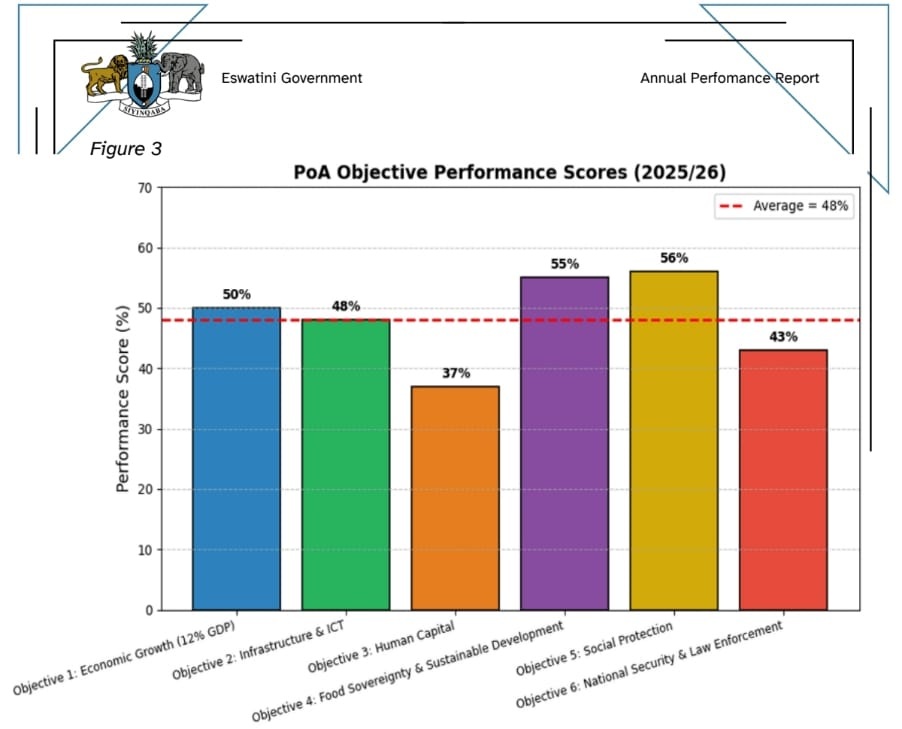
The social protection programme was part of an objective which recorded an overall performance score of 56%.
Government also reported that its Positive Parenting Strategy had been developed and was under implementation, earning a 100% progress score.
The review of the Orphaned and Vulnerable Children grant was also scored at 100%, with a pilot programme underway involving 667 learners receiving revised grants.
Programmes dealing with gender-based violence, femicide, domestic violence and violence against children achieved an 87% progress score, while the National Social Assistance Policy was developed and validated, receiving 90%.
The report nevertheless identified child-protection policies, elderly legislation and disability mainstreaming among areas that still require greater attention.
26923 fibre passes take internet closer to people
Digital connectivity emerged as another major success.
Government reported that 26923 fibre passes were deployed across the country, increasing internet access in commercial zones and towns.
This deliverable was given a 100% annual progress score.
The development comes as Government pushes to modernise public services and build an increasingly connected economy where businesses, schools, Government institutions and ordinary citizens can benefit from reliable digital infrastructure.
The Government email system was reported to be functional, registering a 76% progress score, while two pplatform, a mobile application and USSD service, were implemented as part of efforts to fully digitalise Government services.
That programme stood at 50%.
The broader Infrastructure and ICT Integration objective achieved an overall performance score of 48%.
The report described strong delivery in water infrastructure, both rural and urban, as well as selected ICT deployments including optical fibre and Government email.
However, weaknesses were recorded in energy infrastructure, transport infrastructure and expansion of smart-city initiatives outside Mbabane.
The smart-cities programme, which includes CCTV cameras, artificial intelligence and security systems, stood at 23%, with cameras and AI installations reported in Mbabane.
12308.76 tonnes of maize produced
Food security also emerged prominently in the scorecard.
Under the Hamba Ubuye food-security programme, Government reported production of 12308.76 metric tonnes of maize, resulting in a 100% progress score.
Infrastructure supporting modern agriculture also performed strongly.
Government reported that 20 modern agricultural facilities, including net facilities, had been constructed, producing an annual progress score of 84%.
Under Eswatini Water and Agricultural Development Enterprise programmes, 30 farmer companies were established, while sugarcane planting reached 93% and other crop planting stood at 59%.
Construction of Mpakeni Dam was reported at 46%.
Government’s Food Sovereignty and Sustainable Development objective achieved an overall performance score of 55%.
The report said strong performance was registered in food production, particularly through Hamba Ubuye, as well as agricultural infrastructure including dams, irrigation schemes and packhouses.
The Land Policy was reported at 72% completion, while the seed production and quality-control system was reviewed and revitalised, scoring 76%.
Government’s Nationally Determined Contributions were finalised and submitted to the United Nations Framework Convention on Climate Change, while a draft National Adaptation Plan was developed.
That intervention achieved a 75% progress score.
2898.6km of feeder roads maintained
Road infrastructure presented both encouraging delivery and one of Government’s clearest areas requiring acceleration.
The report states that 2898.6 kilometres of feeder roads were maintained, resulting in a progress score of 75%.
Government also reported that 200 kilometres of roads had been paved against a broader target of 500 kilometres.
Meanwhile, progress towards operationalising the Road Authority included the appointment of its board and securing office space, earning a 50% score.
Work on new dry ports and the expansion of Matsapha Dry Port stood at 54%.
Fencing at Matsapha Dry Port was completed and project designs reached 80%, while a feasibility study for the proposed Ngwenya Dry Port was completed.
Government also developed a draft e-mobility policy as part of the review of the public transport system, resulting in a 60% progress score.
A direct flight route to Zambia was secured, while the aviation sector recorded an increase in load factor to 52%.
The report scored progress on improving and marketing the Eswatini aviation industry at 69%.
Rural water projects score 100%
Another notable achievement came from rural water infrastructure.
Government reported that six boreholes and 29 handpumps were installed, earning the intervention a 100% annual progress score.
Technical feasibility and environmental studies for bulk-water storage were also completed, with that programme sitting at 50%.
On dams and irrigation infrastructure, construction of an earth dam at Mangcongco stood at 10%, while rehabilitation of two dams at Sidvokodvo was completed.
The broader intervention recorded a 62% progress score.
Factory shells completed in four areas
Government also recorded a full score on the construction of factory shells aimed at supporting industrial development.
Four factory shells were constructed in Gamula, Ndzevane, Hlathikhulu and Nhlangano, resulting in a 100% progress score.
The facilities form part of Government’s efforts to spread economic activity beyond the main urban centres and create infrastructure capable of attracting businesses and generating employment opportunities.
Health system integration hits 100%
Healthcare was another area in which specific programmes recorded strong progress.
The integration of the health system through CMS/CMIS was reported as complete, with equipment procured and fully configured.
The programme received 100%.
Government also reported that the EMSA Act had received Royal Assent and that EMSA was established as a semi-autonomous agency. This intervention scored 80%.
Under human capital development, however, Government recorded an overall score of 37%.
The report recognised strengths in health infrastructure and essential health services, including progress in the HIV cascade and rollout of Lenacapavir PrEP.
It nevertheless noted weaker performance in some education reforms, teacher professional development, governance of the University of Eswatini and integration of values into the education system.
3985 study loans granted
In education, the report shows that 3985 study loans were granted as Government continued reviewing the scholarship financing model and regulations.
The overall scholarship fund review and revitalisation programme received a progress score of 26%, signalling that considerable institutional reform is still required despite the loans already issued.
Government also established a partnership with Kwame Nkrumah University of Technology, through which eight scholarships were acquired.
Another partnership with Azerbaijan delivered three scholarships.
Grade 0, 8 and 9 syllabi were completed, while AS/A-Level material was borrowed from Cambridge and pilot schools commenced implementation. Curriculum alignment with international standards was scored at 70%.
The four-year high-school programme was being implemented in all targeted secondary schools, scoring 50%.
One of the strongest education indicators was the integration of soft skills into the competency-based education curriculum, which registered 90%.
All Grade 8 teachers targeted under professional agriculture programmes were trained in agricultural technology, producing a 100% score.
Government further reported that 1816 candidates were trade tested, with the programme receiving 65%.
Four regional arts centres established
Government’s development programme also recorded progress in sport and the creative sector.
Four regional arts centres were established under the programme to create multi-sporting and creative-arts centres in Tinkhundla.
The intervention achieved a 92% annual progress score.
Five parcels of land were also acquired for sporting facilities in Siteki, Nhlangano, Manzini, Mbabane and Matsapha, while three sporting facilities were constructed or upgraded.
That programme stood at 49%.
Anti-corruption policy records 100%
Governance and law reform also featured strongly in the report.
Government recorded 100% progress on the National Anti-Corruption Policy after the policy was developed and submitted for Cabinet approval.
The Legal Aid Bill and Legal Practitioners Amendment Bill were assented to and published, also recording 100%.
A total of 20 constitutional sections were reviewed and aligned, while the Marriage Bill and Matrimonial Property Rights draft Bill were tabled in Parliament.
Government further reported that 31 public-awareness and legal-rights education campaigns were conducted, resulting in a 93% score.
The Law Reform and Development Bill was passed by Parliament and was awaiting assent, giving the programme an 80% score.
The Crime Prevention Bill was tabled in Parliament, standing at 75%.
The National Security and Law Enforcement objective registered an overall performance score of 43%.
According to the report, Government performed strongly on legislative reforms, anti-corruption policy development and digital case management within His Majesty’s Correctional Services.
However, implementation of data-protection and cyber-security laws, crime-prevention awareness and finalisation of intelligence-related legislation remained weaker areas.
Government execution quality averages 51%
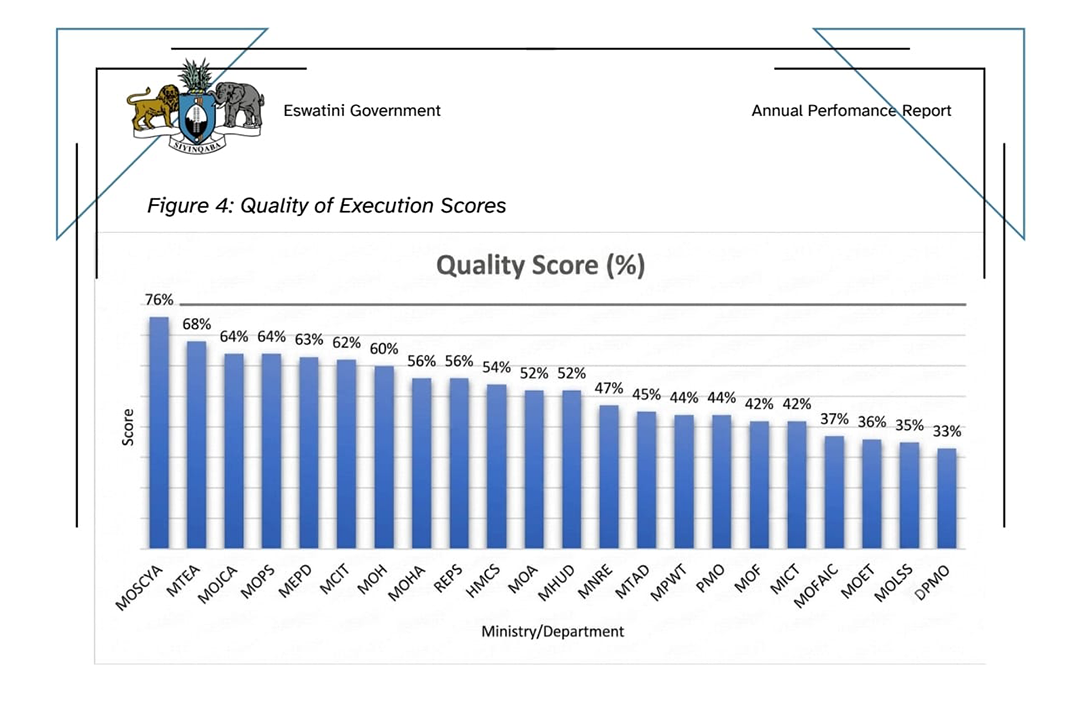
Beyond measuring whether projects were completed, the report also assessed the quality of execution across ministries.
The average quality score was approximately 51%, reflecting what the report described as moderate performance in effectiveness, efficiency and innovation or adaptability.
The Ministry of Sports, Culture and Youth Affairs emerged with the highest quality-of-execution score at 76%.
It was followed by the Ministry of Tourism and Environmental Affairs at 68%, while several other ministries recorded scores above 60%.
The assessment found that some programmes, including legal enactments, fibre rollout and community health systems, demonstrated strong effectiveness.
However, it identified budget constraints, delayed approvals and dependence on external partners as factors reducing efficiency in a number of sectors.
Innovation and adaptability were identified as the weakest dimensions across Government, with ministries encouraged to find alternative ways of overcoming implementation bottlenecks.
The report highlighted some examples of innovation, including in-house approaches by the Ministry of Commerce, Industry and Trade, virtual benchmarking exercises and digital applications for GPS mapping.
A scorecard for the next phase
The 2026 performance report provides one of the clearest snapshots yet of where the Dlamini administration has gained ground and where delivery must be intensified.
Its significance lies not only in percentage scores, but in what those scores represent on the ground – a vulnerable family moving into a house, a community gaining access to clean water, a farmer receiving better agricultural infrastructure, a learner receiving financial support, or a business gaining access to stronger internet connectivity.
The report also does not hide Government’s shortcomings.
Infrastructure and ICT stood at 48%, human capital at 37%, food sovereignty and sustainable development at 55%, social protection and security at 56%, and national security and law enforcement at 43%.
Those figures leave considerable room for improvement.
But the combination of completed houses, expanded fibre, increased food production, maintained roads, water installations, health-system improvements, factory infrastructure and legal reforms demonstrates that parts of Government’s programme are moving from policy documents into measurable delivery.
The challenge for the next reporting period will be to turn the stronger individual achievements into consistently high performance across every ministry and, ultimately, into improvements that ordinary EmaSwati can see and feel in their daily lives.