



BY MBONO MDLULI
MBABANE – Eswatini’s GDP grew by a robust 5.8 per cent year-on-year in the third quarter of 2025 on a seasonally adjusted basis.
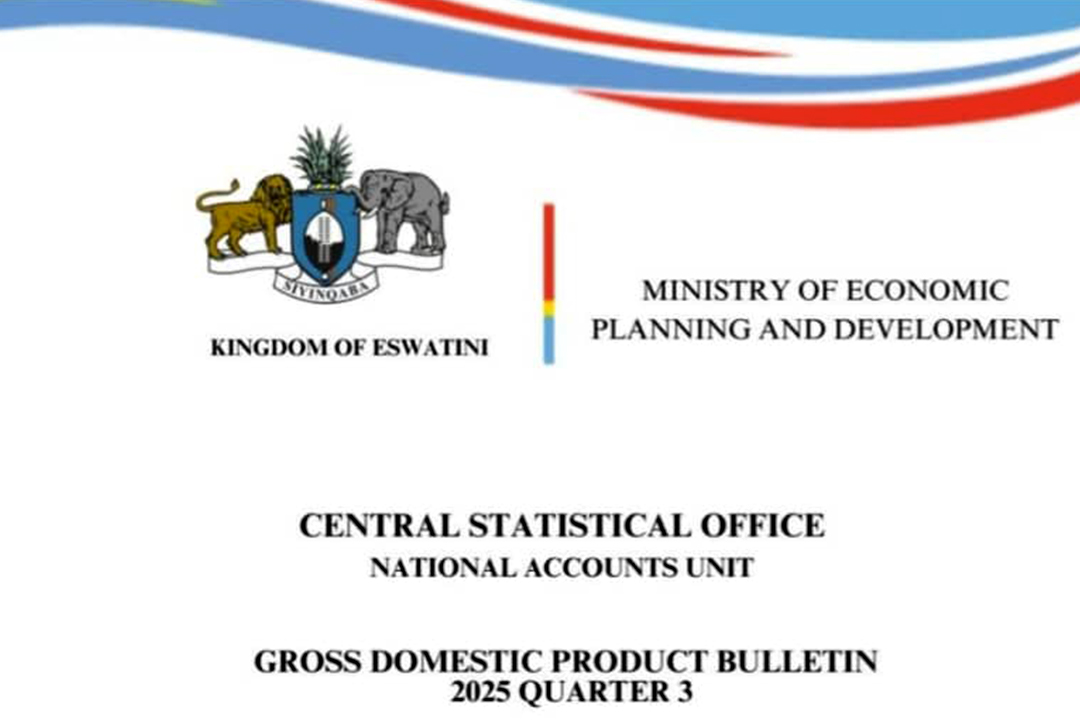
The 2025 Third Quarter Gross Domestic Product (GDP) Bulletin released by the Central Statistics Department’s National Accounts Unit shows that Eswatini’s economy recorded solid and encouraging growth during the period, providing a clear snapshot of improved economic activity across the country.
The bulletin, compiled in line with international standards such as the System of National Accounts 2008 and ISIC Revision 4, and benchmarked to the updated 2019 base year, offers a reliable and comprehensive measure of economic performance in the Kingdom of Eswatini. It serves as a critical source of information for evidence-based policymaking, strategic planning, investment decisions and the monitoring of national development progress.
According to the latest estimates, real GDP grew by a robust 5.8 per cent year-on-year in the third quarter of 2025 on a seasonally adjusted basis. This represents a significant improvement from the 1.9 per cent growth recorded in the corresponding quarter of 2024, highlighting a notable strengthening of economic momentum. On a quarter-on-quarter basis, the economy expanded by 2.1 per cent, sustaining the positive trend observed earlier in the year.

The Primary Sector contributed 7.7 per cent to total industries and recorded strong growth of 11.8 per cent. This performance was driven largely by exceptional expansion in mining and quarrying, which surged by 65.3 per cent, alongside steady growth of 13.4 per cent in forestry. These results underline the increasing contribution of resource-based activities to overall economic growth.
The Secondary Sector, accounting for 37.7 per cent of the economy, also posted impressive results, expanding by 9.9 per cent. Growth in this sector was supported by manufacturing, which grew by 10.0 per cent, electricity supply at 5.6 per cent, and a strong 13.0 per cent increase in construction. This reflects rising industrial activity and continued investment in infrastructure development.
Meanwhile, the Tertiary Sector remained the largest contributor to GDP at 54.5 per cent and grew by 6.2 per cent during the quarter. Notable gains were recorded in wholesale and retail trade at 7.2 per cent, information and communication services at an outstanding 30.6 per cent, and financial and insurance activities at 9.9 per cent, demonstrating the growing strength of service-based industries.
Overall, the third quarter GDP results point to broad-based and balanced economic growth across all major sectors. The data underscores renewed confidence in Eswatini’s economic performance and highlights the value of accurate national accounts in guiding policy decisions and supporting sustainable economic development.
(Courtesy Pic)


