



… Sir Wicknell disclosed that Intratrek Holdings had resolved to self-finance the first phase of the solar project instead of relying on external financiers.
… he intends to establish a permanent residential presence in Eswatini.
… Independent Power Producer (IPP) Generation Licence was processed within what he described as a record-breaking 48 hour
BY MBONGENI NDLELA
LOBAMBA– Zimbabwean billionaire and Eswatini investor Sir Wicknell Chivayo has reasserted his commitment to transforming the Kingdom’s energy sector after holding high-level discussions with His Majesty King Mswati III at the Royal Palace, where he also announced that the first phase of his landmark solar power project will now be financed entirely from his company’s own resources.

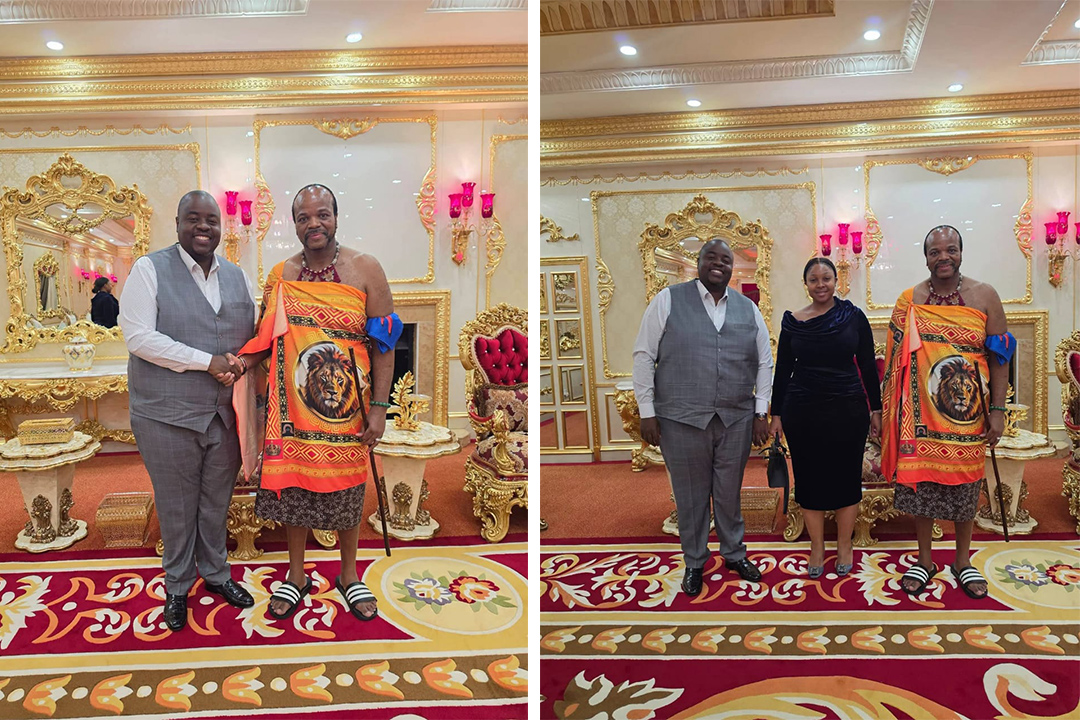
The businessman, who recently acquired Eswatini citizenship and a diplomatic passport, described the royal audience as one of the greatest honours of his life, saying it strengthened his determination to invest even more in the Kingdom.
Sir Wicknell and his wife were accorded a ceremonial reception upon their arrival before being hosted by His Majesty for an official dinner at the Royal Palace, where the two discussed progress on the ambitious renewable energy investment expected to reshape Eswatini’s electricity landscape.
The billionaire said the audience provided an opportunity to brief the King on the significant milestones already achieved towards the implementation of the proposed 300-megawatt solar power project, one of the largest privately funded renewable energy investments ever proposed in Eswatini.
Government efficiency praised
Sir Wicknell reserved special praise for Eswatini’s public service, saying Government departments had demonstrated exceptional professionalism and efficiency throughout the project’s approval process.
He revealed that the Independent Power Producer (IPP) Generation Licence was processed within what he described as a record-breaking 48 hours.
According to the businessman, the speed at which regulatory approvals were handled reinforced his confidence in Eswatini as one of Africa’s most attractive destinations for investment.
“The professionalism and efficiency demonstrated by the various Government departments of the Kingdom of Eswatini deserve commendation,” he said.
He added that the efficiency shown by Government institutions had encouraged him to deepen his investment footprint in the country beyond the energy sector.
Self-funded first phase
In one of the biggest announcements arising from the royal meeting, Sir Wicknell disclosed that Intratrek Holdings had resolved to self-finance the first phase of the solar project instead of relying on external financiers.
He said the company would fund the initial 50-megawatt phase entirely from its own balance sheet and internal financial resources.
The first 10 megawatts, he added, are expected to be completed within six to eight months once construction commences.
The decision demonstrates the company’s confidence in both the project’s viability and Eswatini’s investment environment.
Technical preparations nearing completion
Sir Wicknell informed the King that engineering and technical teams were making significant progress towards satisfying all remaining requirements before construction begins.
These include the Grid Impact Assessment, Environmental and Social Impact Assessment (ESIA), Grid Connection and Interconnection Studies, Geotechnical Investigations and Topographical Surveys.
He said international technical experts were working closely with local teams to ensure that every engineering and environmental requirement is completed to international standards before construction starts.
World-class technology
The businessman also announced a major strategic shift regarding the sourcing of equipment for the project.
While acknowledging previous engagements with Chinese manufacturers, Sir Wicknell said the principal Original Equipment Manufacturers (OEMs) would now predominantly come from the United States and Europe.
As a result, the project’s solar photovoltaic panels, inverters, transformers, switchgear, SCADA systems and other sophisticated control technologies will be procured from internationally recognised manufacturers in those regions.
However, he stressed that African professionals would remain central to the actual implementation of the project.
Engineering, procurement and construction activities will be undertaken by highly skilled professionals drawn from Eswatini, Zimbabwe and South Africa.
“As Africans, we should embrace the best global technology, but the development of our continent must ultimately be driven by Africans, for Africans,” Sir Wicknell said.
Buying a home in Eswatini
Beyond the solar investment, Sir Wicknell also revealed that he intends to establish a permanent residential presence in Eswatini.
Inspired by the country’s investor-friendly environment and efficient Government services, he said he had instructed his team to identify a suitable home valued at up to R50 million.
The residence, he explained, would provide a permanent base whenever he visits the Kingdom for business and investment activities.
The announcement signals what could become an even deeper long-term commitment to Eswatini’s economic development.
Royal hospitality
Sir Wicknell described the dinner hosted by His Majesty King Mswati III as one of the most memorable experiences of his life.
He said he and his wife were humbled by the warmth, dignity and hospitality extended to them by the King.
“As I now depart for Europe via East Africa, I do so with a heart overflowing with gratitude and immense pride,” he said.
“My wife and I remain profoundly humbled by the extraordinary warmth and royal hospitality extended to us by His Majesty King Mswati III.”
He added that the meeting had strengthened his resolve to continue investing in projects that create jobs, expand access to clean energy and contribute to Eswatini’s long-term prosperity.
The proposed 300-megawatt solar project is expected to support the Kingdom’s drive towards energy security while creating employment opportunities, attracting additional foreign investment and strengthening Eswatini’s position as an emerging regional destination for renewable energy development.
(Courtesy Pics)