


BY SIFISO NHLABATSI
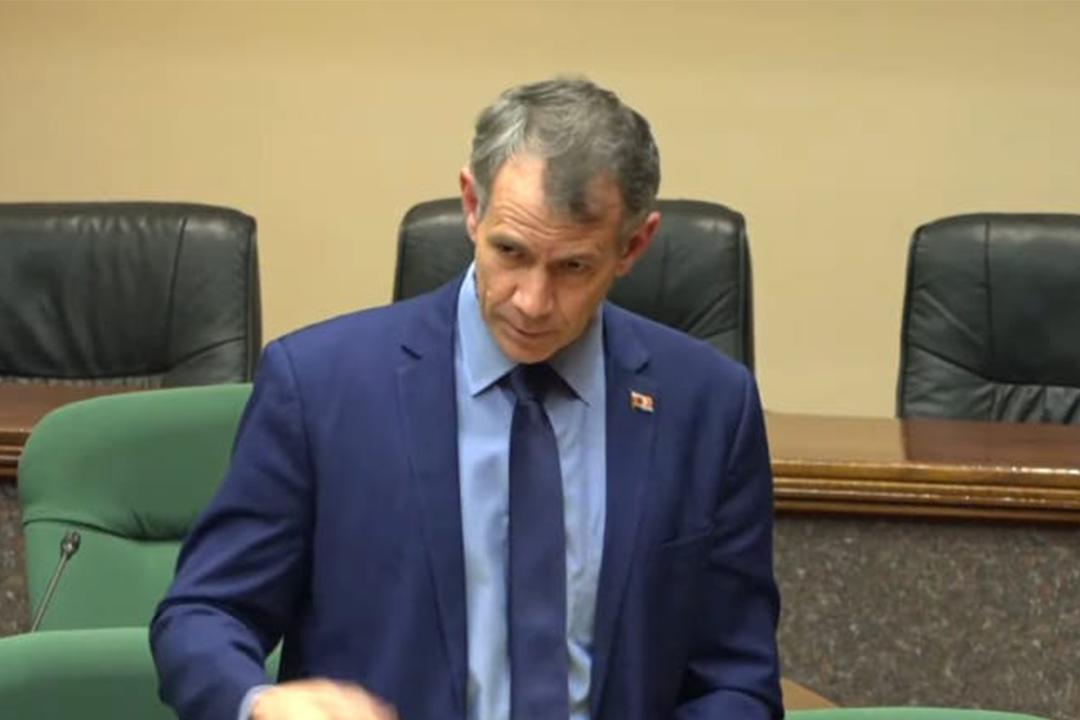
LOBAMBA – Minister of Finance Neal Rijkenberg has told the House of Assembly that municipalities are not barred from approaching commercial banks for loans to finance infrastructure development.
Rijkenberg said Mbabane and Manzini could access bank financing, provided they first obtained approval from Government, while clarifying that there had been no ban imposed on capital investment programme subventions to the two cities.
The minister was responding to Motion 19/2026 moved by Kubuta MP Masiphula Mamba and seconded by Mbabane East MP Welcome Dlamini, calling for the immediate release of outstanding Capital Investment Programme subventions due to the two major cities.
The motion also called on the Minister of Finance to explain why the subventions had allegedly been stopped and to lift the ban, with a report to be tabled in the House within 21 days of adoption.

However, Rijkenberg rejected the suggestion that Government had imposed a ban.
He explained that Government had changed the way the capital investment subventions were allocated after observing that municipalities were receiving relatively small amounts that had limited impact on infrastructure development.
“It was E2 million here, E3 million there, E1 million there,” Rijkenberg said.
According to the minister, the Ministries of Economic Planning and Development and Housing and Urban Development decided to consolidate the allocations instead of spreading small amounts among municipalities.
He said the consolidated allocation currently stood at E26.5 million, which was being directed to one municipality at a time to allow for projects with a greater impact, such as the construction of tarred roads and bridges.
Rijkenberg said the arrangement was intended to ensure that every municipality would benefit over time, with the Ministry of Housing and Urban Development identifying the municipality with the greatest need each year.
The minister also disclosed that Government had now provided for the full amount requested by the two cities for rates.
For Mbabane, E74.5 million had been provided for in the current budget, while E40.8 million had been allocated for Manzini.
Rijkenberg, however, warned that budgetary provision did not necessarily mean immediate payment, citing the Government’s current cash-flow challenges.
He said delays in disbursing the money could occur while Government dealt with its cash-flow position.
“The moment we are cash flow, these issues we raise, the loans we’re raising now will come through, this money will flow through to them,” he said.
The minister further explained that Government had opted to prioritise clearing arrears owed to the municipalities instead of increasing their subventions.
He said E20 million had been provided this year, as was done the previous year, specifically to begin reducing the arrears owed to Mbabane and Manzini.
According to Rijkenberg, the approach was considered a better use of the available funds given the financial pressure across Government.
“It’s not a matter of providing more budget. It’s a matter of making sure that the allocation of the budget is as fair as possible across government,” he said.
He acknowledged that clearing the arrears would take several years, but said Government could reconsider increasing capital investment subventions once the backlog had been reduced.
Rijkenberg also addressed the issue of municipalities accessing loans from financial institutions.
He clarified that municipalities were not prohibited from borrowing from banks, but could not approach banks directly without Government approval.
“There’s no requirement that they can’t go to the banks. It’s just they can’t go directly to the banks. They do need to ask for approval from government to go to the banks,” he said.
The minister said municipalities that followed the required process and obtained Government approval could proceed with borrowing.
This means that municipalities facing infrastructure funding pressures have another potential source of financing beyond Government subventions, although such borrowing remains subject to Government approval.
Rijkenberg maintained that the changes to the capital investment programme were not intended to punish or disadvantage the two cities, but to ensure that limited public resources produced a more meaningful infrastructure impact.
He also reminded Members of Parliament that such funding concerns should ideally be raised during the budget process, when allocations are being considered, rather than after the national budget has already been passed.
He said the issues could also be revisited when the supplementary budget was considered.
#Eswatini #Mbabane #Manzini #NealRijkenberg #Municipalities #InfrastructureDevelopment #CapitalInvestment #GovernmentFinance #HouseOfAssembly #EswatiniPositiveNews