



BY SIFISO NHLABATSI
EZULWINI– Eswatini’s Free Primary Education (FPE) Programme has continued to deliver strong results, sustaining primary school enrolment rates above 90 per cent while ensuring that thousands of children remain in school through the national school feeding programme.
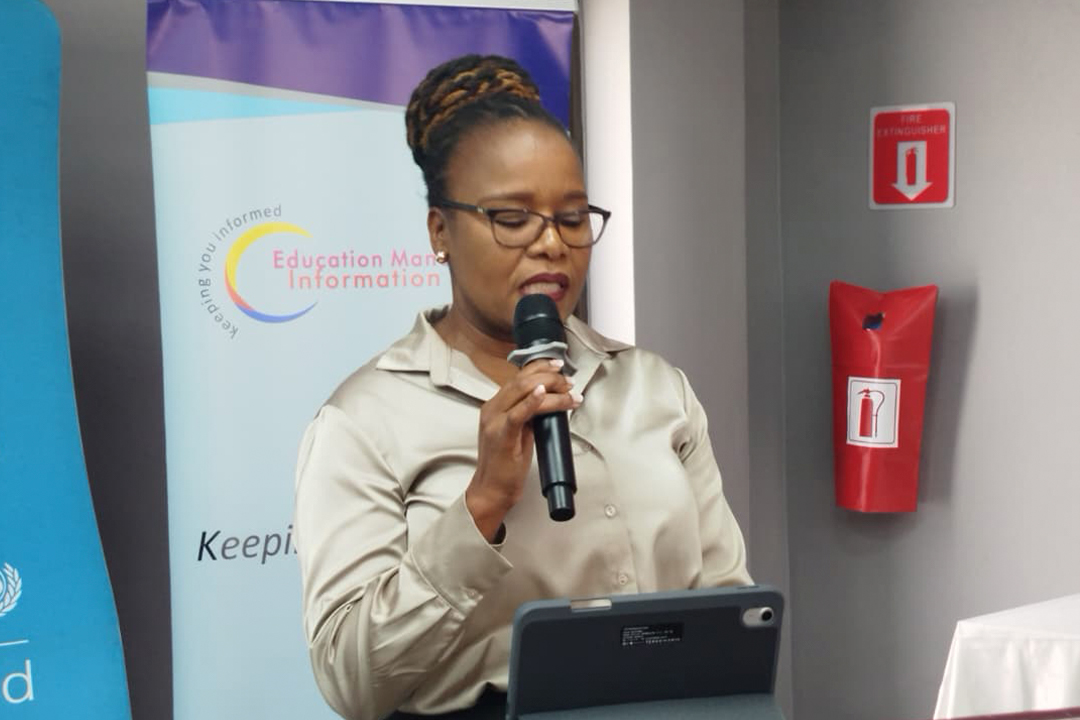
These achievements were highlighted during the presentation of the National Education Progress Report (NEPR) 2025 where Director of Education Tholakele Mngometulu, speaking on behalf of Acting Principal Secretary Nhlanhla Dlamini, said the report demonstrated the importance of reliable data in shaping the country’s education policies and investments.
Addressing government officials, development partners, education stakeholders and the media, Mngometulu described the report as more than a collection of statistics.
“The NEPR is far more than an annual technical summary of figures, graphs and words. It is a strategic compass,” she said.
She noted that in an environment of competing priorities and limited resources, credible data remained essential for evidence-based planning, targeted budgeting and sound policy formulation.
“Without reliable data, policy risks being guided by assumptions rather than reality. The insights provided in the 2025 report give us the clarity required to direct financial and human resources precisely where they are needed most, ensuring that every allocation translates into tangible learning outcomes for our students,” she said.
According to the report, the FPE Act of 2010, together with the national school feeding programme, has successfully maintained high primary school enrolment, reinforcing government efforts to provide universal access to basic education.
The report also shows that although enrolment at secondary school level has continued to grow steadily over the past four years, it remains significantly lower than at primary school level, standing at approximately half of primary enrolment.
Nationally, there were 358 885 learners enrolled in primary and secondary schools in 2025. Of these, 234 141 learners (65.2 per cent) were in primary schools while 124 744 learners (34.8 per cent) were in secondary schools.
Female enrolment at primary level increased from 107 613 in 2023 to 112 423 in 2025, while male enrolment rose from 115 371 to 121 718 over the same period.
At secondary level, female enrolment increased from 62 727 in 2023 to 64 528 in 2025. Male enrolment, which dipped slightly in 2024, recovered to 60 216 learners in 2025.
The report further indicates that the country’s education system currently supports 894 public schools and 92 private schools, comprising 663 primary schools and 323 secondary schools.
Early childhood education also recorded encouraging progress, although access remains limited. The Gross Enrolment Rate for Grade Zero stands at 33.9 per cent, meaning only one in three children currently receives formal Grade Zero preparation before entering primary school.
A total of 9 784 learners are enrolled in Grade Zero, including 4 851 girls and 4 933 boys.
Out of the country’s 663 primary schools, only 406 schools currently offer Grade Zero classes. Among these, 385 are public schools, representing 94.8 per cent of providers, while 21 are private schools.
However, the report notes that many public schools offering Grade Zero continue to face infrastructure challenges, particularly deteriorating classroom ceilings.
Despite the positive enrolment figures, the report also identifies several challenges requiring urgent intervention.
While normal progression under the Competency-Based Education (CBE) framework has helped reduce repetition rates at primary school level to four per cent, repetition at secondary school level has increased sharply to 15.2 per cent, prompting calls to review the implementation of the national repetition policy.
The report also reveals that lower secondary transition rates remain consistently above 80 per cent, indicating that most learners continue progressing through the education system.
However, concern remains over examination attrition, where increasing numbers of learners enrol in grades leading to external examinations but drop out before sitting these high-stakes assessments.
Mngometulu said the findings should not simply remain in a report but should stimulate further research and practical solutions.
“While the report highlights key achievements, it also brings to light several persistent challenges across the sector. We would not be doing justice to the sector if we let these findings remain on the page,” she said.
She challenged universities, research institutions, civil society organisations and development partners to undertake targeted research aimed at identifying the root causes of the challenges and developing effective interventions.
She also applauded the Ministry’s Education Management Information System (EMIS) team and the Planning Unit for producing the report and embedding a Results-Based Monitoring (RBM) framework into it.
According to Magagula, the framework shifts attention from merely tracking activities to measuring actual outcomes and long-term impact, thereby strengthening accountability and aligning implementation with the Education Sector Strategic Plan 2022-2034 and its Multi-Year Action Plans.
She also acknowledged UNICEF for its continued technical and financial support in strengthening the country’s education data systems.
“UNICEF’s continued partnership in strengthening our data systems and monitoring capacity over the years remains invaluable to our reform agenda. Thank you very much for doing this for every child,” she said.
Magagula added that the ministry had expanded this year’s programme by inviting experts from various sectors that collect education statistics to present their latest findings, providing stakeholders with a more comprehensive picture of the state of education in Eswatini.
She urged participants to engage constructively with the findings and remain focused on achieving equitable, quality education for every learner.
“We must engage open-mindedly with the data, challenge our assumptions and keep our shared goal at the forefront, ensuring equitable, quality education for every learner,” she said.
#NEPR2025 #EducationEswatini #FreePrimaryEducation #QualityEducation #EMIS #EducationReform #ResultsBasedManagement #UNICEF #GradeZero #EducationForAl
(Courtesy Pic)