


BY THEMBA ZWANE
EZULWINI – The Parliament of the Kingdom of Eswatini has called for stronger accountability in the public service, warning that oversight must ultimately translate into better decisions, responsible use of public resources and improved services for citizens.
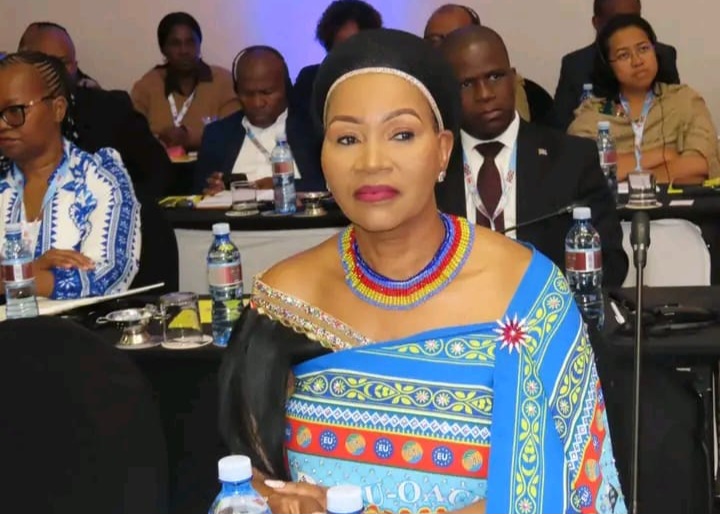
Senate President Pastor Lindiwe Dlamini said parliamentary oversight should not merely be about finding fault with government institutions, but should serve as a catalyst for strengthening institutions, correcting weaknesses and ensuring that public administration remains responsive to the people it exists to serve.
She was speaking on the second day of the Public Service Commissions (PSC) Chairpersons and Commissioners Forum, where she addressed delegates on the theme: “The Oversight Role of the Eswatini Parliament as a Catalyst for Transparency and Accountability in the Public Service.”
Dlamini said the quality of government was ultimately experienced through its public service, noting that citizens encounter the state at hospitals, schools, border posts, government offices and wherever public officers exercise authority or deliver services.

“It follows, therefore, that an efficient, professional and accountable public service is not merely an administrative aspiration. It is one of the foundations upon which public confidence in the state rests,” she said.
The Senate President said Parliament had an important responsibility in safeguarding public confidence and could forge a robust partnership with Public Service Commissions in advancing public service excellence.
She highlighted the role of parliamentary committees, particularly the Public Accounts Committee (PAC), in ensuring that government ministries account for public resources and address audit findings raised by the Auditor General.
According to Dlamini, parliamentary oversight should go beyond establishing whether public funds were spent.
“Was it spent lawfully? Was it spent prudently? Did it achieve its intended purpose? Did citizens receive the service for which those resources were appropriated?” she asked.
She said this performance-oriented approach was particularly important at a time when governments faced limited resources and rising public expectations.
Dlamini warned that funds lost through inefficiency, waste, maladministration or corruption represented services that citizens could have received.
“Unaccounted-for funds, as a result of inefficiency, waste, maladministration or corruption means that we cannot build a classroom, procure medicine, maintain infrastructure or provide another essential public service,” she said.
She stressed that Parliament viewed accountability not merely as a compliance requirement, but as an obligation owed to citizens.
The Senate President also called for transparency to become embedded in the culture of public institutions, saying accountability depended on access to accurate, timely and reliable information.
She said annual reports, performance reports, financial statements, audit reports and appearances before parliamentary committees were important mechanisms through which Parliament scrutinised government activity.
However, she cautioned that transparency should not be reduced to the production of documents.
“It requires ethical leadership and a culture in which public institutions are willing and able to explain their decisions, demonstrate their results and acknowledge areas requiring improvement,” she said.
Dlamini called for closer collaboration between Parliament and Public Service Commissions in strengthening ethics and integrity in public administration.
She said while Parliament enacted anti-corruption and public finance laws, Public Service Commissions played an important role in enforcing ethical standards at the operational level.
“Together, we must entrench a culture where integrity is rewarded, corruption is swiftly disciplined, and public officers are protected when upholding the rule of law,” she said.
The Senate President further emphasised the need for a professional public service that is competent, ethical, politically impartial, responsive and committed to the national interest.
She said this would require deliberate efforts by both Parliaments and Public Service Commissions to build exemplary public institutions.
Dlamini said the role of oversight should also evolve alongside the development needs of Eswatini and the wider region.
She identified unemployment, poverty, inequality, climate vulnerability, pressure on public health systems, infrastructure needs and rapidly changing technology as some of the challenges confronting Southern Africa.
“Meeting these challenges requires more than sound policies. It requires capable institutions that can translate policy into results,” she said.
She argued that parliamentary oversight should therefore increasingly examine whether public institutions had the capacity, resources and systems required to deliver national priorities.
“Accountability should help institutions perform better. Transparency should help citizens trust them more. Oversight should help the state learn, adapt and improve,” she said.
Dlamini also pointed to digital transformation as an opportunity to strengthen accountability, saying digital systems could improve procurement, financial management, human-resource administration, record keeping and service delivery.
She said the future of parliamentary oversight would increasingly depend on the ability of Parliament to interrogate data, identify patterns and assess performance in near real time.
“This means our institutions must prepare for an environment in which accountability becomes increasingly evidence-driven,” she said.
Turning to regional cooperation, Dlamini urged SADC countries to share successful approaches to merit-based recruitment, parliamentary monitoring, ethics, integrity and service delivery.
She said regional integration should not only facilitate the movement of goods, services and people, but should also enable the movement of good ideas and sound institutional practices.
In her concluding remarks, the Senate President challenged delegates to strengthen regional peer learning, develop standardised metrics for public administration performance and deepen legislative-administrative dialogue in their respective countries.
She called for the building of a public service across Africa that is “not merely reactive to current demands, but proactively equipped to drive our continent’s transformation.”
“The Parliament of the Kingdom of Eswatini remains committed to playing its part in that endeavour, working within our constitutional framework and alongside the institutions entrusted with safeguarding the integrity and effectiveness of our public service,” Dlamini said.
The PSC Chairpersons and Commissioners Forum brings together public service oversight and administration leaders from across the region to exchange experiences and explore ways of strengthening public administration and service delivery.
#Eswatini #ParliamentOfEswatini #Senate #SenatorLindiweDlamini #PublicService #PublicServiceCommissions #Accountability #Transparency #GoodGovernance #PublicServiceDelivery #SADC #Africa #Governance #PublicSector #Integrity