
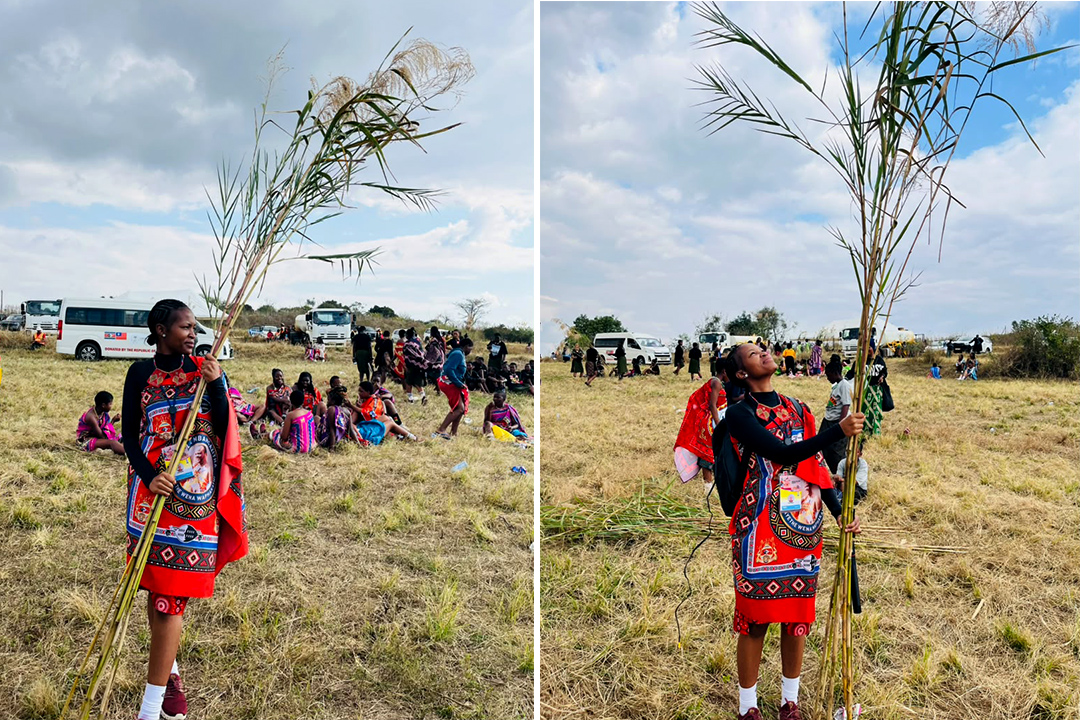




BY NELIWE NGUBANE
LOBAMBA— I arrived at the 2026 Umhlanga Reed Dance as a reporter, notebook and camera in hand, but left with something far more personal , an experience of walking, singing, dancing and living alongside thousands of maidens during one of Eswatini’s most celebrated cultural ceremonies.
What began as an assignment from our editor at Eswatini Positive News (EPN), where the Umhlanga girls’ team was tasked with experiencing and covering Umhlanga from the inside, became an eight-day journey that took me from the excitement of arrival and registration to the emotional goodbye as maidens returned to their respective chiefdoms.
More than a colourful annual celebration, Umhlanga is a living expression of Eswatini’s heritage, identity, unity and respect for tradition. The ceremony brings maidens together from different chiefdoms to cut and present reeds to the Queen Mother, while also giving young maidens an opportunity to celebrate their culture, heritage and national identity.
For me, the significance became clearer the deeper I went into the experience. I was no longer simply reporting what I saw. I was walking through a tradition that generations before me had carried forward.
DAY ONE: ARRIVAL AND REGISTRATION
Tuesday, August 25, marked the beginning of the 2026 Umhlanga programme, with maidens arriving and registering at Ludzidzini Royal Residence.
As the EPN girls’ team, we were assigned to cover the arrival of the maidens, and the atmosphere immediately showed that this would be more than an ordinary assignment.
Maidens arrived in numbers from their respective chiefdoms, travelling in buses filled with excitement. The moment they stepped off the buses, the surroundings came alive with singing, dancing, laughter and ululation.
They registered before offloading their bags and making their way to the various campsites prepared for them.
For me, watching the maidens singing and dancing as they arrived was a reminder that Umhlanga is not simply about the main performance seen by thousands of spectators. The journey itself is part of the heritage.
The traditional attire, songs and dancing immediately created a sense of identity. Each group carried the character of where they came from, yet once they gathered at Ludzidzini, those differences seemed to disappear into one united body of Imbali.
As a reporter, I found myself documenting the excitement, but at the same time, I could feel myself becoming part of the experience.
DAY TWO: THE WALK TO NGABEZWENI
Wednesday, August 26, brought one of the most memorable experiences of the week, the commissioning of the participants and the walk from Ludzidzini Royal Residence to Ngabezweni Royal Residence.
The maidens were commissioned under the leadership of Indvuna Yembali Bongiwe “Viviane” Hlatjwako, together with Royal Princess Sakhizwe and Liphovela LaZuma.
We walked from Ludzidzini to Ngabezweni by foot.
The journey immediately brought back memories of when I used to attend Umhlanga as an attendee. I remembered the walks, the songs and the excitement, but experiencing it this time as a reporter and participant gave it a completely different meaning.
The distance did not feel as difficult as one might imagine. Instead, the road was filled with singing, dancing and laughter.
The Imbali Forces came out with their best energy, singing and dancing as though everyone was determined to bring their A-game.
The Emazinyane, the King’s children, were also enjoying every moment of the journey, adding to the excitement along the way.
When we finally reached Ngabezweni Royal Residence, we were warmly welcomed with food.
But another surprise awaited us.
All the maidens, including myself, received new sneakers from His Majesty King Mswati III.
The excitement on the faces of the maidens said everything. The sneakers were beautiful, and receiving them after the long walk made the experience even more special.
Later, His Majesty commissioned the maidens to their respective reed-cutting destinations. The younger maidens were assigned to Masundvwini, while the older maidens were assigned to Mpisi Farm.
As the maidens boarded buses to their respective destinations, the singing and dancing continued.
DAY THREE: INTO THE REED FIELDS
Thursday, August 27, was reed-cutting day.
I was assigned to cover the young maidens at Masundvwini, where the reed-cutting activities were led by Princess Ntsandvweni.
We walked from the campsite to the designated reed-cutting area.
It was another opportunity to experience Umhlanga away from the main arena.
The walk itself became part of the experience. Once again, songs and dancing accompanied us as we made our way to the reed fields.
There was a strong sense of unity among the maidens. Although we were walking to perform a specific cultural duty, the atmosphere remained joyful.
The sight of maidens carrying out a tradition passed down through generations made the meaning of the ceremony feel more tangible.
After cutting the reeds, we made our way back, continuing to sing and dance along the journey.
For me, this was one of the moments when the assignment truly stopped feeling like ordinary work. I was not merely watching the experience through a camera lens. I was walking through it.
DAY FOUR: THE REEDS RETURN HOME
Friday, August 28, was dedicated to transporting and returning with the reeds.
Although our team did not cover the day, the activities brought back memories of my previous experiences of Umhlanga.
I remembered enjoying the long walks from Mpisi Farm to Mafutseni.
At the time, the distance could have appeared challenging, but the singing, dancing and togetherness made the journey enjoyable.
The maidens were transported by buses back to Ngabezweni Royal Residence before continuing their journey to Ludzidzini with the reeds.
The return of the reeds was an important part of the build-up to the major presentations, as the maidens prepared to present what they had gathered before Their Majesties.
DAY FIVE: A MOMENT TO REST
Saturday, August 29, was a rest day.
After several days of walking, singing, dancing and reed cutting, the maidens were given time to rest and prepare themselves for the major activities ahead.
The day provided an opportunity to recover physically while also preparing mentally and traditionally for the weekend programme.
For me, it was a reminder that behind the colourful performances seen by the public is a demanding experience that requires endurance from the maidens.
The rest day was therefore important before the major celebrations.
DAY SIX: PRESENTING THE REEDS
Sunday, August 30, brought the presentation of the reeds before Their Majesties.
We headed to the Ludzidzini Arena, where the maidens gathered for traditional dancing in the presence of Their Majesties.
The atmosphere was already building as the maidens prepared to showcase their traditional dances.
One of the highlights was witnessing the kugiya, the solo dance performed by the Indvuna Yembali, princesses and maidens.
Watching the different performers take centre stage demonstrated the confidence and energy that had been building throughout the week.
For me, covering the day was particularly exciting because I was able to see how the journey from arrival, walking and reed cutting eventually came together in the arena.
The maidens had arrived days earlier full of excitement, walked long distances together, cut reeds and rested, and now they were preparing to present themselves before Their Majesties.
DAY SEVEN: THE MAIN REED DANCE
Monday, August 31, was the main Reed Dance day and a national public holiday.
This was the day when the biggest crowds gathered at Ludzidzini Arena, with people travelling from different parts of Eswatini and beyond to witness the traditional dancing and singing.
The atmosphere was electric.
But before the first step was taken, the maidens themselves became a moving display of heritage.
On the main day, their traditional attire stood out as much as their dancing. The maidens wore brightly coloured traditional short beaded skirts, complemented by colourful sashes and traditional accessories. Beaded ornaments and rattling anklets added movement and sound to every step, while the overall dress created the distinctive sea of colour associated with Umhlanga.
The attire was not simply for beauty. It formed part of the cultural identity of the ceremony, allowing the maidens to enter the arena proudly representing a tradition that has survived across generations.
As the maidens moved, their attire moved with them,beads catching the light, anklets rattling against the ground and colourful sashes rising and falling with every dance.
Then came the songs.
The arena was filled with voices singing, responding and celebrating. Songs such as “Halala” added an even more emotional layer to the celebration as maidens and those gathered joined in celebrating His Majesty King Mswati III’s 40 years on the throne and 58th birthday.
The sound of “Halala” carried through the arena like a collective message of celebration.
This was not merely a dance. It was a moment where culture, music, monarchy and national pride came together.
The year’s celebration therefore carried additional significance. His Majesty’s 40 years on the throne and 58th birthday gave the occasion an added celebratory character, with the maidens’ songs and dances becoming part of a wider national tribute.
One of the moments I particularly enjoyed was watching the kugiya by the princesses, including Princess Buhlebetive and Princess Sakhizwe, as well as the Indvuna Yembali and other maidens.
The performances were energetic, expressive and entertaining.
It was also special seeing maidens from different countries participating, adding an international dimension to the celebration.
Another memorable moment was watching the King and his delegation participate in kudlalisela.
Towards the end of the celebrations, the Queen Mother also danced as a sign of happiness, creating another memorable moment for those present.
As darkness fell, the arena transformed.
Fireworks lit up the sky while phone lights could be seen shining in the air as people captured the historic celebrations.
For a reporter, it was a dream assignment.
There was so much happening at once, the dancing, singing, royal participation, celebration of the King’s milestones, traditional attire, fireworks and thousands of people sharing the same moment.
It was not only something to report; it was something to experience.
DAY EIGHT: GOODBYE, IMBALI
The final day was the emotional goodbye.
After spending days together, it was time for the maidens to return to their respective chiefdoms.
I covered the departure as the maidens prepared to board buses back home.
However, before leaving, the maidens received food parcels through Indvuna Yembali Bongiwe “Viviane” Hlatjwako.
The parcels included bread, drinks, sweets and meat.
It was a thoughtful gesture that ensured the maidens did not leave empty-handed after completing the week-long journey.
As the buses prepared to leave, the atmosphere was different from the excitement of Day One.
On arrival, everyone had been eager to begin the experience.
Now, there was a sense that something meaningful had come to an end.
MORE THAN AN ASSIGNMENT
Looking back, Umhlanga 2026 taught me that journalism is not always about standing outside an event and recording what happens.
Sometimes, the best way to understand a story is to experience it.
From the first songs at Ludzidzini, the long walk to Ngabezweni, receiving new sneakers, cutting reeds at Masundvwini, resting, witnessing the kugiya, watching thousands of maidens in their traditional attire on the main day, singing along to songs such as “Halala”, covering the historic celebration and finally saying goodbye,every day brought a different story.
The experience also taught me that heritage is not something that exists only in history books or museums.
It lives in songs.
It lives in dance.
It lives in dress.
It lives in the reed carried by a maiden, in the footsteps of thousands walking together and in the voices of generations coming together to preserve what belongs to them.
Umhlanga is therefore more than a spectacular annual gathering. It is a living expression of Eswatini’s culture, identity, unity and heritage, a tradition that continues to bring generations together.
What started as an assignment from our editor became an experience that connected me with memories of attending Umhlanga in the past while allowing me to see the ceremony through the eyes of a reporter.
I arrived to cover the Imbali.
I left feeling like I had become part of the journey.
#Umhlanga2026 #ReedDance #Imbali #EPN #EswatiniCulture #Journalism #UmhlangaExperience#SwatiCulture
(Courtesy Pic)


