


BY THEMBA ZWANE
EZULWINI – Institutions responsible for combating illicit financial flows (IFFs) across the SADC region remain fragmented, creating vulnerabilities that could allow illicit funds to move across jurisdictions faster than authorities can detect, investigate and recover them.
This was highlighted during submissions by Commission One at the Southern African Development Community Organisation of Public Accounts Committees (SADCOPAC) 18th Annual Conference in Eswatini, where delegates examined the growing challenge of illicit financial flows in an increasingly digital financial environment.
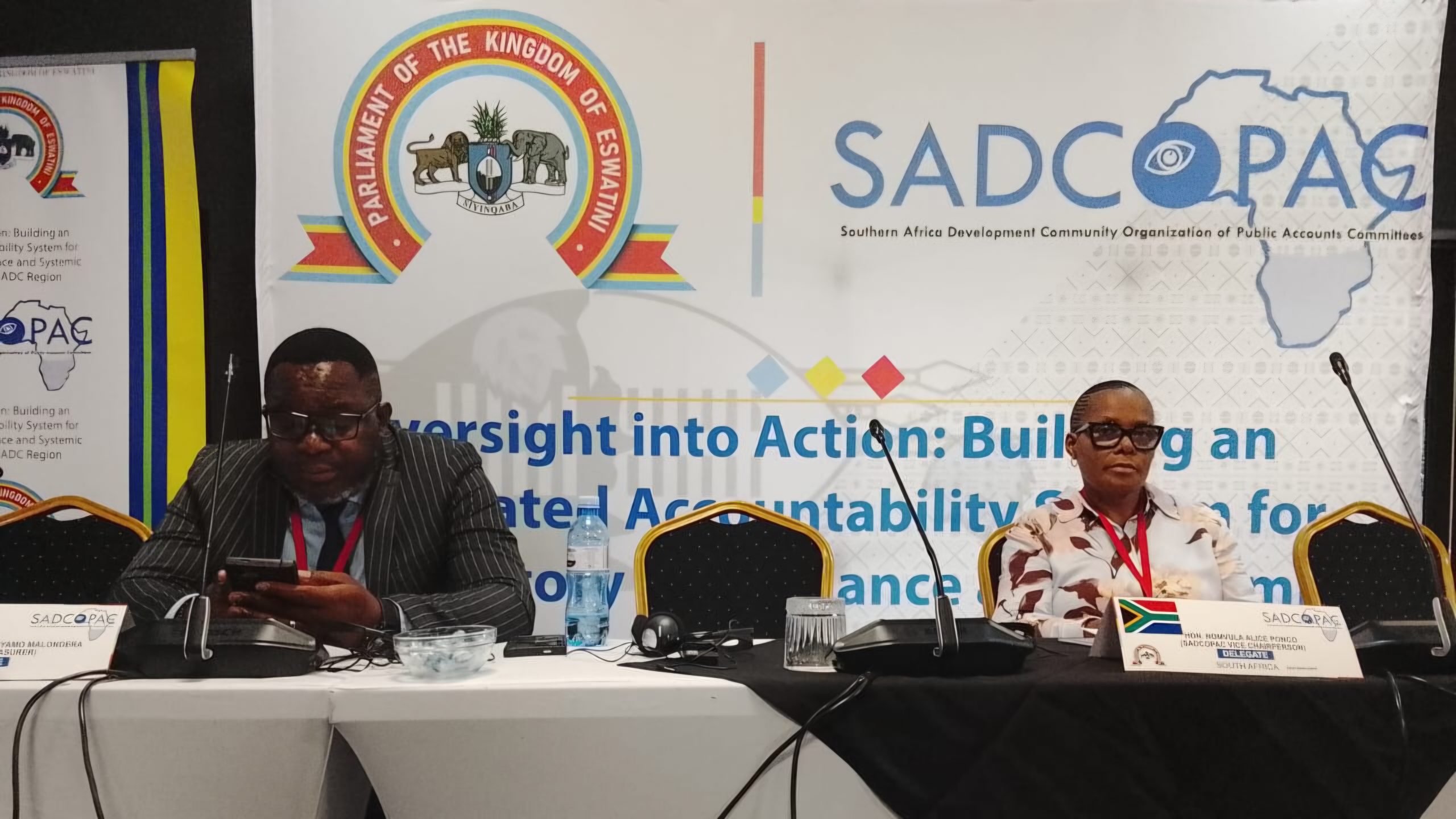
The Commission One report, presented to the plenary by its Chairperson, Hon. Nomvula Alice Ponco of South Africa, warned that the rapid digitisation of financial systems is changing the speed and complexity of illicit financial activity.
Traditional financial crimes that once relied heavily on cash and conventional banking channels can now be facilitated through cryptocurrencies, virtual-asset platforms, mobile money, digital wallets and online payment systems.

The challenge, according to the commission, is compounded by the fact that institutions responsible for combating these flows often operate in separate silos.
“Supreme Audit Institutions, Public Accounts Committees, Financial Intelligence Units, revenue authorities, central banks, anti-corruption agencies, law-enforcement bodies, prosecutorial authorities and procurement regulators frequently hold different pieces of relevant information,” the commission observed.
It warned that where information remains trapped within institutional silos, no single institution may have a complete picture of how illicit funds are generated, moved and ultimately concealed.
Ponco said the region therefore needs an integrated approach that brings together the different institutions responsible for detecting and responding to financial crime.
The commission noted that criminal networks are increasingly exploiting technology to move funds across borders within minutes, while authorities remain constrained by national mandates, lengthy mutual legal-assistance procedures and differences in legislation.
This creates a situation in which criminal networks can operate at a speed that traditional regulatory, audit and investigative systems struggle to match.
The commission identified corruption, tax evasion, procurement fraud, cybercrime, trafficking, fraud and money laundering as major sources of illicit financial flows.
It further warned that digital technologies can be exploited to conceal the origin, ownership, movement and ultimate beneficiaries of unlawfully acquired funds.
Virtual assets were singled out as presenting particular challenges, especially where transactions involve unregulated exchanges, peer-to-peer transfers, offshore platforms and other mechanisms that can make it difficult to establish beneficial ownership.
However, the commission stressed that digital finance itself should not be treated as inherently illicit.
Cryptocurrencies, mobile payments and other financial technologies can promote financial inclusion, reduce transaction costs and support innovation.
The concern, it said, arises when legitimate technologies are exploited to facilitate financial crime.
The commission found that many oversight institutions are still structured around financial systems dominated by cash, banks and paper-based records, while their laws, audit methodologies, investigative procedures and technical capabilities have not always evolved at the same pace as financial technology.
It consequently called for institutions to be retooled to deal with the digital era.
Supreme Audit Institutions, in particular, were encouraged to adopt data analytics, artificial intelligence, automated risk assessment and continuous auditing.
Such technologies could help identify unusual transaction patterns, split payments, duplicate suppliers, unexplained transfers, suspicious procurement relationships and other indicators of potential illicit financial activity.
Nonetheless, technology alone will not solve the problem.
The commission cautioned that auditors and investigators still require professional judgement to interpret anomalies within their legal, institutional and economic contexts.
It also called for secure and timely access to government financial, procurement and revenue-management systems so that SAIs can follow public money through increasingly digital financial platforms.
Public Accounts Committees, meanwhile, were urged to broaden their oversight beyond conventional financial records.
The commission said PACs should scrutinise whether governments have adequate frameworks for regulating virtual assets and supervising virtual-asset service providers.
They should also examine whether Financial Intelligence Units, revenue authorities, anti-corruption agencies, police and prosecutorial bodies have sufficient legal authority, resources and technical capacity to trace digital financial flows.
The commission made it clear that PACs should not become investigative agencies themselves.
Their responsibility, it said, is to ensure that institutions mandated to prevent, detect and investigate illicit financial flows are properly equipped, coordinated and held accountable for results.
Joint engagements involving SAIs, PACs, Financial Intelligence Units, central banks, tax authorities and investigative agencies were therefore recommended where audit findings expose complex digital transactions or possible cross-border movement of public funds.
The private sector was also identified as a critical partner.
Banks, mobile-network operators, payment-service providers, cryptocurrency exchanges and other virtual-asset service providers hold transaction information that could assist authorities in detecting suspicious financial activity.
The commission recommended appropriate legal frameworks requiring timely reporting and preservation of relevant transaction records, while safeguarding privacy and fundamental rights.
At regional level, delegates called for stronger cooperation to trace, freeze, confiscate and recover digital assets transferred across national borders.
They also recommended interconnected beneficial-ownership registers to help investigators identify the individuals behind companies, trusts, accounts and digital transactions.
Among the key recommendations were the modernisation of legislation governing virtual assets, cybercrime, money laundering, digital evidence, asset recovery and beneficial ownership.
Member States were also urged to license and effectively supervise virtual-asset service providers and strengthen the technical and financial capacity of PACs, SAIs, FIUs, revenue authorities and investigative agencies.
The commission further recommended formal information-sharing arrangements, joint investigations and secure platforms for exchanging intelligence.
It called for regular reporting to Parliament on the value, patterns and investigation of illicit financial flows, including cases involving virtual assets.
SADCOPAC and regional SAI structures were also identified as important platforms for developing common standards, exchanging expertise and coordinating responses to emerging digital-finance risks.
The commission concluded that the transition from cash to digital finance must be matched by a corresponding transition in public oversight.
For Ponco and her fellow delegates, the challenge is no longer simply to detect illicit financial flows after they have occurred, but to build an accountability system capable of identifying emerging risks early and acting collectively before money disappears across institutional and national boundaries.
The recommendations from Commission One form part of the resolutions expected to be considered at the 22nd SADCOPAC Annual General Meeting tomorrow.
If adopted, they could strengthen the region’s move from fragmented, retrospective responses towards a more integrated and anticipatory system for protecting public resources in the digital age.
#SADCOPAC #SADC #IllicitFinancialFlows #FinancialCrime #PublicAccountability #DigitalFinance #PublicFunds #ParliamentaryOversight #Eswatini #FinancialIntelligence #AssetRecovery #DigitalEconomy
(Courtesy Pic)