



By NOXOLO DLAMINI
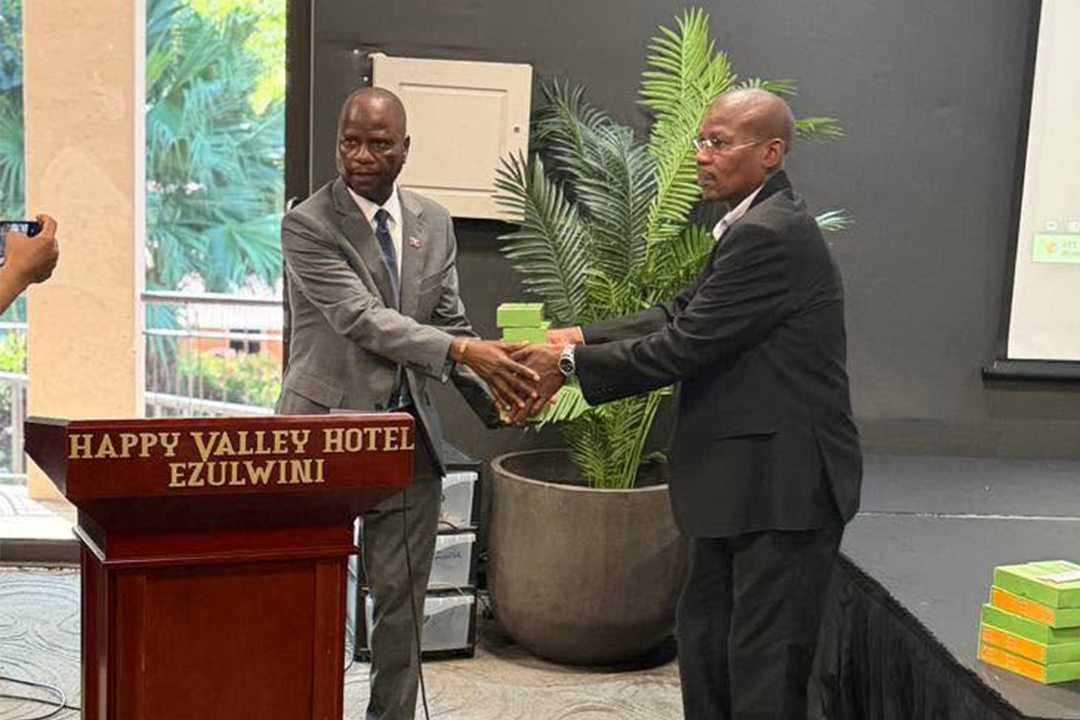
PIGGS PEAK – Farmers across Eswatini are set to gain faster access to soil information after the National Maize Corporation (NMC) donated 20 digital soil testers valued at E11 680 to the Ministry of Agriculture for distribution to Rural Development Areas (RDAs) across the country.
The donation, handed over at Happy Valley Hotel in Ezulwini, is aimed at bringing soil testing closer to farming communities, reducing the need for farmers to travel long distances for testing and helping them obtain quicker information to guide decisions on fertiliser, lime and other agricultural inputs.
Minister of Agriculture Mandla Tshawuka said the donation was an important step towards encouraging farmers and the agricultural sector to embrace modern technology to improve the speed and efficiency of agricultural services.
SOIL TESTING BROUGHT CLOSER TO FARMERS
NMC Chief Executive Officer Velaphi Vilane said the corporation had been using the digital soil-testing technology and decided to donate the devices after hearing concerns from farmers and the Ministry of Agriculture about access to soil testing services.

Vilane demonstrated how the devices can be used together with smartphones to obtain soil information and indicated that NMC could consider donating additional testers in future.
The portable devices are expected to provide rapid field readings of selected soil characteristics, depending on the capabilities of the particular device. These may include indicators such as soil pH, moisture, temperature and electrical conductivity.
The technology is expected to complement, rather than replace, the Ministry of Agriculture’s existing laboratory soil-testing services.
SUPPORTING BETTER FARMING DECISIONS
The Ministry’s Soil Testing Unit provides soil fertility information and analyses soil for characteristics including pH, exchangeable acidity and macro- and micronutrients. The results are used to support lime and fertiliser recommendations.
The availability of digital testers at RDAs could therefore give farmers and extension officers an earlier indication of soil conditions while making detailed laboratory testing available where further analysis is required.
Acting Director of Agriculture Nikiwe Dlamini welcomed the donation, saying the devices respond to concerns raised by farmers regarding access to soil-testing services.
She said improved access to soil information could assist farmers in making informed production decisions and contribute towards improved agricultural productivity.
TSHWUKA CALLS FOR GREATER USE OF TECHNOLOGY
Tshwuka said the agricultural sector needed to keep pace with technological developments and make use of modern machinery capable of delivering faster and more efficient results.
The donation comes as agriculture increasingly adopts technologies intended to support farmers with timely information and improve the efficiency of production.
For farmers, quicker access to soil information could help them understand the condition of their fields before making decisions involving fertiliser, lime and other inputs.
RDAs TO SERVE AS ACCESS POINTS
The distribution of the 20 testers to RDAs is expected to take soil-testing technology closer to farming communities.
The Ministry’s extension network already plays a role in providing farmers with technical advice on soil fertility and crop production. The digital testers could provide extension officers with an additional tool to assess soil conditions in farming areas.
However, proper soil sampling remains essential.
Vilane cautioned that farmers should continue following correct soil-sampling procedures despite the availability of faster digital technology.
A reading from an incorrectly selected or poorly collected sample may not accurately represent the condition of an entire field. Proper sampling therefore remains important when using soil information to guide fertiliser and lime decisions.
DIGITAL TESTERS TO COMPLEMENT LABORATORY SERVICES
The new technology is not expected to replace the Ministry’s laboratory soil-testing system.
Instead, rapid field testing could provide preliminary information, while samples requiring detailed analysis could still be sent to the laboratory.
This could create a system where farmers receive quicker preliminary information at the RDA level, extension officers assist with interpretation and the laboratory provides more detailed analysis and recommendations where necessary.
The success of the initiative will therefore depend not only on the availability of the 20 devices, but also on their proper deployment, maintenance, correct use and the capacity of extension officers to interpret and communicate the results to farmers.
For Eswatini’s farmers, the donation represents an opportunity to bring an important agricultural service closer to where production takes place.
#SoilTesting #EswatiniAgriculture #NMC #MinistryOfAgriculture #Farmers #AgricultureTechnology #SoilHealth #RDAs #AgriculturalDevelopment


