



BY THEMBA ZWANE
EZULWINI– African countries have been urged to move beyond treating artificial intelligence (AI) and emerging technologies as standalone digital skills programmes and instead embed them across the entire teacher professional development system.
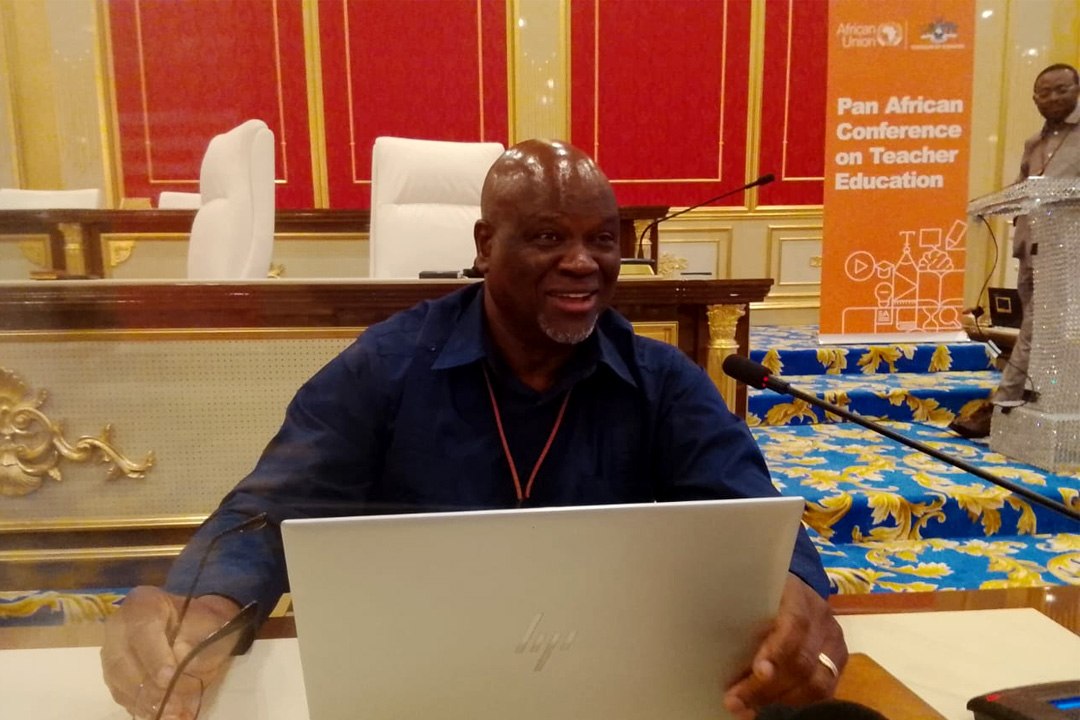
The call was made during the Pan-African Conference on Teacher Education (PACTED) 2026 at the Ezulwini Palazzo International Convention Centre, where the Republic of South Africa’s Teacher Development and Curriculum Research, Curriculum and Professional Development Unit, Dr AE Nkhosi presented South Africa’s experience as a model for moving from technology policy to practical implementation in classrooms.
The presentation stressed that the real challenge is no longer simply providing teachers with technological tools, but ensuring that technology becomes part of teacher professionalisation, pedagogy and education system design.
South Africa’s experience suggests that AI should be integrated across the teacher development continuum – from initial teacher education and induction programmes to continuous professional development and classroom practice.

“The approach builds on existing policy instruments, including the White Paper on e-Education, the Integrated Strategic Plan for Teacher Education, the Professional Development Framework for Digital Learning, the Minimum Requirements for Teacher Education Qualifications and the Continuing Professional Teacher Development (CPTD) online platform,” he said.
He said the White Paper on e-Education provides the policy foundation for using information and communication technologies to transform teaching and learning, while the teacher education strategy provides an architecture through which teachers’ professional needs can be identified and addressed.
The Professional Development Framework for Digital Learning moves beyond basic computer literacy by bringing together technology, pedagogy and content knowledge.
Dr Nkhosi noted that the Minimum Requirements for Teacher Education Qualifications, meanwhile, provide an entry point for embedding digital competence into initial teacher education.
“The CPTD online platform provides opportunities for continuous, scalable and self-directed professional learning.”
In his presentation, he noted that the Professional Development Framework for Digital Learning contains 11 competencies, which universities are expected to incorporate into initial teacher education programmes.
The CPTD online platform further provides teachers with 15 competencies delivered through 15 modules and micro-learning programmes designed to develop specific professional competencies.
Dr Nkhosi argued that this existing continuum provides a foundation upon which AI can be integrated without creating a completely separate professional development system.
“Under the proposed approach, teachers entering the profession should graduate with the ability to understand AI and its limitations, use AI appropriately for lesson preparation and educational resources, integrate AI into subject-specific pedagogy and critically evaluate AI-generated information,” he said.
He said they should also understand issues surrounding ethics, privacy, copyright and academic integrity, while being equipped to teach learners how to become responsible users of AI.
For teachers already in the profession, he said, professional development should progress from digital literacy and digital pedagogy to AI literacy, AI-supported pedagogy, responsible AI and AI-enabled innovation.
However, the presentation emphasised that technology should never come before pedagogy.
The central question, he said, should be: “What educational problem are we trying to solve?”
He noted that AI should only be introduced where it can address an identified teaching and learning challenge or improve existing pedagogical approaches.
He said another critical component is continuous professional learning. Existing platforms such as the CPTD system can be used to provide diagnostic tools and personalised learning pathways, allowing teachers to identify their development needs and access relevant learning.
“The impact of AI interventions must also be measured beyond the number of teachers trained or devices distributed.”
He said the real indicators, according to his presentation, should include access, teacher competency, improved teaching practices and, ultimately, improved learning outcomes.
“If we are able to deal with these aspects in terms of impact assessment, we will be able to say we are on track,” Dr Nkosi noted.
The experience also offered several lessons for other African countries.
Countries were encouraged to build on existing teacher development systems rather than creating parallel AI structures, while ensuring that pedagogy remains the starting point rather than technology.
The presentation further stressed that teachers must be developed before they can be expected to develop learners.
This is particularly important as learners are increasingly exposed to AI and emerging technologies outside the classroom.
African education systems were also encouraged to use scalable digital platforms and micro-learning to reach teachers across large and geographically dispersed systems.
At the same time, he noted that AI strategies must be designed around African realities, including connectivity constraints, multiple languages and cultural diversity.
He warned that AI disparities could potentially deepen existing linguistic and cultural inequalities, making it necessary for African countries to deliberately address these challenges as they develop AI-enabled education systems.
National and cross-border collaboration was identified as another critical component.
Rather than continuously developing new standards and frameworks, countries were encouraged to examine what is already working elsewhere, identify successful approaches and adapt them to their own circumstances.
The message was therefore clear: Africa does not necessarily need more standalone AI frameworks for teachers.
Instead, countries need to strengthen existing teacher development systems and embed AI within the competencies teachers already require – ensuring that technology ultimately serves pedagogy, improves teaching and delivers better learning outcomes.
#PACTED2026 #TeacherEducation #AIinEducation #ArtificialIntelligence #DigitalLearning #TeacherDevelopment #Education #Africa #Eswatini