



BY THEMBA ZWANE
MBABANE– The University of Eswatini (UNESWA) has the potential to become a national centre for aquaculture innovation, fisheries management, aquatic ecosystem conservation and professional skills development, positioning the institution at the heart of the Kingdom’s blue economy ambitions.
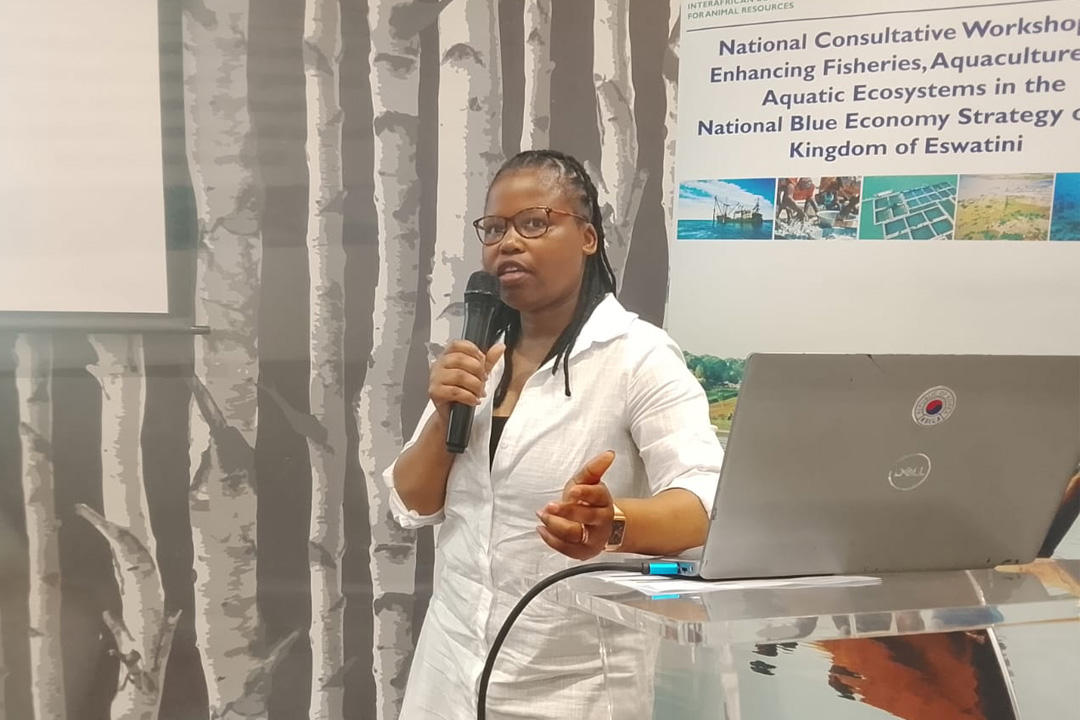
This was highlighted by Dr Thulile Sgwane, an aquaculture lecturer at UNESWA’s Luyengo Campus, who outlined the university’s proposed priorities for strengthening research, practical training and partnerships to support the sustainable development of fisheries and aquaculture in Eswatini.
Sgwane said the university could play a much bigger role than teaching aquaculture, by generating research-based solutions to challenges facing fish farmers, supporting government policymaking and developing skilled professionals for the sector.
Her presentation emphasised the need for coordinated investment in research facilities, modern equipment and collaboration between government, academia, the private sector and development partners to unlock the country’s aquatic resources.
The proposal comes as Eswatini seeks to strengthen food security, diversify agricultural production, create employment and reduce dependence on imported aquatic products.
STRENGTHENING RESEARCH AND PRACTICAL TRAINING
UNESWA already provides an academic foundation for the development of aquaculture skills through Principles of Aquaculture (ASC106), offered to Level 1 students, and Aquaculture Production (ASC409), offered to Level 4 students.
However, Sgwane noted that practical training and applied research remained constrained by limited facilities and equipment.
She identified the establishment of a modest aquaculture teaching and research unit as one of the priorities that could strengthen the university’s contribution to the sector.
“The proposed unit would include experimental ponds and/or tanks to support practical classes, student projects and research aimed at improving fish production,” she noted.
“The university would also benefit from basic water-quality monitoring equipment capable of measuring dissolved oxygen, pH, temperature, conductivity, ammonia and nitrate.’
She said such equipment would enable students and researchers to assess water conditions, identify potential risks to fish health and develop practical solutions to production challenges.
“Additional equipment for fish sampling, weighing, measuring, handling and feed preparation would further strengthen practical learning and production research,” she said.
Sgwane acknowledged the university’s existing collaboration with the Aquaculture Research Centre, which has provided access to laboratory facilities, a hatchery and an established fish farm.
She indicated that strengthening the university’s own capacity would complement these existing facilities and create more opportunities for research and training.
RESEARCH TO ADDRESS FISH FARMERS’ CHALLENGES
Beyond infrastructure, UNESWA wants its research agenda to respond directly to the realities faced by fish farmers, local communities and policymakers.
Sgwane identified the need to investigate the social, technical, financial and institutional factors limiting the adoption, productivity and sustainability of small-scale fish farming in Eswatini.
Another priority is the development of affordable fish feeds using locally available ingredients.
She also revealed that feed costs can be a significant consideration in fish production, making research into cost-effective formulations important for farmers seeking to improve profitability without compromising fish growth or health.
The university also proposes research into common fish health problems, farm-level biosecurity and the prevention, diagnosis and management of disease outbreaks and unexplained fish deaths.
Researchers could further investigate the role of probiotics in improving water quality, fish health and production performance.
Climate resilience is another key area, with proposed studies examining how drought, seasonal changes and climate change affect water availability and quality.
By identifying practical adaptation measures, the university could help fish farmers manage water-related risks and maintain production under changing environmental conditions.
Economic research would also assess production costs, market access, value addition and profitability to establish the viability of small-scale aquaculture enterprises.
CONSERVATION MUST ACCOMPANY AQUACULTURE GROWTH
Sgwane stressed that expanding aquaculture should not come at the expense of rivers, wetlands, native fish species or water quality.
She proposed freshwater biodiversity surveys and fish population assessments to establish baseline information for conservation planning and sustainable fisheries management.
The university could also contribute to monitoring pollution, sedimentation, water abstraction and habitat degradation, helping identify priority areas for environmental protection.
“Responsible fish stocking practices would be important in preventing the escape of farmed fish and the introduction or spread of invasive and non-native species.”
Sgwane further called for environmental safeguards for fish farms, including appropriate effluent treatment, responsible chemical use and disease prevention measures to minimise harm to surrounding water bodies.
She said climate-resilient aquaculture practices that use water efficiently and account for competing domestic, agricultural, industrial and ecological needs would also be essential.
The approach would allow Eswatini to pursue economic opportunities in fish production while protecting the freshwater ecosystems upon which communities and future generations depend.
PARTNERSHIPS TO DRIVE THE BLUE ECONOMY
To maximise its contribution, UNESWA proposes the establishment of a national fisheries and aquaculture partnership network involving government departments, fish farmers, water authorities, environmental agencies, private-sector producers, regional universities, research institutions and development partners.
The proposed network would promote collaborative research, student placements, internships, technical training, shared use of facilities and equipment, joint funding applications and knowledge exchange.
It could also strengthen the link between scientific research and government decision-making by providing reliable data and technical recommendations for fisheries and aquaculture policies.
Sgwane said these priorities align with the African Union’s Africa Blue Economy Strategy of 2019, particularly its emphasis on sustainable resource use, wealth creation, stronger value chains, capacity development and the protection of aquatic ecosystems.
Through this alignment, UNESWA could contribute to sustainable fisheries management, improved aquaculture production, environmental conservation and the development of inclusive economic opportunities.
The university’s proposed role also extends to supporting youth- and women-led fish enterprises, small-scale producers, entrepreneurship and value addition across the fish value chain.
AN OPPORTUNITY FOR NATIONAL DEVELOPMENT
The proposed expansion of UNESWA’s role presents an opportunity to strengthen the connection between higher education, agricultural production, environmental protection and economic development.
With appropriate investment and stronger institutional partnerships, the university could help build a skilled workforce, generate locally relevant research and support fish farmers with evidence-based solutions.
Its contribution could also help government establish more effective strategies for managing inland fisheries, protecting freshwater resources and developing commercially viable aquaculture enterprises.
For Eswatini, the vision is to ensure that the university’s knowledge and expertise translate into practical benefits for producers, consumers and communities, while supporting the country’s broader blue economy objectives.
#UNESWA #Aquaculture #BlueEconomy #Eswatini #FisheriesDevelopment #FoodSecurity #ResearchAndInnovation #SustainableAgriculture #YouthEmpowerment #EnvironmentalConservation
(Courtesy Pic)