


…Inkhosikati LaNgangaza says healthcare must reach every Liswati
BY GCWALISILE MHLABANE
KWALUSENI– Eswatini is placing communities at the centre of its push towards Universal Health Coverage (UHC), with a renewed call for healthcare services, research and prevention programmes to reach people where they live, work and learn.
The message took centre stage at the inaugural Eswatini Community Health Research Conference held at the University of Eswatini (UNESWA) Kwaluseni Campus on Thursday, where Her Royal Highness Inkhosikati LaNgangaza said meaningful progress towards health for all would depend on strengthening healthcare at community level.
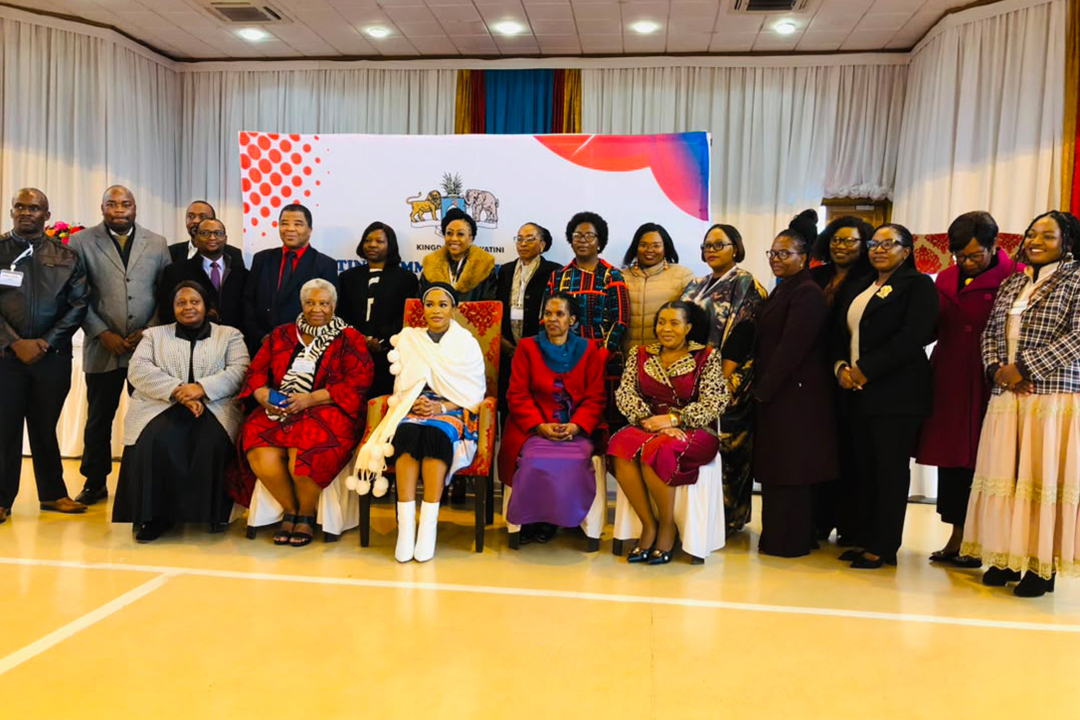
Inkhosikati LaNgangaza, who was Guest of Honour, was represented by Her Royal Highness Princess Tiyandza, who delivered her address during the gathering.

The conference, hosted by the UNESWA Department of Community Health Nursing Science together with the Ministry of Health’s Health Research and Innovation Unit, brought policymakers, researchers, healthcare practitioners, academics, students, development partners, civil society and community representatives under one roof.
Held under the theme, “Community Health as a Panacea for Universal Health Coverage in Eswatini,” the conference explored how locally generated research, stronger primary healthcare and community participation can help improve health outcomes across the country.
At the heart of the discussions was a simple but important message: healthcare should not only be available at major hospitals and clinics, but should increasingly reach families within their own communities.
Inkhosikati LaNgangaza said Universal Health Coverage must ultimately translate into every Liswati being able to access quality healthcare regardless of where they live or their economic circumstances.
“Universal Health Coverage is not merely a policy slogan,” she said.
She said the country’s journey towards health for all must begin in communities, where evidence-based interventions can identify health challenges early and provide practical solutions before illnesses become more severe.
The Inkhosikati singled out community health workers as an important link between households and the formal healthcare system.
Because they often understand the language, culture and everyday realities of the communities they serve, she said community health workers are well placed to build trust, encourage people to seek treatment and improve the use of health services.
She further placed strong emphasis on prevention, identifying immunisation, hygiene education, family planning, maternal healthcare, nutrition counselling and mental health awareness among interventions that could help prevent disease and reduce the need for costly hospital treatment.
“The real breakthrough comes when we build from the ground up – through communities that are informed, empowered and supported,” she said.
Inkhosikati LaNgangaza warned that healthcare systems relying mainly on top-down interventions would struggle to achieve universal access without meaningful involvement of communities.
“Community healthcare is not a soft option or temporary fix. It is the most powerful, equitable and sustainable strategy we have to make the right to health a lived reality for every person,” she said.
The conference also provided an opportunity to reflect on some of Eswatini’s public health gains.
Inkhosikati LaNgangaza highlighted routine immunisation coverage of 85 per cent and a reduction of more than 92 per cent in malaria cases since the early 2000s. The country has also achieved 100 per cent parasitological testing for suspected malaria cases.
On HIV, she noted that Eswatini had surpassed the UNAIDS 95-95-95 targets, with 97 per cent of people living with HIV aware of their status and 98.4 per cent achieving viral suppression.
These gains, she indicated, demonstrate what can be achieved when policy, science, healthcare systems and communities work together.
UNESWA Vice-Chancellor Professor Justice M. Thwala said locally generated research would be critical in ensuring healthcare policies and interventions respond directly to the realities facing EmaSwati.
“Evidence-based community research serves as the cornerstone for achieving sustainable Universal Health Coverage,” Thwala said.
He stressed the importance of producing research that does not remain confined to academic institutions, but instead informs programmes capable of improving people’s lives.
Representing the Minister of Health, HMIS Manager and Acting Chief of the Strategic Information Department Zanele Simelane said community health remained fundamental to Eswatini’s pursuit of Universal Health Coverage.
She further highlighted the importance of strong and data-driven health systems in ensuring services are accessible and equitable.
Beyond speeches and presentations, the conference showcased health research, innovations and community-based initiatives through exhibition stalls, which Princess Tiyandza toured.
Inkhosikati LaNgangaza called for closer cooperation between government, healthcare professionals, traditional leaders, development partners, communities, the private sector, religious organisations and academic institutions.
“Let this conference be a catalyst for action. Let it ignite new partnerships, new ideas and new commitments,” she said.
Her message was that achieving Universal Health Coverage would require more than policies and statistics. It would require communities that understand their health needs, researchers who develop practical solutions and a healthcare system capable of reaching people before they become critically ill.
“Because when communities are healthy, nations thrive. And when every community is reached, Universal Health Coverage ceases to be a slogan and becomes a truth,” Inkhosikati LaNgangaza said.
The inaugural conference therefore marked an important step towards strengthening the relationship between research, policy and the everyday health needs of EmaSwati, while positioning community-based healthcare as one of the key foundations of a healthier and more equitable Eswatini.