


BY MBONGENI NDLELA
MBABANE – Growing business confidence and increased economic activity pushed private sector credit to more than E23 billion during the first quarter of 2026, highlighting strong demand for investment and expansion opportunities.
According to the Ministry of Economic Planning and Development’s Quarterly Economic Bulletin, total private sector credit rose by 3.3 percent to E23.151 billion during the review period.
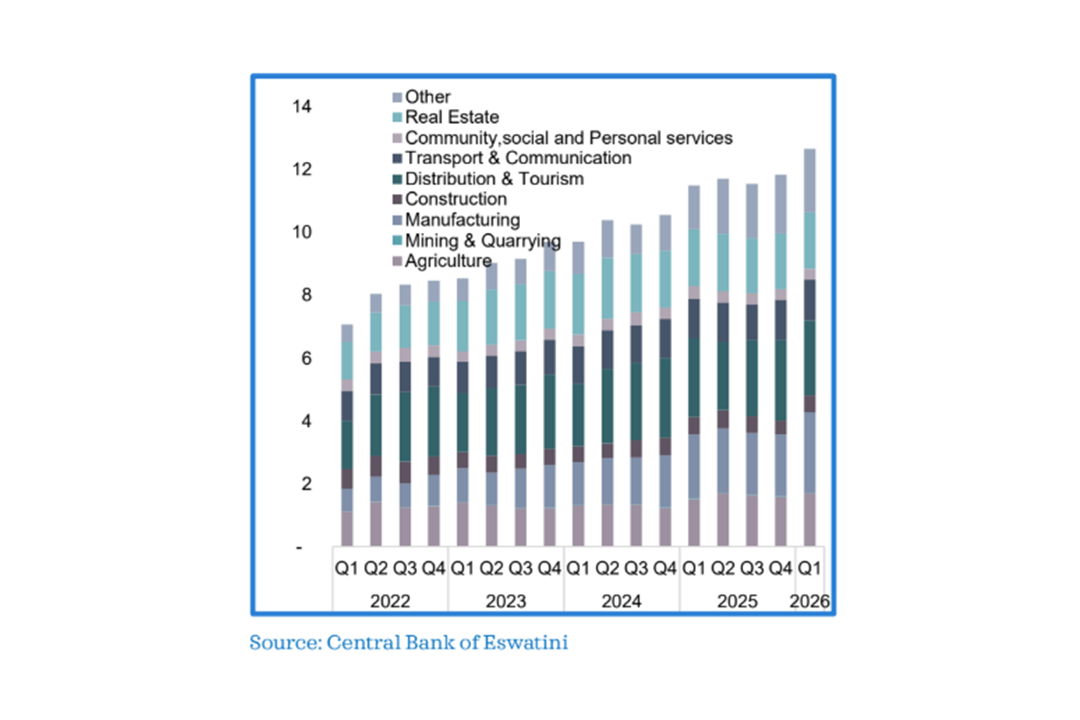
The increase was driven primarily by business borrowing, which expanded by 6.9 percent.
Credit extended to businesses reached E12.668 billion, up from E11.851 billion recorded in the previous quarter.

The report notes that strong loan uptake was recorded in manufacturing and construction, sectors that continue to play a critical role in economic growth and job creation.
Manufacturing credit increased by an impressive 30.5 percent, while construction credit rose by 22.3 percent.
Additional growth was observed in agriculture, transport and communication, community services, real estate and other business activities.
“Supported by the prevailing monetary policy environment and increased economic activity, total private sector credit grew by 3.3 percent,” the Ministry stated.
Economic experts view the growth in lending as a positive indicator of confidence among businesses.
“When businesses borrow to invest, expand production or undertake new projects, it generally signals optimism about future economic prospects,” an economist said.
The report reveals that Small and Medium Enterprises (SMEs) maintained an upward borrowing trend throughout the quarter, demonstrating increasing participation in economic activity.
Large enterprises, which account for approximately two-thirds of business credit, also strengthened their borrowing activity during the latter part of the quarter.
Credit extended to households also increased slightly, rising from E9.439 billion to E9.471 billion.
The growth in lending occurred alongside stable interest rates and moderate inflation, creating favourable conditions for borrowers.
Government and financial sector stakeholders continue to emphasise the importance of access to finance in supporting entrepreneurship, industrialisation and employment creation.
The strong performance of manufacturing and construction lending is particularly significant because both sectors generate substantial economic linkages and employment opportunities.
As businesses continue investing in productive activities, credit growth is expected to contribute positively to economic expansion in the coming quarters.
The latest figures reinforce confidence in Eswatini’s financial sector and demonstrate the willingness of businesses to pursue growth opportunities despite global economic uncertainties.
With investment activity remaining strong, the country’s private sector continues to play an important role in driving economic transformation and development.