



BY MBONGENI NDLELA
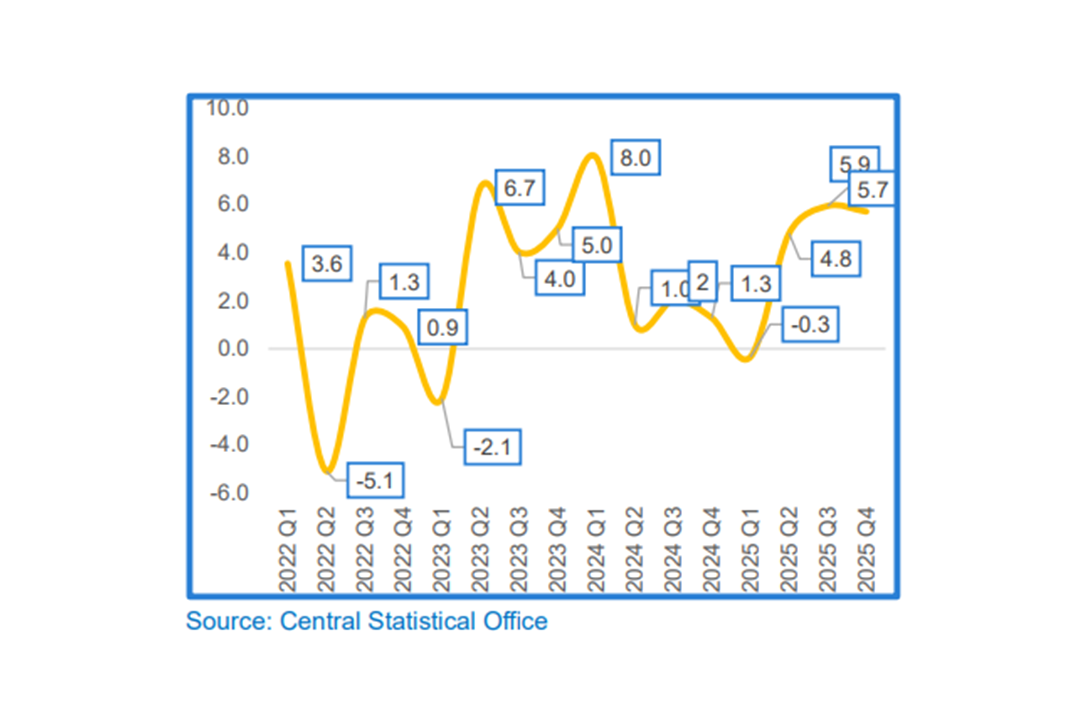
MBABANE – Eswatini’s economy continued to demonstrate resilience and growth despite a challenging international environment, recording real Gross Domestic Product (GDP) growth of 5.7 percent in the fourth quarter of 2025.
According to the Ministry of Economic Planning and Development’s Quarterly Economic Bulletin for the first quarter of 2026, the country’s economic performance remained robust across major sectors of the economy, highlighting the effectiveness of ongoing investment and development initiatives.
The report indicates that economic activity expanded by 5.7 percent on a year-on-year basis, while quarter-on-quarter growth stood at 0.3 percent. This growth was driven by positive performances in the primary, secondary and tertiary sectors.
The primary sector recorded growth of 2.6 percent, supported mainly by mining and quarrying activities, which expanded by 6 percent. Increased demand for coal in export markets and rising quarrying activities linked to public and private construction projects contributed significantly to this performance.

The construction industry emerged as one of the strongest performers, growing by 11.8 percent. Ongoing infrastructure projects across the country helped offset challenges experienced in manufacturing, electricity and water supply.
The services sector delivered the most impressive results, expanding by 9.9 percent. Information and Communication Technology (ICT) grew by 16.8 percent, while wholesale and retail trade increased by 15.5 percent.
Financial and insurance services stood out with remarkable growth of 26.5 percent.
“The domestic economy reflected resilience despite heightened uncertainty in the global environment,” the Ministry noted in the bulletin.
Economic analysts say the strong growth demonstrates increasing diversification within the economy.
“The broad-based nature of this growth is encouraging because it shows that multiple sectors are contributing to national development,” said an economic analyst familiar with the report.
The report comes at a time when the global economy faces growing uncertainty due to geopolitical tensions in the Middle East and slower growth projections in several major economies.
Despite these external challenges, Eswatini’s economy continues to benefit from strong domestic demand, investment in infrastructure and expanding services industries.
The bulletin further notes that sectors such as ICT, wholesale and retail trade, financial services and construction are becoming increasingly important drivers of economic activity.
Government continues to prioritise programmes that stimulate investment, create jobs and strengthen productive sectors.
With growth remaining significantly higher than projections for many economies across the world, the latest figures position Eswatini as one of the stronger-performing economies in the region.
The positive performance provides confidence that the country remains on a path toward sustainable economic development while creating opportunities for businesses and citizens alike.


