


BY GCWALISILE MHLABANE
MANZINI— With a growing number of EmaSwati facing uncertainty over the land beneath their homes, residents are calling for Government to act swiftly on land disputes and reported homestead demolitions that continue to leave families worried about their future.
The call was made during a civic and voter education session conducted by the Elections and Boundaries Commission (EBC) in Madonsa on August 16 2026, where residents raised concerns about land, residence, community identity and voting rights.
The engagement provided residents with an opportunity to voice concerns that extend beyond the electoral process, with questions emerging over the security of their homes and what could happen to their families should relocation become necessary.
One of the residents, Zodwa Shabangu, urged the EBC to ensure that the community’s grievances reach His Majesty King Mswati III.

“We are asking that our concerns do not end here. We want the EBC to take our grievances forward so that they can reach His Majesty and the relevant authorities,” Shabangu said.
The concerns raised in Madonsa come against the backdrop of land disputes reported in different parts of Eswatini, where families have faced uncertainty over homes they say have been occupied by their families for generations.
In some instances, families have said they believed they were living on land allocated through traditional structures and the process of kukhonta, only to later face claims that the land is privately owned and registered as farmland.
These disputes have highlighted the need for clear communication, proper documentation and meaningful engagement between Government, traditional authorities, private landowners and affected communities.
Among the cases that have drawn attention is that of the Shabangu family in KaNcesi under the Eluvinjweni Chiefdom.
The High Court ordered the demolition of Bonkhe Shabangu’s newly constructed home, reportedly valued at E500000, after ruling that the property stood on privately owned farmland. The family had maintained that the land had been allocated through the local umphakatsi.
A second family in KaNcesi also reportedly lost an E450000 home under similar circumstances, prompting calls for greater attention to the impact of land disputes on families.
At Gege Mbondzela Farm, also known as Farm 19, close to 20 people were reportedly left homeless following a dispute involving private management. Families such as the Mdlulis have maintained that their ancestors lived on the land for about a century.
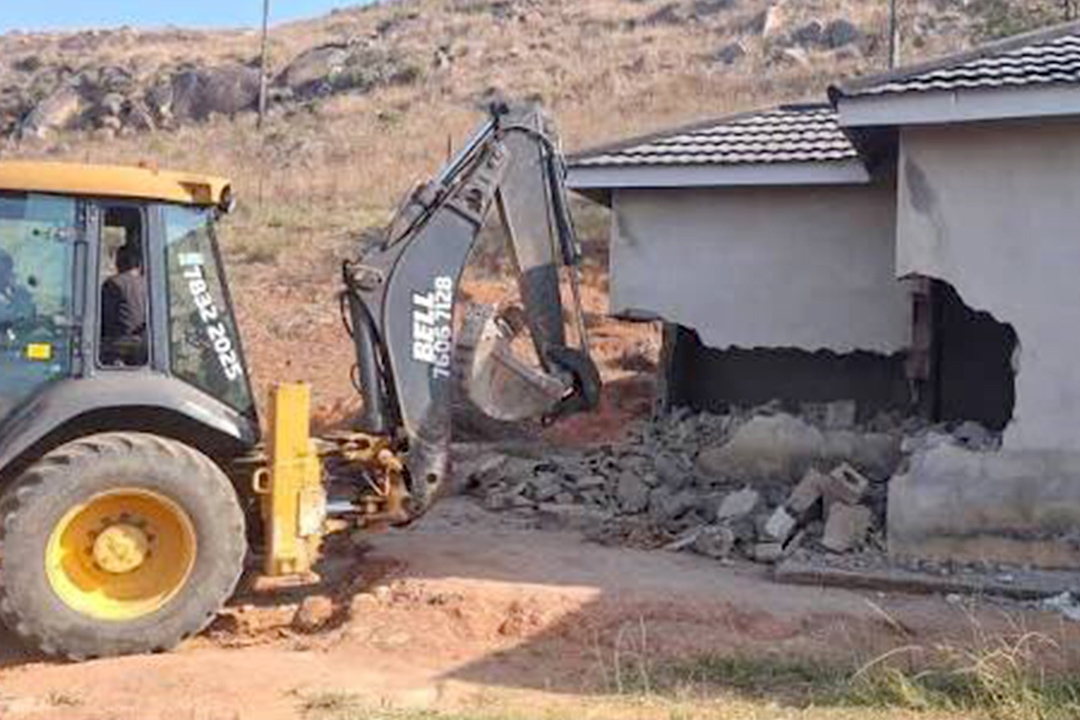
Their multi-million-emalangeni structures were reportedly brought down by tractors under armed police supervision, leaving affected residents without homes and highlighting the difficult human consequences that can accompany unresolved land disputes.
In Nkhaba Chiefdom, at least 1050 homes reportedly face potential demolition following a court ruling in favour of a private farm owner.
Roughly 1000 homesteads are believed to have been established across 278 privately registered farms within the chiefdom. Many of the affected families are understood to be descendants of herdsmen who worked for early settlers before establishing permanent homes under traditional structures.
Similar concerns have been reported in KaMbhoke, where multiple families reportedly lost ancestral homes after a private developer used a TLB tractor to flatten structures that were said to encroach on private land.
Meanwhile, more than 200 families in Moneni continue to face uncertainty as a long-running disputed land case threatens their established homesteads.
While the circumstances differ from one community to another, the cases have strengthened calls for solutions that respect lawful property rights while ensuring that affected families receive clear information, meaningful engagement and a fair opportunity to understand their circumstances.
For Madonsa residents, the land question is also closely linked to their ability to participate in future elections.
Residents questioned how possible relocation would affect their voter registration and voting locations, particularly as proof of residence is expected to become an additional requirement ahead of the 2028 elections.
They also sought clarity on which royal kraal they would belong to if they were relocated.
“The biggest concern is where we will belong and how we will continue to participate as voters if we are moved,” Shabangu said.
The concerns demonstrate that uncertainty over residence can have consequences beyond housing, potentially affecting community identity, access to services and participation in national processes.
Shabangu therefore called on the EBC to ensure that the concerns raised during the civic education session do not remain at community level.
For Madonsa residents, the preferred outcome is constructive engagement, clarity and a lasting solution that gives families certainty about their homes and future.
Their appeal is ultimately for Government and relevant authorities to act swiftly, engage affected communities and work towards peaceful solutions to land disputes before more families face the prospect of losing their homesteads.
As their grievances move beyond the EBC engagement, residents remain hopeful that their concerns will receive the attention required to create a peaceful and sustainable way forward.
#EswatiniPositiveNews #Madonsa #GovernmentAction #LandDisputes #HomesteadDemolitions #EBC #ZodwaShabangu #KingMswatiIII #LandRights #Kukhonta #VotingRights #2028Elections #CommunityDialogue #EmaSwati
(Courtesy Pic)