



BY SIFISO NHLABATSI
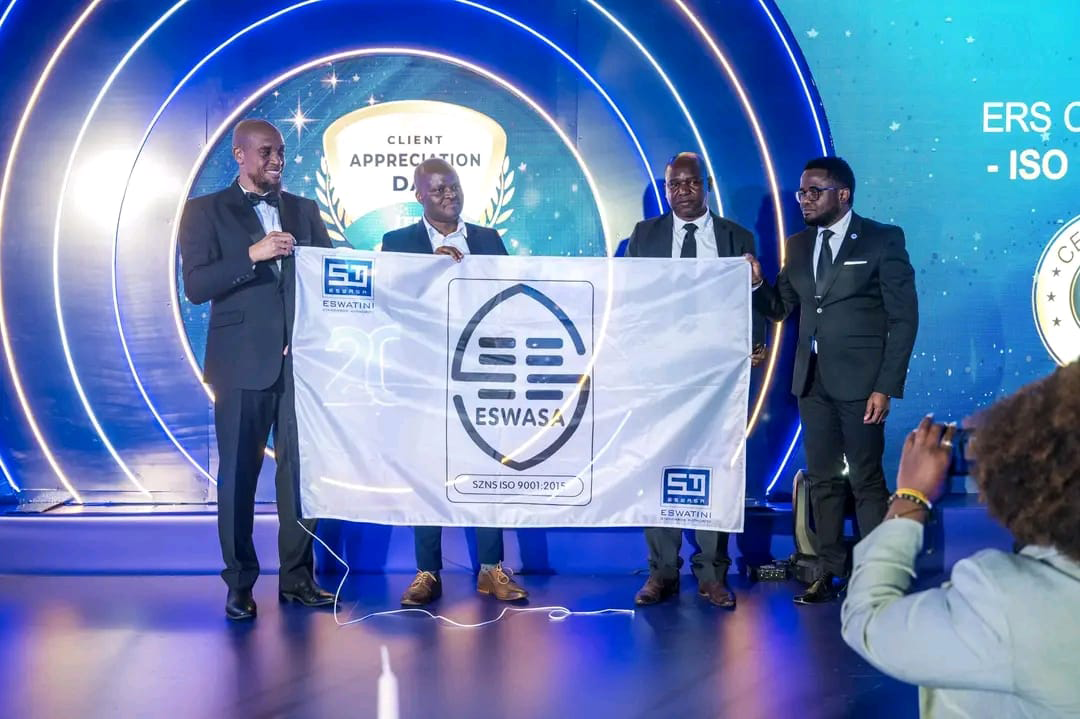
EZULWINI – The Eswatini Revenue Service (ERS) has achieved a major milestone in its drive to improve public service delivery after receiving ISO 9001 Quality Management System certification from the Eswatini Standards Authority (ESWASA), becoming one of the country’s public institutions to attain the internationally recognised standard.
During the handover ceremony held at the 4th ERS Client Appreciation Day in Ezulwini on Friday, ESWASA used the occasion to challenge State-Owned Enterprises (SOEs) and other large organisations to pursue internationally recognised certification through the local standards authority, arguing that doing so would strengthen Eswatini’s quality infrastructure while keeping expertise and investment within the country.
The certification, which is valid for three years subject to annual surveillance audits, recognises ERS for implementing a quality management system that meets the requirements of the internationally recognised ISO 9001 standard. The certification confirms that the organisation has established processes designed to deliver consistent, customer-focused services while promoting continual improvement across its operations.
Handing over the certificate, ESWASA Executive Director Ncamiso Mhlanga congratulated the revenue authority, saying the achievement was the result of dedication, disciplined implementation and commitment from leadership and staff.

Mhlanga explained that the certification process began with ESWASA providing comprehensive training to ERS officials to build awareness and understanding of ISO 9001 requirements across the organisation. However, he stressed that certification was not awarded simply because of training.
According to Mhlanga, ERS translated the standard into documented procedures, integrated quality management into its daily operations and ensured that employees at every level embraced the principles of the system before undergoing a rigorous independent assessment.
He said ESWASA subsequently conducted a two-stage audit. The first phase assessed the organisation’s readiness and documentation, while the second evaluated whether the quality management system had been effectively implemented throughout the institution.
“The certificate is earned, not handed out,” Mhlanga said, adding that ERS had successfully demonstrated compliance with all the necessary requirements.
Addressing guests, he emphasised that ISO 9001 represents far more than a framed certificate displayed in an office.
“It is a way of working,” he said, explaining that the standard promotes consistency, customer focus, proactive risk management and evidence-based decision-making.
He noted that taxpayers would ultimately benefit from faster, more efficient and reliable services as a result of the improvements embedded within ERS.
Mhlanga further said ISO 9001 creates a culture of continual improvement by encouraging organisations to constantly evaluate their performance, correct shortcomings and seek better ways of serving customers.
While celebrating ERS’s achievement, the ESWASA Executive Director used the platform to issue a direct challenge to other State-Owned Enterprises and large organisations.
He said the successful certification of an institution as large and complex as the Eswatini Revenue Service demonstrated that ESWASA possesses the technical capacity to certify major organisations against internationally recognised standards.
Mhlanga urged public institutions to examine their internal systems and service delivery processes and consider ESWASA as their preferred certification partner.
He argued that relying on foreign certification bodies unnecessarily exports scarce foreign currency while increasing costs associated with international travel and logistics.
According to Mhlanga, using ESWASA enables institutions to retain financial resources within Eswatini, strengthen local technical expertise and contribute towards building a stronger national quality infrastructure.
He described supporting ESWASA as an investment in the country’s long-term economic development and competitiveness, particularly as Eswatini seeks to grow exports and improve institutional performance.
Turning his attention back to ERS, Mhlanga reminded the organisation that certification marked the beginning rather than the end of its quality journey.
He encouraged the revenue authority to maintain compliance during annual surveillance audits and continue embracing the values underpinning ISO 9001, including integrity, consistency, customer focus and operational excellence.
He also highlighted that ESWASA offers certification and training in several other internationally recognised management systems, including ISO 31000 for risk management, ISO 45001 for occupational health and safety, and ISO 14001 for environmental management systems.
Mhlanga noted that effective risk management remains particularly important for an institution entrusted with collecting national revenue and assured ERS that ESWASA stood ready to support its future quality improvement initiatives.
The certification was presented during the 4th ERS Client Appreciation Day, held under the theme “Honouring Clients Who Build Eswatini.” The annual event recognises compliant taxpayers and stakeholders whose contributions support national development through responsible tax compliance.
#ERS #ESWASA #ISO9001 #QualityManagement #ClientAppreciationDay2026 #ServiceExcellence #StateOwnedEnterprises #PublicService #TaxAdministration #Eswatini #GoodGovernance #ContinuousImprovement #HonouringClientsWhoBuildEswatini


