



BY SIFISO NHLABATSI
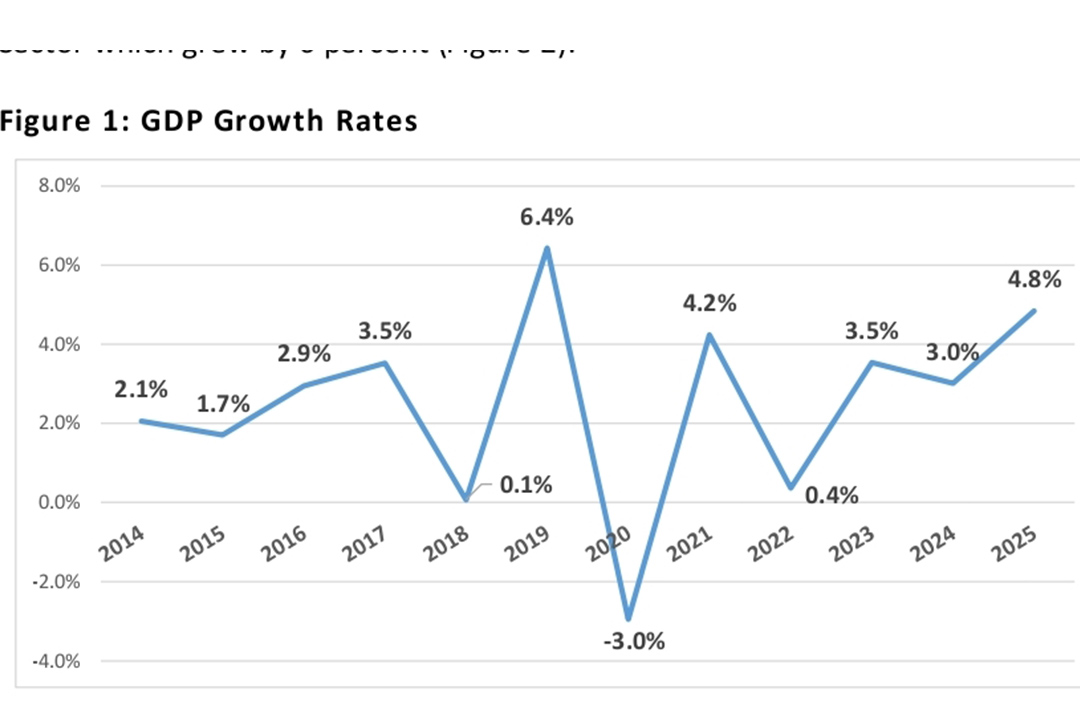
MBABANE- Eswatini’s economy expanded by 4.8 per cent in 2025, accelerating significantly from the 3.0 per cent growth recorded in 2024, with the country’s Gross Domestic Product (GDP) reaching E96.618 billion.
According to the 2025 GDP Annual Estimates released by the Central Statistical Office (CSO), the positive economic performance was largely driven by the strong performance of the tertiary sector, which grew by six per cent during the year.
The latest figures point to a stronger pace of economic activity across the Kingdom, with the improvement in real GDP growth reflecting increased production of goods and services.
Presenting the 2025 GDP estimates, CSO Director of Statistics Thembinkosi Shabalala said GDP measures the monetary value of all final goods and services produced within the country’s borders during a given period.
He said the annual estimates were compiled in line with the internationally recognised 2008 System of National Accounts (SNA), providing a comprehensive framework for measuring economic activity.
“The Gross Domestic Product (GDP) for the year 2025 stands at E96.6 billion. The Real GDP grew by 4.8 percent compared to a growth of 3.0 percent realised in 2024,” said Shabalala.
He attributed the growth mainly to the tertiary sector, which recorded a six per cent expansion.
The tertiary sector covers a broad range of service-based economic activities, making its strong performance an important contributor to the overall expansion of the economy.
Manufacturing remained the largest contributor to Eswatini’s GDP in 2025, accounting for 28.8 per cent of total economic output.
It was followed by wholesale and retail trade, which contributed 15.5 per cent, while public administration and defence accounted for eight per cent.
Agriculture and forestry also remained an important contributor to the economy, accounting for seven per cent of GDP.
The figures demonstrate the continued importance of both productive industries and services to the Kingdom’s economic performance.
At the lower end of the industry contribution scale were arts, entertainment and recreation at 0.2 per cent and activities auxiliary to financial services at 0.4 per cent.
The expenditure approach to GDP also showed positive movement in private consumption expenditure during 2025.
According to the CSO, private consumption expenditure increased by 2.9 per cent during the year, indicating an increase in spending by households and non-profit institutions serving households.
However, general government final consumption expenditure recorded a marginal decline of 0.1 per cent, while gross fixed capital formation contracted by 18.2 per cent.
The CSO noted that negative net exports contributed to a higher positive statistical discrepancy at current prices, reflecting differences between the production and expenditure approaches used to compile GDP.
Meanwhile, the 2024 preliminary GDP estimate was revised upwards by 0.01 per cent, with the tertiary sector recording the most significant revision of 1.35 per cent due to changes in source data.
Shabalala emphasised the importance of accurate and consistent data in informing policy formulation and decision-making.
He said revisions to national accounts are necessary when new source data becomes available, existing data is revised or new methodologies are introduced.
The CSO said the revisions are undertaken systematically and transparently to maintain the quality and integrity of national accounts.
The latest GDP figures present a positive picture of Eswatini’s economic trajectory, with the acceleration from 3.0 per cent growth in 2024 to 4.8 per cent in 2025 marking a notable improvement in the country’s real economic performance.
The next major GDP publication is expected on September 28, 2026, when the CSO will release the second-quarter GDP estimates for 2026.
#EswatiniEconomy #GDP2025 #EconomicGrowth #Eswatini #EconomicGrowth2025 #GrossDomesticProduct #CSOEswatini #TertiarySector #Manufacturing #EconomicDevelopment #Growth #EswatiniEconomy
(Courtesy Pic)