


BY KING’S OFFICE CORRESPONDENTS
CAPE TOWN, SOUTH AFRICA – The reimagined SACU industrialisation initiative, originally launched at the 2023 Summit hosted by the Kingdom of Eswatini, received renewed attention at the 9th Summit of SACU Heads of State and Government.
The initiative, launched in the Kingdom in August 2023, focuses on key governance issues, industrialisation, a regional export strategy, financing mechanisms, and management of the common external tariff.
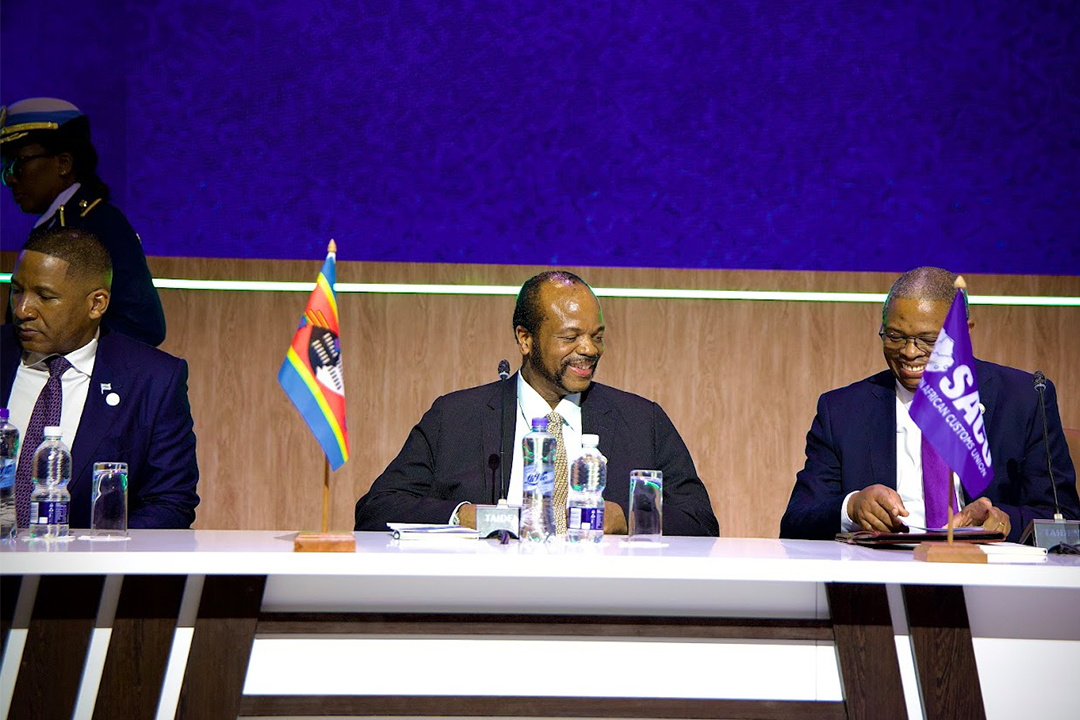
In his address to the high-level gathering, which included His Majesty the King, South African President Cyril Ramaphosa as Chairperson, and other Heads of State and Government, SACU Executive Secretary Dumsani Masilela highlighted the initiative’s central role in driving the region’s industrial agenda amid global economic shifts.
While acknowledging that efforts at Council and Commission level have left the region behind schedule on some aspects, Masilela expressed optimism that Heads of State and Government would provide strategic guidance to accelerate implementation.

At the heart of the initiative is the goal of broadening the region’s industrial base to fully exploit opportunities presented by the African Continental Free Trade Area (AfCFTA) and evolving global trade dynamics.
The AfCFTA, a flagship project of ‘The Africa We Want’, targets a massive single market of 55 countries, an estimated 1.4 billion consumers, and a combined GDP exceeding US$3.4 trillion – roughly E56.1 trillion at current exchange rates.
“South Africa has placed the implementation of the AfCFTA high among its priorities,” Masilela said, urging the private sector across the region to seize the moment. He explained that a regional approach to industrialisation would not only expand production capacity but also promote deeper integration and inclusivity, ensuring benefits reach all member states, including Eswatini.
The Summit was informed that significant achievements have been recorded since the adoption of the SACU Strategic Plan in June 2022, which underpins the reimagined initiative. These include the completion of a value-chain mapping exercise and the convening of round tables on priority sectors such as agro-processing, fruits and vegetables, meat and meat products, textiles and clothing, cosmetics, and essential oils.
Ongoing work encompasses a developmental approach in the pharmaceutical sector and value-chain mapping for fertilisers, other chemicals, and seed production. These efforts aim to enhance sustainable agricultural production, strengthen food security, and foster strategic cross-border collaborations among member states.
Recognising the strategic importance of the automotive and critical minerals beneficiation sectors, the SACU Council reportedly agreed in December 2024 to fast-track their advancement through smart specialisation strategies. A broader SACU industrialisation strategy is also being developed to set clear milestones, expected outcomes, and a framework for cross-border value chains.
Complementing these industrialisation efforts, Masilela said the SACU Trade Facilitation and Logistics Programme has delivered notable results in modernising cross-border trade. Key milestones include the interoperability of customs management systems, automated exchange of customs data, and improved visibility of transactions, which have enhanced efficiency and risk management.
The Executive Secretary noted that SACU has conducted successful joint enforcement operations against illicit trade, protecting revenue and consumers, while more than 1,000 traders have been registered under the Authorised Economic Operator Programme. Pilots for mutual recognition arrangements are strengthening supply chain security while facilitating legitimate trade.
Masilela noted that intensified efforts are still required to integrate other government agencies into the trade facilitation agenda. The revised programme adopts a coordinated border management approach, with a strong emphasis on infrastructure development, including one-stop border posts, single-window systems, and the rehabilitation of critical roads.
He said a seamless, non-stop border trade environment is under exploration, with clearer policy direction expected by the end of the 2026/27 financial year.
Furthermore, digital transformation frameworks and tools to address sanitary and phytosanitary measures, technical barriers to trade, and non-tariff barriers are also advancing, aimed at reducing obstacles and improving competitiveness.
Masilela added that a mid-term review of the 2022–2027 Strategic Plan, completed in April, indicates that the region remains broadly on track despite challenges, particularly the availability of financial resources for programmes and infrastructure. To this end, he said, the Council extended the Strategic Plan to 2029 to allow the completion of outstanding work.
Masilela conveyed gratitude to President Ramaphosa and the South African Government for their leadership during the chairmanship and reaffirmed the Secretariat’s commitment to supporting member states.