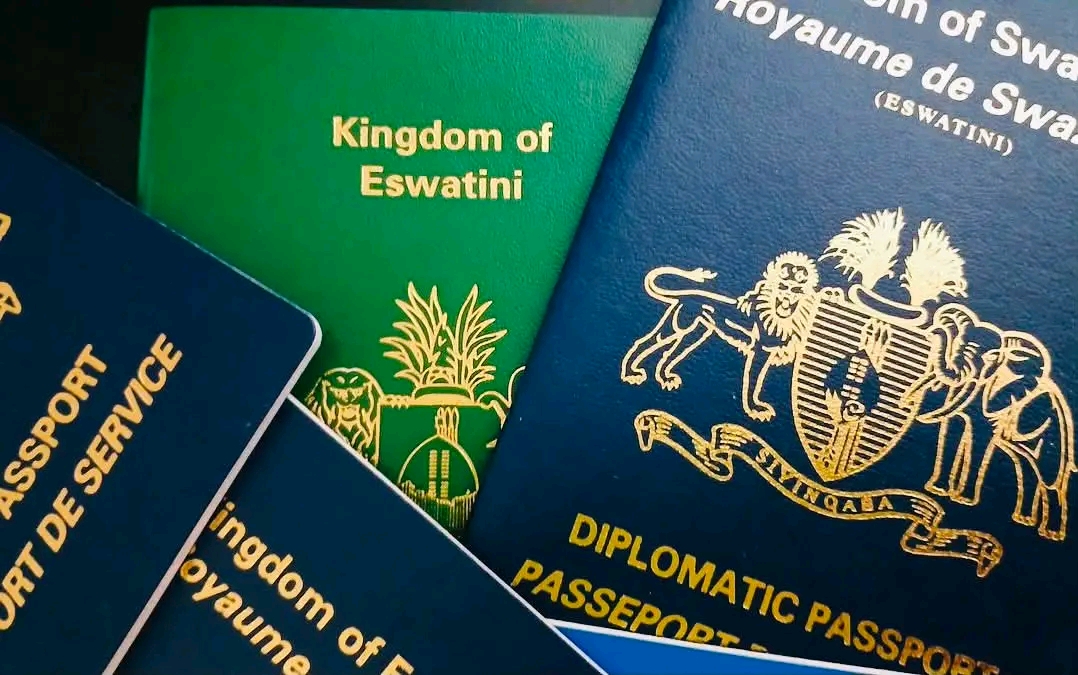




BY MBONGENI NDLELA
MBABANE – The Eswatini passport has secured a place among Africa’s top 10 passports, ranking eighth on the continent and giving emaSwati access to 78 destinations without first having to obtain a traditional visa.
The latest passport ranking data places Eswatini eighth among 54 African passports and 115th globally, giving the Kingdom a mobility score of 78.
For ordinary emaSwati, the ranking means greater travel convenience when visiting dozens of countries for tourism, business, family visits and other purposes, although entry requirements and permitted lengths of stay differ from one destination to another.
The 78 destinations include countries where Eswatini passport holders can enter visa-free, obtain permission on arrival or use an electronic travel authorisation instead of going through the conventional visa application process before travelling.
According to the report, Eswatini passport holders currently enjoy completely visa-free entry to 41 destinations, while another 30 destinations allow entry through visa-on-arrival or similar simplified arrival arrangements.

A further seven destinations can be accessed through electronic travel authorisation systems.
However, emaSwati still require traditional visas before travelling to another 120 destinations.
Overall, the Eswatini passport provides access to 39.4 per cent of the destinations assessed in the report.
CARIBBEAN LEADS IN ACCESS
The Caribbean emerges as one of the easiest parts of the world for emaSwati to visit.
According to the report, Eswatini passport holders have access to 93.8 per cent of Caribbean destinations covered in the ranking.
Of these, 13 destinations are visa-free, one can be entered through an arrival-based arrangement and another uses electronic travel authorisation.
Africa is the second most accessible region for Eswatini passport holders, with overall access standing at 66 per cent.
Within Africa, emaSwati can enter 17 destinations visa-free, 15 through arrival-based arrangements and another three through electronic travel authorisation.
Eighteen African destinations still require an advance visa.
The figures underline the relatively strong mobility Eswatini passport holders enjoy within the continent at a time when easier movement across borders can support tourism, trade, cultural exchange and people-to-people connections.
UP TO 180 DAYS WITHOUT VISA
Some destinations allow emaSwati surprisingly lengthy stays without requiring a traditional visa.
Antigua and Barbuda, Barbados and Dominica are listed as allowing visa-free stays of up to 180 days.
Fiji and Vanuatu allow stays of up to 120 days.
Countries listed with visa-free stays of up to 90 days include Botswana, Kenya, Malawi, Mauritius, Namibia, Tanzania, Uganda, Zambia and Zimbabwe, among others.
South Africa, one of Eswatini’s most important neighbouring travel destinations, is among the countries listed as allowing Eswatini passport holders to stay for up to 30 days without a visa.
The Philippines, Micronesia and Rwanda are also listed among destinations offering 30-day visa-free stays.
Malaysia and Singapore are listed as visa-free destinations but require travellers to complete an arrival card, while Suriname requires a tourist card.
SEVEN DESTINATIONS USE ELECTRONIC AUTHORISATION
The growing use of digital travel systems is also reflected in the report.
Seven destinations are listed as accessible to Eswatini passport holders through electronic travel authorisation.
These include Côte d’Ivoire, Ghana, South Korea, Saint Kitts and Nevis, Seychelles, Sri Lanka and Israel.
The permitted stays differ by destination, ranging from 30 days in countries such as South Korea and Sri Lanka to 90 days in Côte d’Ivoire, Saint Kitts and Nevis, Seychelles and Israel.
Ghana is listed with a period of up to 60 days.
Another 30 destinations fall under arrival-based arrangements, including countries where electronic visas are also available.
These include Burundi, Djibouti, Ethiopia, Gabon, Guinea, South Sudan, India, Cambodia, the Democratic Republic of the Congo, Madagascar, Mauritania, Nigeria, Sierra Leone, Vietnam and Jordan.
Russia is also listed under this category, with an eVisa option and a stay of up to 30 days.
EUROPE REMAINS MOST RESTRICTIVE
While the passport performs strongly in Africa and the Caribbean, travelling to Europe remains considerably more restrictive for emaSwati.
The report puts Eswatini’s overall access to Europe at only 4.3 per cent.
Only one European destination covered in the report is listed as visa-free and one uses an arrival-based arrangement, while 45 require Eswatini passport holders to secure visas before travelling.
Access stands at 57.1 per cent in Oceania, 56.5 per cent in North America, 33.3 per cent in South America and 32 per cent in Asia.
The Middle East records 17.6 per cent access.
The Gulf countries and Central Asia remain the toughest regions covered by the report, recording zero per cent access without an advance visa.
All six Gulf destinations and all five Central Asian destinations assessed require emaSwati to obtain visas before travelling.
ESWATINI ALSO EIGHTH AMONG AU COUNTRIES
Beyond the overall passport mobility ranking, the report also places Eswatini eighth among the 54 African Union countries.
The Kingdom ranks 38th among 56 Commonwealth countries and 63rd among 132 G77 countries.
It is also ranked 107th among 159 World Trade Organisation members.
In a separate welcoming ranking, which measures how easily foreign passport holders can enter a country, Eswatini is placed 88th among 199 countries.
The Kingdom also ranks 40th among 60 English-language countries and fifth among five absolute monarchies assessed in the report.
The report further highlights differences in reciprocal travel arrangements.
Citizens of countries such as Germany, the United States, the United Kingdom, France, Japan, Canada, Australia and New Zealand can enter Eswatini through visa-free or simplified arrangements, while Eswatini passport holders require visas for travel in the opposite direction.
Other countries reflect the reverse situation, where their citizens require visas to enter Eswatini but Eswatini passport holders enjoy visa-free, electronic or arrival-based entry into those destinations.
The report stresses that these arrangements reflect different entry policies between countries and does not provide reasons for the differences.
Taken together, the ranking places Eswatini firmly among Africa’s top 10 passports, with access to 78 destinations and especially strong travel opportunities across Africa and the Caribbean.
For emaSwati with plans to explore new markets, visit family, conduct business or simply see more of the world, the figures point to a passport that offers meaningful international mobility, while also showing where traditional visa barriers remain.
(Courtesy Pic)