


BY TANDZILE DLAMINI
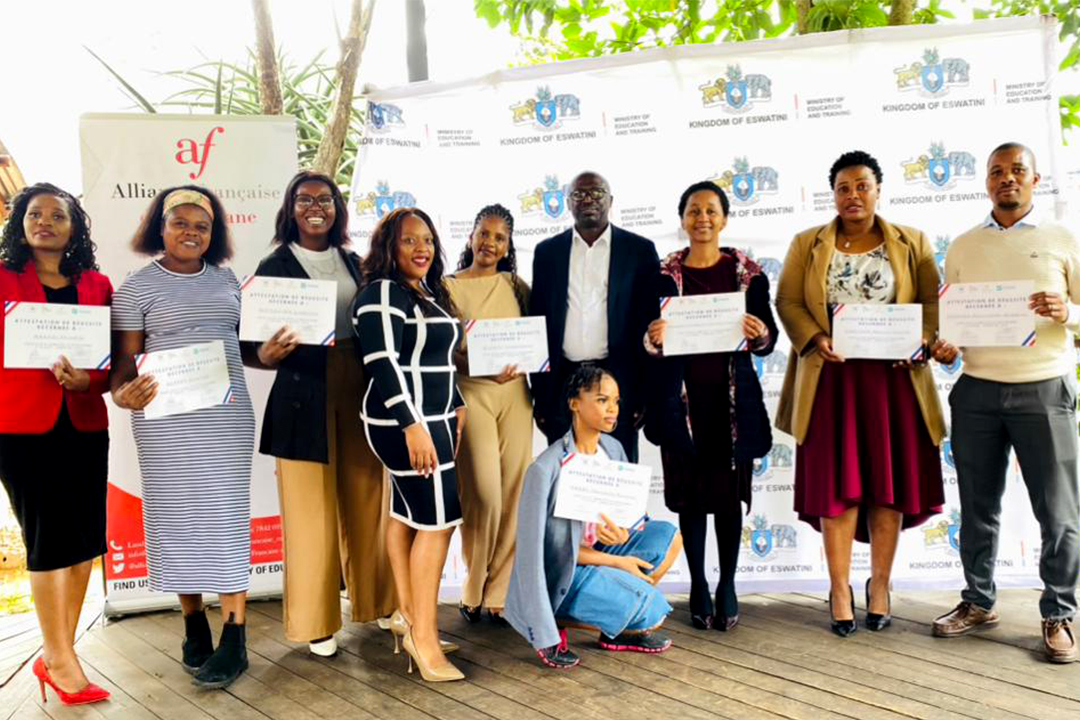
MBABANE– Eswatini has proudly carved its name into Africa’s education history after 15 outstanding teachers became the first on the continent to graduate from the prestigious Institut Français (IF) Classe programme.
The landmark graduation took place on Wednesday, 10 December 2025 at the Alliance Française de Mbabane, marking a powerful leap forward for French language education and professional teaching standards in the Kingdom.
Drawn from schools across all four regions of Eswatini – from St Michael’s Primary School in Manzini to Lubombo Central High School – the pioneering educators completed months of intensive training in advanced language mastery, modern teaching methods and learner-centred pedagogy. They now return to their classrooms fully equipped to transform how French is taught and learned, bringing renewed energy, creativity and global relevance to their lessons.
The graduation ceremony brought together key national and international stakeholders, including Principal Secretary for the Ministry of Education and Training Naniki Mnisi, French inspectors, and development partners, reflecting the significance of this achievement for the country’s education sector.

PS Mnisi hailed the IF Classe programme as far more than a training initiative, describing it as a strategic investment in the quality of teaching and learning in Eswatini’s schools. “By strengthening teacher capacity, the IF Classe programme contributes directly to building a skilled, competitive and globally connected workforce,” she said.
She emphasised that the initiative aligns perfectly with Eswatini’s national development goals and the global commitment to Sustainable Development Goal 4: Quality Education. The enhanced skills gained by the teachers, she noted, will prepare learners for new regional and international opportunities in higher education, tourism, diplomacy and global trade.
For the graduates themselves, the programme has been a deeply transformative journey. Temalangeni Dlamini from Assemblies of God Primary School shared how the training boosted her professional confidence and classroom effectiveness. “I am now able to apply learner-centred techniques in my classes, ensuring students are actively engaged,” she said, adding that her speaking, writing and classroom management skills had all improved significantly.
Lindelwa Matsenjwa from St Michael’s Primary School highlighted the importance of digital skills gained during the programme. She said the training introduced her to modern educational technologies, including the responsible use of artificial intelligence for lesson planning and interactive learning sessions. “These tools have made teaching French more interactive and aligned with global best practices,” she explained, demonstrating how Eswatini’s classrooms are keeping pace with international innovation.
The success of the IF Classe initiative reflects the strength of collaboration between the Ministry of Education, the French Embassy and the Alliance Française. PS Mnisi commended these partnerships, pointing to earlier successful programmes such as the FSPI Project and the Language Assistant Programme as evidence of long-standing cooperation in strengthening language education.
Looking ahead, she announced the launch of the FEF Project in January 2026, which will train 40 more Emaswati French teachers, ensuring that the impact of the IF Classe programme continues to grow nationwide.
As Eswatini prepares to roll out the four-year secondary education programme and transition fully to Competency-Based Education (CBE) in 2026, PS Mnisi said the IF Classe programme provides a powerful blueprint for future teacher development. “The momentum we have built through this initiative must continue as we strengthen teaching and learning across all subjects,” she said.
Senior Inspector for French, Annelisa Stoffels, echoed these sentiments, describing the programme as a key investment in human capital development that directly supports the Ministry’s mandate for continuous professional growth among educators.
The graduation of the 15 IF Classe teachers represents more than an academic achievement. It is a national statement of intent – that Eswatini is committed to producing globally competent learners through innovative, high-quality education. As these teachers return to their schools, they carry with them not only new skills, but the responsibility of shaping a generation ready to thrive in a connected world.