
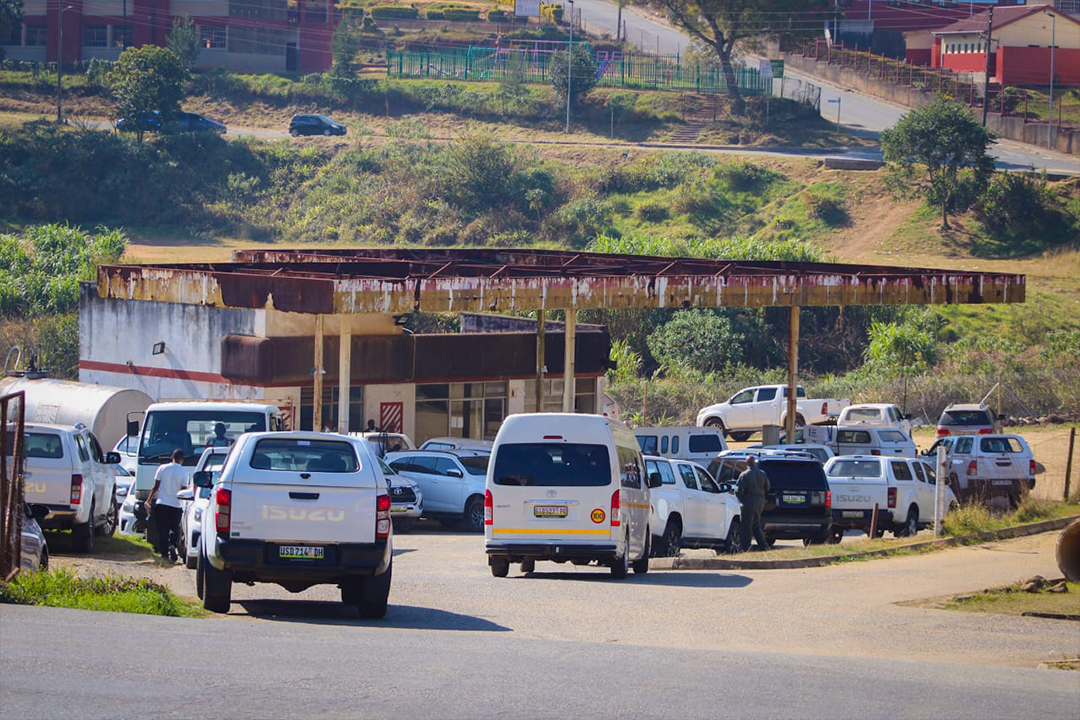




- Fuel Management System tracks every litre dispensed in real time
- New vehicle tagging targets coupon fraud and unauthorised trips
BY MFANUFIKILE KHATHWANE
MBABANE – After years of fuel coupon fraud, unauthorised trips and rampant abuse of government vehicles that cost taxpayers millions of emalangeni, Government has launched the Fuel Management System, a real-time vehicle monitoring platform designed to ensure every litre of fuel dispensed is tracked and accounted for.
This was revealed by General Transport Manager, Mduduzi Lukhele, on July 6,2026 during an interview with Eswatini Positive News.
Years of abuse prompted action
The introduction of the Fuel Management System follows years of concern over the abuse of government fuel resources under the previous manual fuel distribution system.

Before the new technology was introduced, government relied largely on fuel coupons and manual reconciliation of fuel consumption. While ministries were allocated fuel for official duties, the system made it difficult for the Central Transport Administration (CTA) to monitor vehicle movements and fuel usage in real time.
This created loopholes that allowed some civil servants to abuse the system by making unauthorised trips, manipulating fuel coupons and drawing fuel beyond operational requirements.
Parliamentary investigations and audits uncovered shocking cases of abuse. In one instance, an Isuzu 4×4 reportedly consumed more than 600 litres of diesel in a single day before recording another 743 litres the following day.
Investigations also revealed that some civil servants fuelled government vehicles up to four times in a single day using fuel coupons obtained from different ministries.
Another widely reported case involved vehicles assigned to the Ministry of Education allegedly being fuelled several times in one day using coupons from multiple ministries, forcing the ministry to launch an internal investigation.
The Government Vehicle Inspectorate Division (Anti-Abuse Unit), despite operating with limited resources, also caught 89 civil servants illegally using government vehicles, most of them involving light motor vehicles.
The fraudulent practices increased government’s operational costs, with public funds being used to cover unnecessary fuel expenditure instead of financing essential public services.
Why Government introduced the new system
Government introduced the Fuel Management System as part of its commitment to prudent management of public resources.
He said the previous manual processes limited the CTA’s ability to monitor fuel consumption as it happened and made it difficult to match fuel usage with actual vehicle activity.
“The system allows Government to monitor both government vehicles and fuel expenditure in real time, ensuring that fuel allocated to every vehicle is used strictly according to its operational needs,” he said.
How the Fuel Management System works
Under the new arrangement, every government vehicle is fitted with an electronic tag linked directly to the Fuel Management System.
Each tag corresponds to the specific litres allocated to that vehicle based on its approved usage patterns.
Fuel can therefore only be dispensed according to that allocation, preventing vehicles from receiving fuel beyond authorised limits.
Unlike the previous system, where irregularities were often discovered long after fuel had been consumed, the new technology enables CTA officials to monitor transactions as they occur.
This allows officers to quickly identify vehicles consuming unusually high amounts of fuel, those that are underutilised and any suspicious activity requiring investigation.
The system also reduces the administrative burden associated with manual fuel logs and reconciliation.
Who will be covered
Lukhele said the Fuel Management System will cover all government vehicles managed by the CTA.
These include vehicles assigned to government ministries, departments and agencies whose transport services fall under the CTA’s fleet management mandate.
The rollout is being coordinated centrally to ensure every eligible government vehicle is tagged and monitored using the same system.
Boosting accountability and transparency
According to Lukhele, the system creates a complete and traceable record of every litre of fuel dispensed. Every fuel transaction is linked directly to a specific vehicle, making it easier to compare fuel consumed with the vehicle’s approved allocation and operational requirements.
He said this significantly strengthens accountability, improves transparency and leaves little room for unexplained or excessive fuel consumption.
Government expects savings
Government believes the Fuel Management System will reduce fuel wastage, eliminate opportunities for fuel coupon fraud, improve fleet management and ensure taxpayers’ money is spent more efficiently.
The initiative also forms part of broader efforts by the CTA, working alongside the Public Accounts Committee (PAC), to strengthen oversight of government vehicles, reduce unauthorised vehicle use and protect public resources from abuse.
#GovernmentFuelManagement #FuelManagementSystem #EswatiniGovernment #MinistryOfPublicWorks #CentralTransportAdministration #CTA #FuelFraud #GovernmentVehicles #PublicFunds


