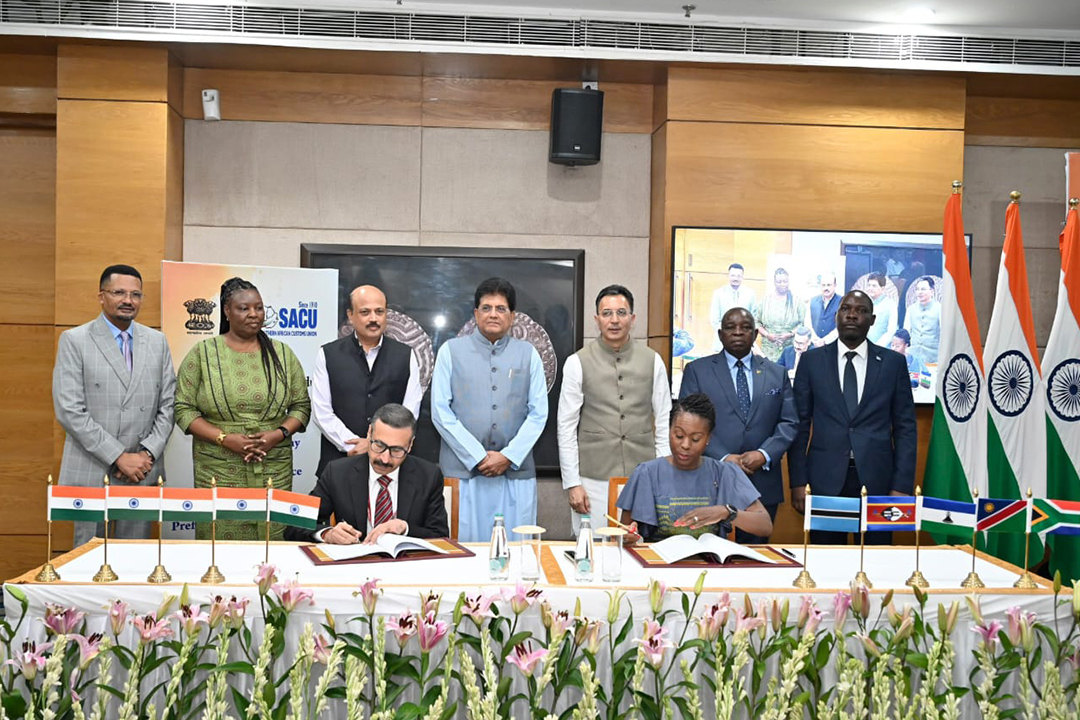



…Eswatini took part in signing of ToRs which occured yesterday, August 12
BY THEMBA ZWANE
MBABANE– India and the Southern African Customs Union (SACU), which includes Eswatini, have signed the Terms of Reference (ToRs) to pave the way for negotiations on a Preferential Trade Agreement (PTA), opening a new chapter in trade relations between India and the five SACU member states.
The agreement brings Eswatini, South Africa, Botswana, Lesotho and Namibia into a formal negotiating framework with India, with negotiations expected to commence within one month of the signing and conclude within one year.
The ToRs serve as the negotiating mandate and roadmap, setting out the broad parameters within which the countries will negotiate the proposed trade pact.

India’s Commerce and Industry Minister Piyush Goyal attended the signing, according to India’s Commerce Ministry.
The development could create new opportunities for Eswatini exporters and businesses as the proposed agreement seeks to provide duty concessions on goods traded between India and SACU member states, potentially boosting two-way commerce.
Eswatini is one of the five countries making up SACU, alongside South Africa, Botswana, Lesotho and Namibia. The customs union provides its members with a common external tariff and facilitates trade among the member states.
The move follows renewed efforts by India and SACU to establish a preferential trade arrangement. The two sides previously held negotiations for a proposed agreement in 2008, but the talks stalled over market-access issues.
South Africa remains India’s largest trading partner within SACU. Bilateral trade between India and South Africa declined by 13.55 per cent to US$15.56 billion in 2025-26 from US$18 billion in 2024-25.
Indian exports to South Africa include vehicles and components, transport equipment, pharmaceuticals, engineering goods, footwear, chemicals, textiles, rice, gems and jewellery, while major imports include gold, coal, copper ores, phosphoric acid, manganese ore and aluminium.
For Eswatini, the proposed PTA represents an opportunity to strengthen access to the Indian market and potentially attract greater trade and investment cooperation between the Kingdom and one of the world’s major economies.
The negotiations will be conducted at SACU level, meaning Eswatini will participate alongside the other four member states in determining the terms of the proposed agreement.
The development comes as India also deepens its individual trade and economic engagement with other African countries.
India and Namibia recently held discussions on expanding bilateral trade beyond raw materials and increasing value addition. The two countries also identified cooperation in critical minerals, railways, renewable energy, battery storage, green hydrogen, biofuels and desalination.
The India-Namibia Joint Trade Committee also agreed to establish a dedicated Services Working Group, while cooperation was identified in lithium, graphite, copper, cobalt and rare earth elements.
India’s Commerce Ministry said bilateral merchandise trade with Namibia increased to US$592.94 million in 2025-26 from US$568.40 million in 2024-25.
The signing of the SACU-India ToRs now formally sets the stage for negotiations that could reshape trade opportunities between India and Eswatini, together with the wider SACU market.
#Eswatini #India #SACU #Trade #TradeAgreement #PreferentialTradeAgreement #EconomicDiplomacy #InternationalTrade #EswatiniBusiness #Investment #Exports #Imports #AfricaIndiaRelations
(Courtesy Pic)