


BY MBONGENI NDLELA
NEW YORK, USA – War does not only take lives. It destroys roads, scares away investment, interrupts trade, raises the cost of living and consumes resources that could have built schools, hospitals and industries.
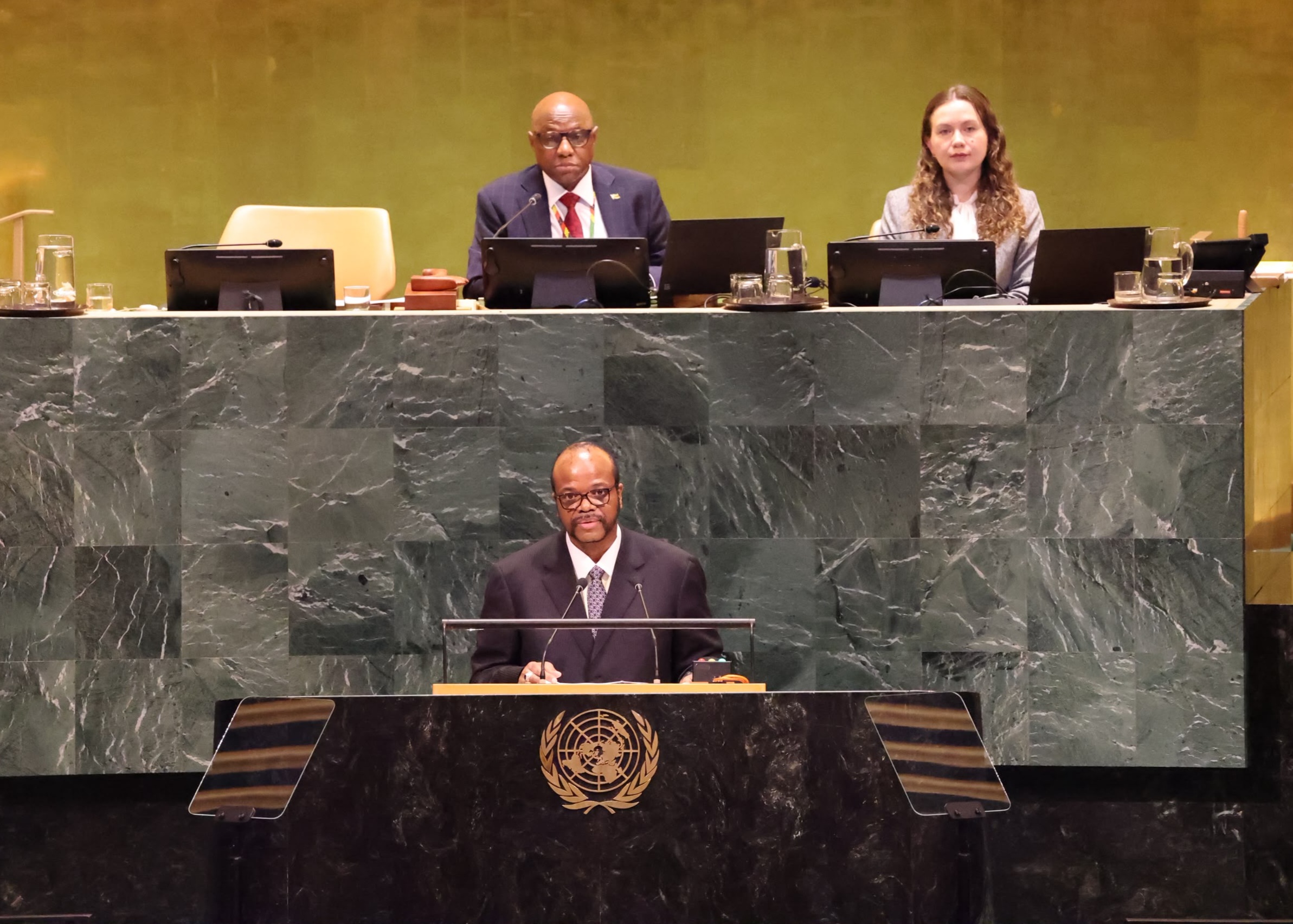
That was the wider economic and human argument advanced by His Majesty King Mswati III when he addressed the 81st Session of the United Nations General Assembly yesterday night, where he called for diplomacy and political dialogue to remain at the centre of efforts to end conflicts across the world.
In one of the strongest passages of his address, the King reduced the connection between peace and development to three short statements.
“Where there is war, development is reversed. Where there is instability, investment withdraws. Where there is fear, human potential is lost,” His Majesty said.

The King said Eswatini remained deeply concerned about continuing wars, armed conflicts and humanitarian crises affecting different regions.
Beyond the immediate loss of life and displacement of communities, he warned that conflict imposed economic costs that were eventually felt well beyond the countries where fighting was taking place.
He said wars diverted money needed for development into military expenditure, pushed up energy and transportation costs, disrupted global supply chains and worsened cost-of-living pressures.
His Majesty therefore called for diplomatic and political solutions, arguing that battlefield outcomes alone could not produce the durable peace required for development.
“Only through dialogue can sustainable peace be established,” he said.
The King said the United Nations should remain the institution where dialogue was always possible, even at moments of deep disagreement.
“The United Nations must remain the place where the door to dialogue never closes,” he said.
His Majesty also placed particular emphasis on African-led peace processes.
He said instability on the continent demonstrated the need to strengthen regional organisations so they could prevent conflict, mediate disputes and help build sustainable peace.
The message carries added regional significance following Eswatini’s assumption of the chairmanship of the Southern African Development Community Organ on Politics, Defence and Security Cooperation.
The King said Eswatini would use that responsibility to work with member states on preventative diplomacy, dialogue and mediation.
He linked the Organ’s work directly to SADC’s long-term development ambitions, saying Southern Africa could not achieve its Vision 2050 without peace and stability.
“We believe that for SADC to attain its Vision 2050, we have to create a peaceful, competitive and industrialised region that guarantees sustainable well-being and freedom for all our citizens,” he said.
His Majesty also referred to the African Union’s Agenda 2063 and the ambition to silence the guns, while raising concern about unconstitutional changes of government.
He said respect for constitutional order and the rule of law remained fundamental to stability and urged the international community to support decisions taken by regional bodies against such changes.
The King further called for stronger UN oversight of peace agreements after they were signed.
He said countries should respect agreements already reached and that follow-up and monitoring were necessary to prevent renewed destruction of infrastructure and loss of innocent lives.
His address presented peace not as an isolated diplomatic objective, but as the foundation upon which jobs, investment, trade and social progress depend.
For Eswatini and the wider SADC region, the message was equally clear: industrialisation and development plans will struggle to take root where instability persists.
At a General Assembly centred on restoring trust, His Majesty’s position was that the path to durable peace must remain open even when political differences appear at their deepest.
Dialogue, he argued, is the route capable of producing the stability on which lasting development depends.