


BY THEMBA ZWANE
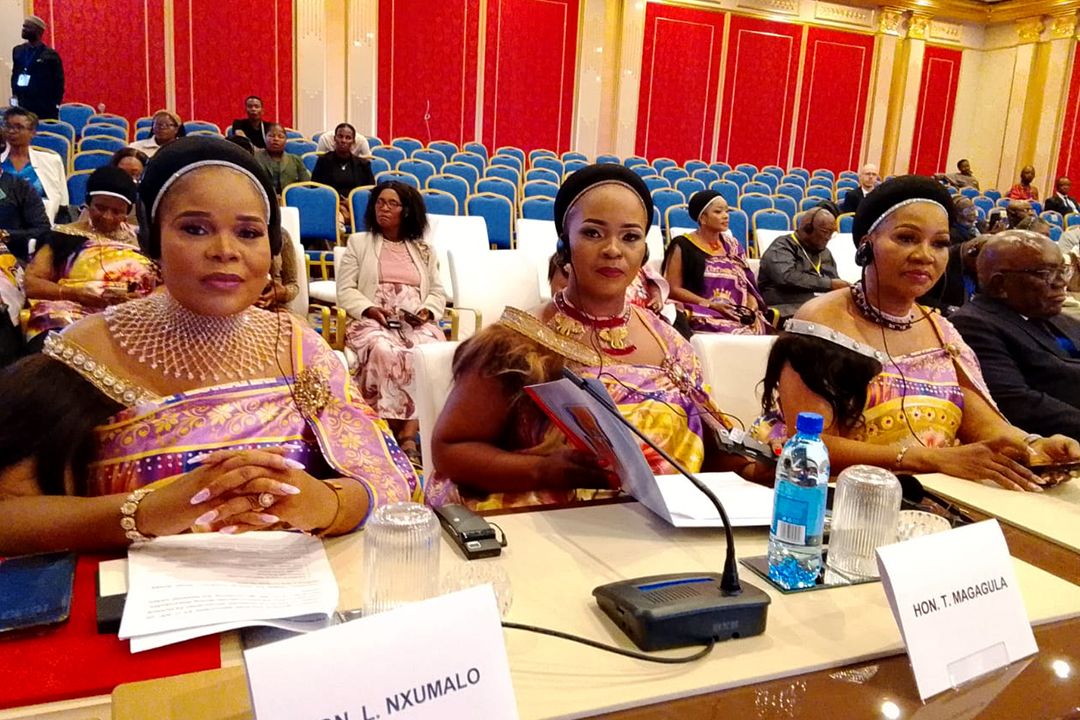
EZULWINI– Senator Linda Nxumalo and Hhohho MP Tenele Magagula have pushed for adequate financial support and economic inclusion for Eswatini women.
This was during the OACPS 1st Africa-EU Parliamentary Assembly Women’s Forum at the Ezulwini Palazzo International Convention Centre on May 13, 2026.
First, making her submission, Nxumalo said as the world commemorates the United Nations International Year of the Woman Farmer 2026, they are reminded that women are not only central to agriculture, but also to economic transformation, food security, climate resilience, and poverty reduction.
“In Eswatini, agriculture contributes approximately 8% of GDP, while supporting more than 70% of rural households. Women remain the backbone of this sector, particularly in smallholder farming, food production, informal agricultural trade, agro-processing, and household nutrition systems,” she said.

Despite this immense contribution, Nxumalo said, women farmers continue to face structural barriers. These include limited access to land ownership, inadequate financing, climate vulnerabilities, limited mechanisation, and weak access to export markets and value-addition opportunities.
“Notwithstanding these challenges, Eswatini has made encouraging progress over the years. Through partnerships between the Government of Eswatini, the European Union, Food and Agriculture Organisation, International Fund for Agricultural Development, World Food Programme, UN Women, and other development partners, important strides have been made toward empowering women in agricultural value chains.”
She said recent FAO-supported initiatives have enabled women and youth farmers to transition from subsistence farming to commercial production through greenhouse technologies, climate-smart agriculture, protected farming systems, and structured market access through the National Agricultural Marketing Board.
She noted that the World Food Programme further reported that in 2024, more than 1,000 smallholder farmers in Eswatini received technical support and agricultural inputs, with approximately 70% of the beneficiaries being women.
Furthermore, she said, the newly launched SATAM programme, valued at approximately 751 million US dollars and supported by IFAD and the Green Climate Fund, is expected to directly benefit nearly 19,600 households and over 117,000 people through improved productivity, climate resilience, and market access.
“These interventions clearly demonstrate that when women are empowered, agricultural productivity improves, household incomes rise, food security becomes more resilient, and rural economies grow,” she said.
However, she said, more still needs to be done. The senator said Eswatini has a unique opportunity to strengthen women-led agro-processing, climate-smart agriculture, irrigation systems, digital agriculture, export readiness, and agricultural financing targeted specifically at women and youth.
She noted that Further collaboration opportunities with Organisation of African, Caribbean and Pacific States partners, the European Union, United Nations agencies, and the private sector should focus on the following:
*Value addition and industrialization;
*Women-focused agricultural financing;
*Regional trade under the African Continental Free Trade Area;
*Innovation and technology transfer; and
*Sustainable climate adaptation.
“As parliamentarians, we must continue strengthening policy oversight, gender-responsive budgeting, and legislative reforms that place women farmers at the center of national development. The empowerment of women in agriculture is ultimately about dignity, inclusion, productivity, and economic justice.”
If Africa is to achieve sustainable development, food security, and inclusive growth, then the woman farmer must move from the margins of policy discussions to the center of economic transformation according to the legislator.
On the other hand, Magagula thanked the Organisation of African, Caribbean and Pacific States, the European Union, and the Joint Parliamentary Assembly for the important initiative.
“As women, we strongly believe that this milestone marks the beginning of a more prosperous and inclusive era. The year 2026 has been declared the United Nations International Year of the Woman Farmer. It is therefore fitting that we gather here in Africa, where women produce between 60% and 80% of the continent’s food, yet own less than 20% of the land,” she said.
The MP noted, “In Siswati we say: “Umfati ngumgogodla welikhaya,” meaning “a woman is the backbone of the home.” Today, we boldly say: she must also be the backbone of the economy.”
She said they have praised women farmers for decades. But praise does not pay school fees.
Under production, the MP said women planted the maize. During processing, men own the mill. When profits are made, middlemen control the markets. If a woman’s labour ends at the farm gate, then her poverty begins there as well.
“True empowerment means ownership across the entire value chain — from seed to soil, from shelf to bank account. The Samoa Agreement and the African Union Agenda 2063 mean little if they do not reach ordinary women like Make Dlamini in Lubombo with irrigation, seedlings, access to markets, and contracts to supply school feeding programmes.”
She highlighted that some of the progress being made in Eswatini under the leadership of His Majesty King Mswati III.
Through the National Land Policy of 2021, she said, Eswatini now issues joint land titles. Since 2022, thousands of women have co-registered Swazi Nation Land together with their spouses. When land is in her name, dignity is in her hands.
On financing, the MP said, the Women’s Development Fund has disbursed more than E45 million to women-led agricultural SMEs, with nearly 70% invested in horticulture, poultry, and agro-processing. The repayment default rate remains below 3%.
The MP said when you bank on women, women bank on development.
On markets, she said, the women’s agro-parks in areas such as Mahlanya now connect women citrus farmers directly to retailers including Shoprite and Boxer Superstores, as well as school feeding programmes.
“On climate resilience, more than 5,000 women farmers now utilise drip irrigation systems and drought-tolerant seed varieties through climate-smart agriculture programmes. Eswatini would therefore like to table proposals for consideration in this forum’s resolution to the Joint Parliamentary Assembly.”
The lawmaker said all public procurement programmes — including school feeding schemes, hospitality services, and military supply contracts — should source at least 40% from women-owned agribusinesses by 2028.
#OACPS #Eswatini #MilitarySupply #MPs #EzulwiniPalazo #OrganisationOfAfrica #WomenForum