


BY SIFISO NHLABATSI
MBABANE– South Africa has pledged to use its year-long chairship of the Southern African Development Community (SADC) to accelerate regional economic integration, industrialisation, infrastructure development and peace.
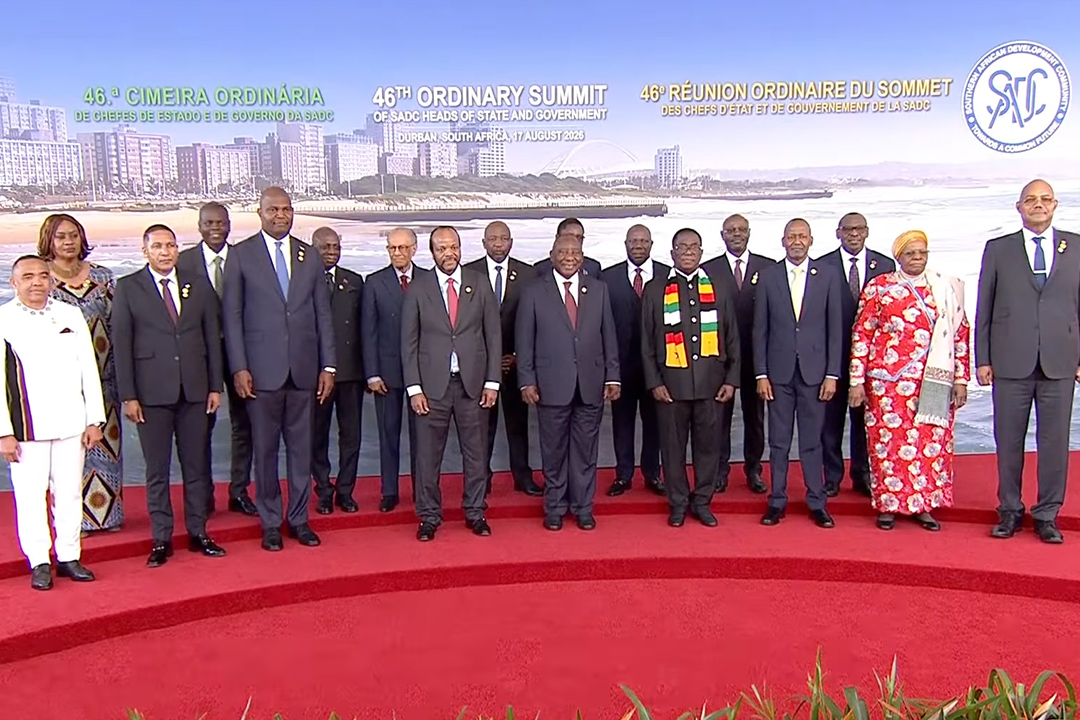
President Cyril Ramaphosa made the commitment after South Africa formally assumed the SADC chairship from Zimbabwe during the 46th Ordinary Summit of SADC Heads of State and Government held in eThekwini, Durban, on Monday. He called for a faster transformation of the 16-member bloc.
Accepting the chairship, Ramaphosa said South Africa took on the responsibility with great humility and a deep sense of responsibility, pledging to work with all Member States on the basis of sovereign equality, mutual respect and consensus building.
He said South Africa would build on the progress made by previous SADC chairs while advancing the implementation of the regional bloc’s Vision 2050 and the Regional Indicative Strategic Development Plan 2020–2030.

“We will seek greater integration of our economies, building ties of trade and investment that drive resilient, sustainable and inclusive industrialisation,” Ramaphosa said.
The commitment comes as the regional bloc continues to grapple with slow economic integration despite having significant natural resources, agricultural potential and a combined population of more than 400 million people.
In his opening address, Ramaphosa said the pace of transformation in the region remained too slow, noting that SADC recorded economic growth of approximately 3.4 per cent in 2025, while intra-SADC trade accounted for only around one-fifth of the region’s total trade.
He said the figures demonstrated the need for SADC countries to move beyond declarations and translate regional integration into tangible economic opportunities for citizens.
“The people of our region are asking us to deliver the dividend of economic liberation,” he said.
“They want decent jobs, growing industries, reliable electricity, affordable food, quality healthcare, education and opportunities for young people.”
Ramaphosa said South Africa’s chairship would therefore focus on strengthening economic ties and creating conditions for businesses across the region to participate more meaningfully in regional and continental markets.
He identified industrialisation and regional value chains as a key priority, arguing that the region should process more of its minerals and agricultural commodities instead of exporting raw materials and importing finished products.
“The minerals and agricultural commodities of our region must become the foundation of Southern African manufacturing,” he said.
“We must process more of what we mine, add value to more of what we grow and manufacture more of what we consume.”
Ramaphosa also called for increased investment in regional infrastructure, including roads, railways and ports capable of connecting countries and facilitating the movement of goods.
He said infrastructure development should not only benefit capital cities and commercial centres, but should also extend to rural communities, border towns and underserved areas.
Energy, water and digital connectivity also featured prominently in his agenda for the region.
Ramaphosa said SADC countries needed to expand electricity generation and transmission capacity while deepening cooperation through the Southern African Power Pool.
He further called for cross-border water infrastructure to secure supplies for households, agriculture and industry, alongside greater investment in affordable digital connectivity.
Food security was another priority, with Ramaphosa saying SADC had the agricultural potential to feed itself and become a major global food producer.
He called for improved agricultural productivity, stronger regional food reserves and value chains, as well as greater support for smallholder and emerging farmers.
The South African President also urged SADC countries to take greater advantage of the African Continental Free Trade Area by removing non-tariff barriers, improving border management and harmonising standards.
He said the regional bloc should become a platform through which Southern African businesses could access the wider African market of more than 1.4 billion people.
However, Ramaphosa cautioned that achieving these ambitions would require a shift from policy commitments to implementation.
“Our decisions must be implemented. They must be properly costed, funded, assigned and monitored,” he said.
“Our communiqués must become construction sites, factories, power lines, water systems, laboratories, businesses and jobs.”
The South African leader also linked economic development to peace and political stability, saying regional integration could not succeed without security.
“Peace without development is fragile. Development without peace is impossible,” he said.
He pledged that South Africa, during its chairship, would work with Member States to promote peace, security and stability, which he described as essential conditions for the wellbeing and development of the people of the region.
South Africa will also seek to strengthen preventive diplomacy, mediation and political dialogue through SADC structures, including the Panel of Elders and the Organ Troika.
Ramaphosa said the region needed to resolve differences through dialogue, uphold shared democratic principles and act collectively where regional peace and stability were threatened.
He further stressed that South Africa’s leadership of SADC was rooted in the history of the region and the solidarity shown by neighbouring countries during the struggle against apartheid.
“South Africa is determined that through our Chairship and through our continued participation in SADC, we will be worthy of the struggles that were fought by the members of this Community for the achievement of our freedom,” he said.
Ramaphosa’s acceptance speech also acknowledged outgoing chairperson President Emmerson Mnangagwa of Zimbabwe, thanking him for his leadership and stewardship of the regional bloc.
He also expressed appreciation to the SADC Secretariat, led by Executive Secretary Elias Magosi, for supporting the Community’s transformation agenda.
The new chairship comes as SADC marks 34 years since the signing of its Declaration and Treaty in Windhoek, Namibia, on August 17, 1992.
Ramaphosa said the anniversary should prompt the region to reflect on whether it was moving with sufficient speed and purpose to realise the vision of the founders.
He said the founders had understood the power of solidarity and collective action, first demonstrated through the region’s common struggle against colonialism, minority rule and apartheid.
Today, he said, that political solidarity needed to be translated into economic and social gains.
“Today, our task is to give economic and social meaning to that political liberation,” he said.
South Africa’s chairship will therefore be closely watched as the country seeks to turn its stated priorities into concrete regional programmes and projects.
Ramaphosa said the success of the chairship should ultimately be measured not by the declarations adopted at summits, but by the impact of decisions on ordinary citizens.
“Let this Summit be remembered not merely for the declarations we adopt, but for the decisions we implement,” he said.
He called for a new era of regional integration that delivers dignity, opportunity and hope to the people of Southern Africa, while advancing the SADC Vision 2050 goal of a peaceful, inclusive, competitive and prosperous region in which no country or person is left behind.
#SADC #SouthAfrica #CyrilRamaphosa #SADCChairship #RegionalIntegration #Industrialisation #SADC2026 #SouthernAfrica #EconomicIntegration #SADCVision2050 #EswatiniPositiveNews
(Courtesy Pic)