



BY GCWALISILE MHLABANE
MANZINI– A small Eswatini business producing honey, handicrafts, processed foods, clothing or other locally manufactured goods could potentially place its products on shelves thousands of kilometres away in the United Kingdom without having to pay import tariffs — provided the products meet the required rules.
That is the major opportunity being presented to local businesses under the SACUM-UK Economic Partnership Agreement (EPA), which gives qualifying Eswatini goods immediate duty-free and quota-free access to the United Kingdom market.
For emaSwati, this is more than an international trade agreement buried in government documents. If fully utilised, it could translate into bigger markets for local companies, expansion of small businesses, increased production, more demand for locally produced goods and, ultimately, employment opportunities.
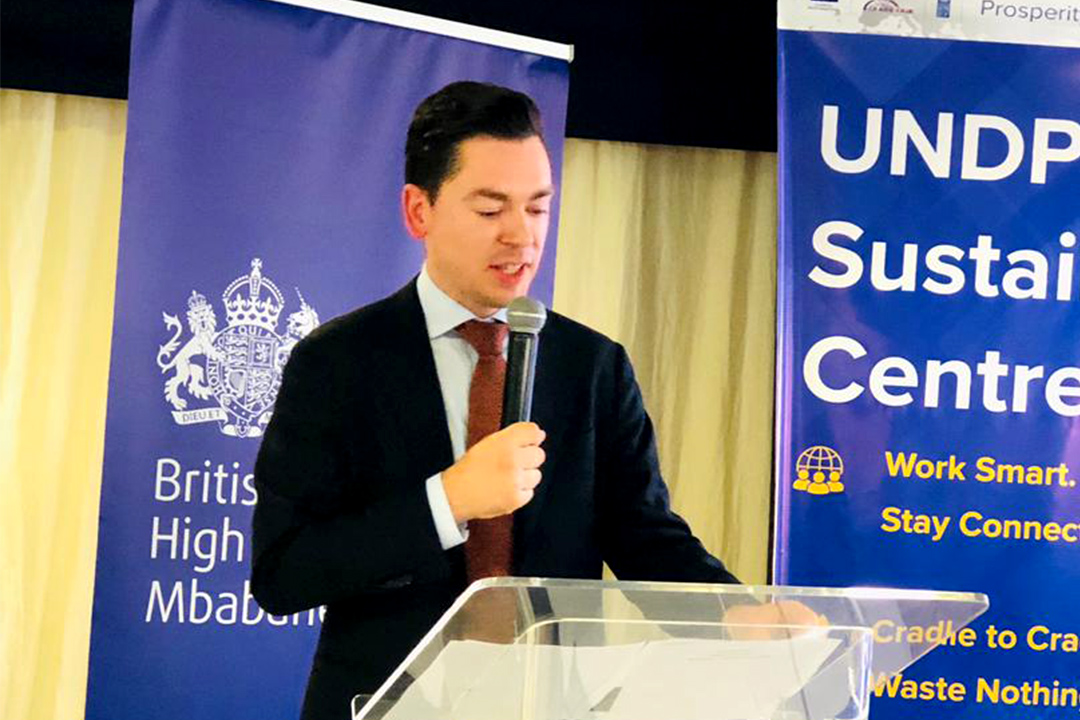
The opportunity took centre stage on September 1, 2026, during a UK market seminar held at the UNDP Sustainable Centre as part of Day 5 of the Eswatini International Trade Fair.

Government officials and representatives of the United Kingdom explained how Eswatini businesses could take advantage of the trade arrangement instead of limiting themselves to the relatively small domestic market.
The seminar, hosted by the British High Commission, was held under the theme: “Unlocking Opportunities in the UK Market: How Eswatini Businesses Can Use the SACUM-UK EPA.”
Representing Minister of Commerce, Industry and Trade Manqoba Khumalo, Principal Secretary Ambassador Melusi Masuku said Eswatini’s longstanding relationship with the UK was increasingly creating economic opportunities for local businesses.
He said international trade agreements such as the SACUM-UK EPA could provide businesses with opportunities to grow beyond Eswatini’s borders and become more meaningful participants in international trade.
“The SACUM-UK EPA serves as a vital catalyst for local economic growth, enabling Eswatini businesses to expand their reach into global markets,” Masuku said.
WHAT THE DEAL ACTUALLY MEANS
One of the strongest messages emerging from the seminar was that Eswatini businesses already have preferential access to the UK market — but companies must understand how to use it.
Foreign, Commonwealth and Development Office Head of Trade Policy for Southern Africa David Machin explained that exporters from Eswatini could export qualifying goods to the United Kingdom without paying tariffs.
“Exporters from Eswatini can send any of their goods — with the sole exception of arms and weapons — to the United Kingdom without paying any tariffs, so long as the rules of origin criteria are met,” Machin said.
In simple terms, tariffs are taxes imposed on imported goods when they enter another country.
Removing these costs can make Eswatini products more price-competitive because an eligible local exporter does not have the added tariff burden when entering the UK market.
That advantage could prove particularly valuable for businesses competing against suppliers from countries whose products may face import duties.
FOUR STEPS BUSINESSES MUST FOLLOW
Machin, however, stressed that duty-free access does not mean businesses can simply package their products and immediately ship them to the UK.
He outlined four major steps that exporters must follow.
The first is understanding the tariff benefit available under the agreement.
Secondly, businesses have to understand the rules of origin governing their products.
These rules determine whether a product genuinely qualifies as originating from Eswatini and is therefore entitled to preferential treatment.
“Step 2 is understanding those rules of origin for your product. To show that the goods have come from Eswatini, they must meet the criteria which is contained in the rules of origin,” Machin explained.
The third requirement relates to product standards and regulations.
Businesses must establish what manufacturing, packaging, labelling, health, food safety or other standards their products must satisfy before being allowed onto the UK market.
“You will need to check before your product goes to the UK if it needs to meet certain manufacturing or packaging standards, or food safety regulations,” Machin said.
The fourth and final step is formally claiming the preferential tariff treatment through the required customs documentation and proof of origin.
“And then Step 4 is to claim those preferences — that is, not paying tariffs or customs duties under the EPA — by submitting the relevant proof of origin and customs forms,” he explained.
E978 MILLION EXPORTS ALREADY BENEFITED
Importantly, the opportunity is not merely theoretical.
According to UK HM Revenue and Customs data presented during the seminar, £42 million — approximately E978 million — worth of exports from Eswatini to the United Kingdom benefited from tariff savings in 2023.
The UK was also Eswatini’s 16th largest export market during the same year.
These figures demonstrate that Eswatini companies are already benefiting from the arrangement, while suggesting there could be considerably more room for local businesses to enter the market.
The challenge is therefore to increase the number of companies with the production capacity, certification, knowledge and market connections required to take advantage of the agreement.
WHAT DOES THIS MEAN FOR EMASWATI?
For an ordinary liSwati, an international trade agreement may appear distant from everyday life.
However, its potential impact can reach directly into communities.
If an Eswatini manufacturer receives a large order from a UK buyer, the company may have to increase production.
Increasing production could require additional employees, more raw materials, improved machinery, transport services, packaging and other supplies.
A food-processing company entering the UK market could, for example, require greater quantities of agricultural produce from local farmers.
A handicraft exporter securing new buyers could create additional income opportunities for rural artisans.
A clothing or manufacturing company increasing exports may need to recruit additional workers.
Transport companies, clearing agents, packaging businesses and other service providers could also benefit from increased export activity.
The opportunity therefore extends beyond individual exporting companies.
Successful exports can create economic activity along an entire supply chain.
BIG OPPORTUNITY FOR SMALL BUSINESSES
The agreement could be particularly significant for Eswatini’s small and medium-sized enterprises.
One of the biggest limitations facing businesses in a country with a relatively small population is the size of the domestic consumer market.
Exporting provides an opportunity for businesses to move beyond that limitation.
A small company does not necessarily have to remain small simply because it operates from Eswatini.
If its products meet international standards, have reliable production capacity and find buyers abroad, its potential market can become considerably larger.
The removal of tariffs under the EPA takes away one potential cost barrier, although businesses must still deal with issues such as transport, logistics, certification, packaging, marketing and compliance with UK standards.
This means the agreement provides the doorway — but businesses must still prepare themselves to walk through it.
ROOM FOR FARMERS AND MANUFACTURERS
The opportunity also provides another reason for Eswatini to strengthen value addition.
Instead of only selling raw materials, local companies can explore opportunities to process, package and brand products before exporting them.
Greater value addition can allow more of the economic benefit to remain inside Eswatini.
It can also create opportunities in sectors such as agro-processing, manufacturing, packaging, textiles, crafts and other export-oriented industries.
The EPA contains flexible rules of origin that can also accommodate, under specified conditions, inputs and materials sourced from other qualifying countries.
This creates opportunities for Eswatini manufacturers participating in regional supply chains rather than requiring every component of a finished product to originate entirely within the Kingdom.
QUALITY WILL BE CRITICAL
Duty-free access, however, does not remove the need for quality.
Local businesses seeking to enter the UK market must be prepared to compete with products from around the world.
Consistency, packaging, food safety, product certification, reliable supply, pricing and compliance with regulations will therefore be critical.
The seminar effectively sent two messages to local businesses: the market is available, but preparation is essential.
Government, business organisations and trade-support institutions will consequently have an important role in helping smaller companies understand export procedures and international standards.
For entrepreneurs, the message is equally important.
The next major customer for an Eswatini-produced product does not necessarily have to be in Mbabane, Manzini or Matsapha. That customer could be thousands of kilometres away in London, Manchester, Birmingham or elsewhere in the United Kingdom.
FROM ACCESS TO ACTUAL EXPORTS
For Eswatini, increased exports could contribute towards bringing more foreign currency into the economy, strengthening local companies and reducing their dependence on the domestic market.
Companies that successfully penetrate international markets can also gain experience, improve production standards and potentially expand into other global markets.
The SACUM-UK EPA therefore provides Eswatini with something extremely valuable: market access that has already been negotiated.
What remains is for local businesses to convert that access into orders, production, income and jobs.
The E978 million worth of Eswatini exports that benefited from tariff savings in 2023 provides evidence that the system can work.
The bigger opportunity now is to ensure that many more emaSwati-owned businesses understand it, prepare for it and benefit from it.
For farmers, manufacturers, entrepreneurs and young people looking for employment opportunities, the agreement could ultimately be most meaningful when duty-free access at the border translates into increased production and economic opportunities back home.
Eswatini already has the key to the UK market.
The challenge — and opportunity — is to use it.
(Courtesy Pic)