


BY SIFISO NHLABATSI
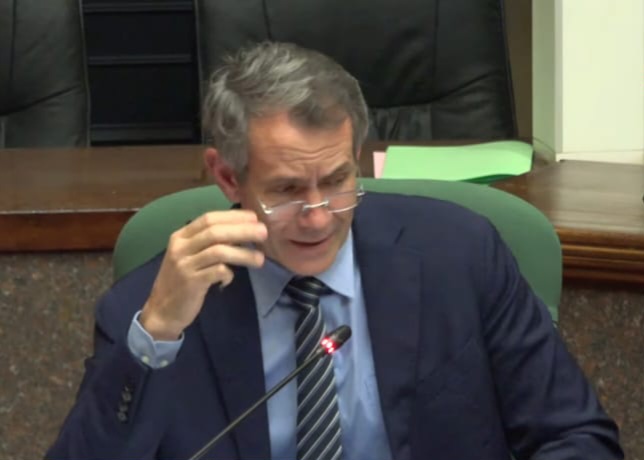
LOBAMBA – Finance Minister Neal Rijkenberg has assured Members of Parliament that the proposed US$39 million (about E682.5 million) in direct government borrowing under the Digital Eswatini Project will not push the country beyond prudent debt-management levels.
Rijkenberg gave the assurance during the Second Reading of the International Bank for Reconstruction and Development (Eswatini Post and Telecommunications Corporation) Loan Guarantee Bill, Bill No. 13 of 2026; the International Development Association (Digital Eswatini Project under the Inclusive Digitalization in Eastern and Southern Africa Multiphase Programmatic Approach Programme) Loan Bill, Bill No. 14 of 2026; and the International Bank for Reconstruction and Development (Digital Eswatini Project under the Inclusive Digitalization in Eastern and Southern Africa Multiphase Programmatic Approach Programme) Loan Bill, Bill No. 15 of 2026.
The three financing arrangements amount to US$65 million, approximately E1.14 billion, but only US$39 million of this would initially constitute direct sovereign borrowing.
The remaining US$26 million is a loan to the Eswatini Posts and Telecommunications Corporation (EPTC), for which government would provide a sovereign guarantee.

Rijkenberg said the country’s public debt was currently close to E40 billion, equivalent to about 45 per cent of Gross Domestic Product (GDP).
He told MPs that the latest figures being used in the presentation were being updated because some of the figures contained in the documentation dated back to 2025.
For comparison, government records show that public debt stood at E36.16 billion, or 40.48 per cent of GDP, at the end of December 2024.
The minister said that, as at March 31, 2025, total public debt stood at E36.03 billion, equivalent to 40.33 per cent of GDP, excluding arrears and contingent liabilities.
He said the proposed US$19.3 million IBRD loan and US$19.7 million IDA credit would add approximately E682.5 million to direct government debt, based on an exchange rate of E17.50 to the US dollar.
At full disbursement, he said total direct debt would therefore rise to approximately E36.75 billion, equivalent to about 41.13 per cent of GDP.
Rijkenberg said this remained within prudent debt-management thresholds contained in government’s medium-term fiscal framework.
Government’s Medium-Term Debt Strategy had projected public debt to peak at about 43.9 per cent of GDP during 2025/26 before declining towards approximately 43 per cent by the end of the strategy period.
The 2026 Budget Speech also stated that government expected debt to GDP to remain at about 43 per cent during the 2026/27 financial year under the financing programme.
The minister distinguished between the direct government loans and the EPTC financing.
He said the US$26 million EPTC facility would be recognised as a contingent liability and would not form part of government’s direct debt stock unless the guarantee was called.
Under the arrangement, EPTC would be responsible for repaying the loan, while government would only become liable if the corporation failed to meet its obligations.
Rijkenberg said the EPTC financing included business-turnaround and financial-stabilisation measures intended to improve the corporation’s ability to meet its obligations.
The minister said the three facilities were also structured differently in terms of their repayment arrangements.
The US$19.7 million IDA facility is concessional, with a 10-year grace period followed by repayment over an extended period.
The US$19.3 million IBRD loan carries a five-year grace period before repayment, with interest linked to the six-month Secured Overnight Financing Rate (SOFR) plus a variable spread.
The EPTC facility similarly carries interest at the applicable reference rate plus a variable spread, together with a 0.25 per cent front-end fee and a 0.25 per cent annual commitment charge on the undrawn balance.
Rijkenberg said the government guarantee would be capped at US$26 million.
He also said there would be a limit on when claims under the guarantee could be submitted, with no claims to be honoured beyond the guaranteed amount or after the specified period following termination or expiry of the loan agreement.
The minister further sought to reassure MPs that government’s debt obligations would progressively reduce as existing loans matured.
He said 18 existing external loans were expected to be fully repaid within the next five years.
This, he argued, would create room for the new financing instruments as repayments on existing facilities fell away.
Rijkenberg’s assurance comes against the backdrop of government’s broader efforts to secure financing for both development projects and budget support.
He told MPs that government was pursuing additional budget-support loans worth more than E3 billion to address the country’s cash-flow pressures and support government operations.
He said these included potential facilities from the African Development Bank, OPEC Fund and Standard Bank South Africa.
The minister acknowledged that government was facing significant cash-flow constraints, including pressure arising from unpaid micro-projects, but maintained that the Digital Eswatini loans were project-specific facilities that had been under preparation for several years.
The World Bank has confirmed that the Digital Eswatini Project comprises US$65 million in financing and is intended to expand affordable broadband access and improve government’s capacity to provide digital public services.
Rijkenberg said the financing would therefore increase the country’s debt stock, but maintained that the increase would remain within government’s stated debt-management framework.
#Eswatini #PublicDebt #DebtManagement #WorldBank #Parliament #GovernmentFinance #DigitalEswatini #NealRijkenberg