


BY SIFISO NHLABATSI
EZULWINI– Hotels, lodges, guesthouses and other accommodation businesses that are not paying the required 3% bed levy could soon face closer scrutiny after the Eswatini Tourism Authority (ETA) joined forces with the Eswatini Revenue Service (ERS) to improve compliance.
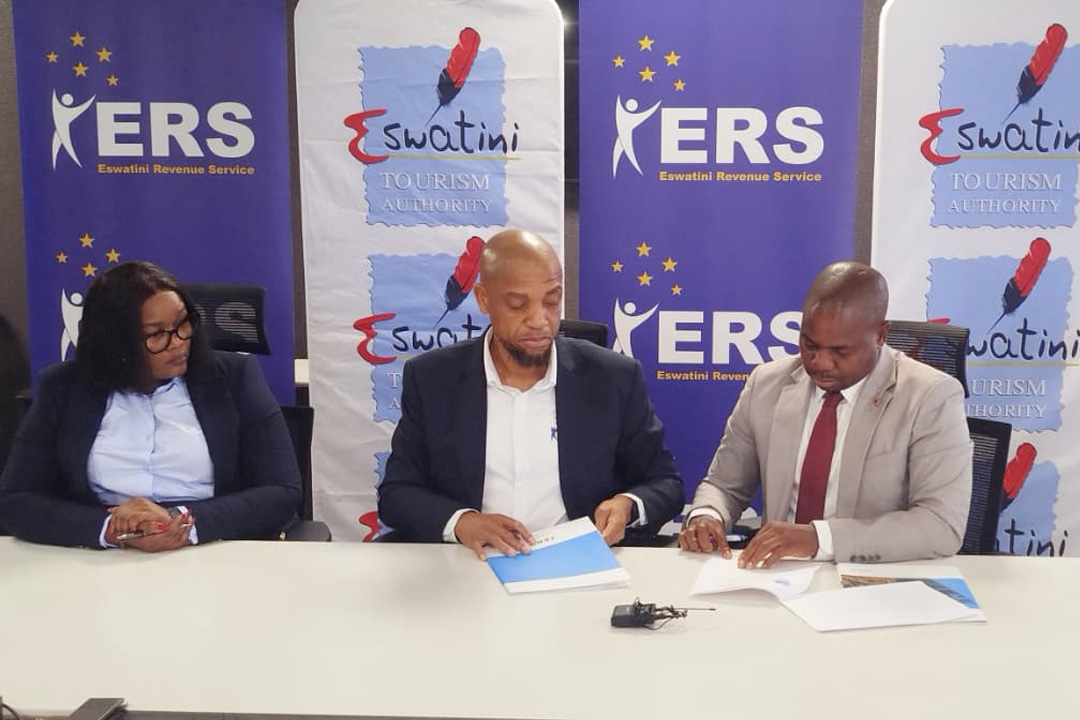
The two institutions signed a Memorandum of Understanding (MoU) at the ERS Headquarters in Ezulwini on Tuesday, creating a formal system through which they will work together, share information allowed by law and identify tourism businesses that may not be meeting their obligations.
ETA Chief Executive Officer Vusie N. Dlamini signed on behalf of the tourism authority, while ERS Commissioner General Brightwell Nkambule represented the revenue service.
At the centre of the partnership is the 3% bed levy charged on accommodation income.

In simple terms, when a hotel, lodge, guesthouse or other accommodation establishment earns money from guests, it is required to collect the levy and pay it over to the ETA.
The money is then used to support the tourism industry.
According to figures previously released by the ETA, 67% of money collected through the bed levy has been spent on tourism marketing, 20% on developing tourism products and 13% on research.
Between January and June 2026, accommodation establishments declared E4.162 million in bed levies, while the ETA successfully collected E4.066 million.
However, the bigger concern is the number of businesses actually complying.
The ETA reported a compliance rate of only 32%, with just 104 accommodation establishments compliant during the six-month period.
This means there are still accommodation businesses that may not be registered, may not be declaring what they earn or may not be paying the levy they are required to remit.
Dlamini said the partnership with the ERS was expected to help close those gaps.
“From a regulatory perspective, the ETA has a legal responsibility to collect Bed Levy from all Accommodation Establishments in the Kingdom of Eswatini,” he said.
He explained that working with the ERS would also help determine whether accommodation businesses were properly registered for other taxes such as income tax, Pay As You Earn (PAYE) and Value Added Tax (VAT), where these apply.
Dlamini said the tourism industry continued to see new accommodation establishments opening, making it important for the authorities to know who was operating and whether they were complying with the law.
He stressed that the agreement should lead to action instead of remaining on paper.
“I do believe CG, that this MoU won’t gather dust, but there are lots of quick wins to get it operational immediately,” Dlamini said.
Nkambule said the agreement would turn what had largely been informal cooperation between the two institutions into a properly structured working relationship.
He noted that tourism was much bigger than hotels and lodges.
The sector also includes tour operators, restaurants, transport businesses, event organisers, artisans and many other service providers.
“Effective coordination between our institutions can therefore support a tourism sector that is well regulated, compliant, competitive and able to contribute meaningfully to Eswatini’s development,” Nkambule said.
Under the agreement, the ETA and ERS will cooperate on public education, stakeholder engagement, research, training, identifying possible risks and referring compliance matters between the two institutions.
They will also be able to lawfully share relevant information where necessary.
This could make it easier to identify accommodation establishments that appear in one institution’s records but not in the other’s.
It could also help officials identify businesses that are operating but are not properly registered or meeting their payment obligations.
Nkambule said the intention was not simply to catch businesses doing wrong.
He said the institutions also wanted to help tourism operators understand what was required of them and make it easier for them to comply.
This is particularly important because the tourism industry includes both long-established businesses and smaller emerging operators who may not always understand all the regulatory and tax requirements.
Nkambule said enforcement alone would not solve the problem.
Businesses also needed clear information, education and support.
He further stressed that any information shared between the ETA and ERS would have to be protected in line with the Data Protection Act, 2022.
The information, he said, would only be used for specific and lawful purposes.
The partnership comes at a time when government continues to regard tourism as an important part of economic growth.
Dlamini said tourism contributed E1.174 billion to Eswatini’s economy in 2024, a figure he described as significant following the disruption caused by the COVID-19 pandemic.
He said the contribution could be even higher in future as more tourism businesses are identified and brought into the formal system.
For the ordinary traveller, the agreement may not immediately change the cost of booking a room because the 3% levy is already part of the existing legal framework.
The main change is that authorities now want to make sure more businesses that are supposed to collect and pay the levy are actually doing so.
For government and the tourism industry, stronger compliance could mean more money being available for promoting Eswatini as a destination, improving tourism products and carrying out research to help the sector grow.
The ETA and ERS have now tasked their technical teams with turning the agreement into practical action, including stronger information sharing, education and follow-up with tourism businesses.
#Eswatini #ETA #ERS #BedLevy #Tourism #RevenueCollection #Compliance #Ezulwini #EconomicDevelopment #TourismDevelopment
(Courtesy Pic)