



BY THEMBA ZWANE
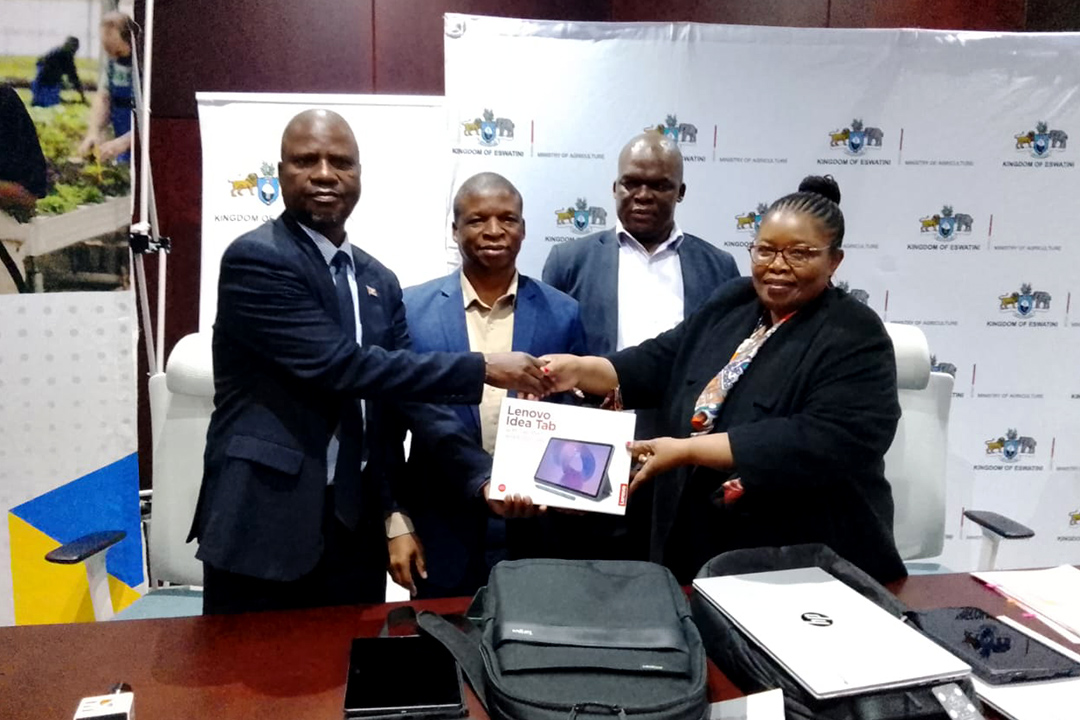
MBABANE- Minister of Agriculture Mandla Tshawuka has handed over digital equipment worth E313 504 to agricultural extension officers as Government moves to strengthen the delivery of services to smallholder farmers under the Smallholder Agricultural Productivity Enhancement and Marketing Project (SAPEMP).
The equipment comprises 40 tablets valued at E229 600 and four laptops worth E83 904, bringing the total value of the gadgets handed over to E313 504.
The handover took place at the Ministry of Agriculture headquarters on August 10, 2026, as the ministry pushes ahead with the implementation of SAPEMP, a flagship agricultural transformation initiative spearheaded by Government in partnership with the Eswatini Water and Agricultural Development Enterprise (EWADE).
The project is backed by key development partners, including the International Fund for Agricultural Development (IFAD) and the Green Climate Fund (GCF).

Speaking during the handover, Minister Tshawuka said the equipment represented more than just technological devices, describing them as tools intended to bridge the gap between traditional farming methods and data-driven agricultural development.
“Today marks another crucial milestone in our relentless journey to modernize Eswatini’s agricultural sector,” Tshawuka said.
He said the ministry was gathered to hand over “vital tools of empowerment” that would help extension officers operate more effectively in the field.
The minister said the 40 tablets and four laptops had been procured specifically for agricultural extension officers under SAPEMP.
IMPROVING FIELD DATA
Tshawuka said one of the major challenges facing extension officers had been the collection of timely agricultural data, crop monitoring and rapid reporting.
“For too long, our extension officers have faced uphill battles regarding timely data collection, localized crop monitoring, and rapid reporting,” he said.
According to the minister, valuable information gathered from the fields was often delayed in transit, limiting the ministry’s ability to respond quickly to developments affecting farmers.
The new equipment, he said, would allow extension officers to capture real-time farm data directly from selected project sites, monitor crop health, weather impacts and livestock metrics digitally, and streamline reporting to regional and national databases.
He said this would ensure that policy decisions were supported by accurate, ground-level information.
The investment in digital equipment is therefore expected to strengthen the connection between farmers in rural communities and decision-makers within the agricultural sector.
THREE PILLARS OF SAPEMP
Tshawuka explained that SAPEMP was built around three core areas.
The first is climate-resilient production, which seeks to move smallholder farmers away from vulnerable subsistence methods towards sustainable and climate-smart agricultural practices capable of withstanding droughts and extreme weather.
The second is market linkages and financial inclusion, which seeks to address aggregation and financing gaps while connecting farmers to domestic and international markets.
The third pillar is institutional strengthening, aimed at improving public service delivery so that extension officers working directly with farming communities can provide guidance with greater precision and speed.
The minister said the digital equipment formed part of this institutional strengthening drive.
“With these four laptops and 40 tablets, we are stepping firmly into the digital age,” Tshawuka said.
TECHNOLOGY TO TRANSFORM FARMING
Tshawuka said the technology would enable extension officers to become more effective “frontline ambassadors” of the agricultural transformation being pursued through SAPEMP.
He said the devices would help officers gather information from farms more efficiently, monitor agricultural conditions and provide information needed for better decision-making.
The minister linked the investment to broader national objectives, particularly improving food security, creating employment and strengthening the resilience of farmers against climate shocks.
Agriculture, he said, remained a backbone of the Eswatini economy and a major source of livelihoods for a large section of the population.
Through SAPEMP, he said, the Government intended to directly impact thousands of smallholder farmers across all four regions of the Kingdom.
The minister said the project was designed to increase yields in high-value crops and livestock, helping households move away from concerns such as empty granaries.
He further said improved agricultural productivity could create employment opportunities and turn farming from a struggle into a profitable commercial enterprise.
On climate resilience, Tshawuka said the project would help protect vulnerable farmers against climate shocks, ensuring that a single drought would not result in total financial ruin for a family.
A DIGITAL SHIFT FOR EXTENSION OFFICERS
The E313 504 investment in the 44 devices signals an increased reliance on technology in the ministry’s efforts to modernise agricultural extension services.
The tablets will be particularly important for officers working in the field, where information on crop performance, livestock, weather conditions and farmer activities can be captured closer to the source.
The laptops, meanwhile, will provide additional capacity for processing, analysing and reporting agricultural information.
Tshawuka urged the extension officers receiving the equipment to use the devices responsibly and ensure that they contribute meaningfully to the transformation of agricultural services.
He described them as being at the frontline of the country’s agricultural development because of their direct interaction with farmers.
“You are the frontline ambassadors of this transformation,” he told the extension officers.
He encouraged them to use the tools responsibly, engage farmers diligently and work collectively towards building a food-secure and prosperous Eswatini.
The minister’s message was that the handover should not be viewed simply as the distribution of 44 electronic devices, but as part of a wider Government effort to modernise the agricultural sector through better information, stronger extension services, climate resilience and improved market access.
The E313 504 investment comes as SAPEMP seeks to translate Government’s agricultural transformation agenda into practical support for smallholder farmers on the ground.
#Eswatini #Agriculture #Government #EWADE #ExtensionOfficers #SAPEMP #ElectronicDevices


