


BY SIFISO NHLABATSI
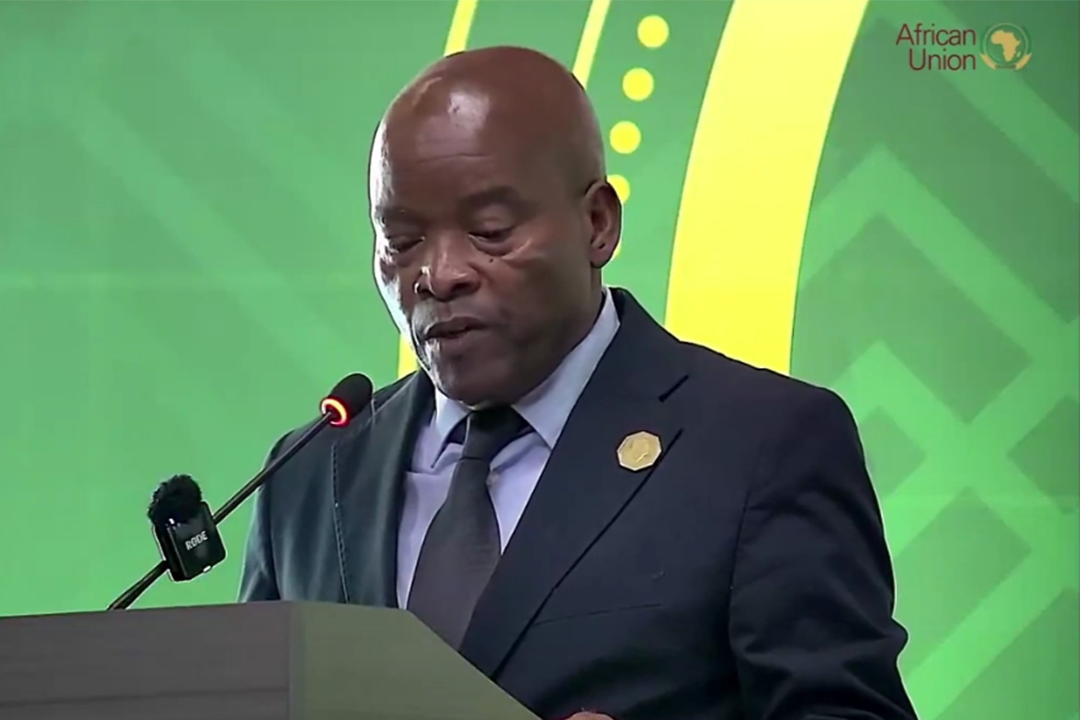
MBABANE – African Union Commissioner for Agriculture, Rural Development, Blue Economy and Sustainable Environment Moses Vilakati says every dollar Africa spends importing food that it has the capacity to produce locally represents a missed opportunity for farmers, businesses, young entrepreneurs and African economies.
Vilakati said Africa was spending approximately US$100 billion every year on food imports, despite possessing the land, water, knowledge, research institutions and human resources needed to produce much of the food it imports.
He said the massive food import bill should not simply be viewed as a cost of feeding the continent, but as money that could instead be circulating within African economies through agricultural production, processing, trade and investment.
“Every dollar spent importing food that could be produced in Africa represents a missed opportunity,” Vilakati said.

He said the opportunities lost through food imports extended across the agricultural value chain, from farmers and agribusinesses to processors, youth entrepreneurs and women-led enterprises.
“An opportunity for an African farmer; an opportunity for an African agribusiness; an opportunity for an African processor; an opportunity for an African youth entrepreneur; an opportunity for an African woman-led enterprise; an opportunity for investment in African economies,” he said.
Vilakati was speaking in Harare, Zimbabwe, during the opening of the 22nd Comprehensive Africa Agriculture Development Programme (CAADP) Partnership Platform, held from September 15 to 18, 2026. The meeting brought together governments, regional economic communities, development partners, farmers’ organisations, the private sector and other stakeholders to advance implementation of the CAADP Strategy and Action Plan 2026–2035.
The Commissioner said Africa’s continued dependence on imported food was particularly difficult to justify given the continent’s agricultural potential.
“The contradiction is striking,” Vilakati said.
“Africa possesses approximately 60 percent of the world’s remaining uncultivated arable land. We possess abundant water resources. We possess vibrant research institutions. We possess growing markets and an energetic youthful population. Yet we continue to depend on others to feed us.”
He described the situation as neither sustainable nor acceptable, arguing that reducing the continent’s dependence on imported food should be treated as an economic transformation priority rather than only an agricultural objective.
According to Vilakati, the approximately US$100 billion food import bill represents several economic opportunities that are currently being lost outside the continent.
“This figure should alarm us; it should challenge us and it should inspire us to act,” he said.
“Because those 100 billion dollars are not merely a food import bill. It is a jobs bill; it is an industrialization bill; it is a trade bill; it is a development bill; it is a resilience bill; and ultimately, it is a sovereignty bill.”
He said producing more food locally would therefore have benefits beyond improving food availability.
Greater agricultural production could create jobs, stimulate agro-processing, support businesses and increase opportunities for young people and women, while strengthening African economies and reducing dependence on external food supplies.
Vilakati’s remarks came as the continent begins implementing the Kampala CAADP Declaration and the CAADP Strategy and Action Plan 2026–2035, which set out targets for transforming Africa’s agrifood systems over the next decade.
Under the Kampala agenda, Africa aims to increase agrifood output by 45 per cent by 2035, reduce post-harvest losses by 50 per cent, triple intra-African trade in agrifood products and inputs, increase local value addition and food processing, and mobilise US$100 billion in investment.
Vilakati said these targets should not be viewed merely as agricultural targets because their impact would extend into the wider economy.
“A 45 percent increase in agrifood output means stronger economies,” he said.
“It means more employment. It means greater resilience. It means lower food-import dependency. And it means improved livelihoods for millions of African citizens.”
The Commissioner said Africa’s food import dependence was occurring against a backdrop of growing pressure on the continent’s food systems.
Climate change was disrupting agricultural production through droughts, floods, cyclones and rising temperatures, while conflicts, economic shocks and geopolitical tensions were disrupting markets and supply chains.
At the same time, Africa’s population is projected to reach approximately 2.5 billion people by 2050, increasing pressure on food production systems.
Vilakati said millions of young Africans also enter the labour market every year in search of employment and economic opportunities, making agriculture and the wider agrifood sector important potential sources of jobs.
However, he said women, despite forming a significant part of Africa’s agricultural workforce, continued to face barriers in accessing land, finance, technology and markets.
He also pointed to inadequate agricultural financing, low irrigation coverage, high post-harvest losses, infrastructure gaps and limited value addition as constraints that needed to be addressed.
For Vilakati, tackling these constraints is central to changing the economic meaning of Africa’s food import bill.
Instead of sending billions of dollars outside the continent to purchase food, he argued that African countries should strengthen their capacity to produce, process and trade food within Africa.
The Commissioner said this would require stronger political leadership, greater involvement of Ministries of Finance and Planning, increased domestic resource mobilisation, stronger private-sector participation and innovative financing mechanisms.
He also called for climate-resilient investment and stronger accountability for agricultural commitments.
Vilakati warned against treating the CAADP process as another cycle of conferences and declarations without corresponding implementation.
“Africa does not need another decade of discussions,” he said. “Africa needs a decade of implementation.”
He said the challenge was no longer determining what Africa needed to do, but ensuring that policies and commitments were translated into results on the ground.
“Every policy we formulate must translate into impact. Every investment we mobilize must translate into opportunity. Every partnership we establish must translate into measurable results. And every commitment we make must ultimately improve the lives of African citizens,” he said.
Vilakati said the continent should therefore use the new CAADP decade to redirect attention towards practical investments that could unlock agricultural production.
He cited irrigation infrastructure, rural roads, digital agriculture, research and innovation, climate resilience, youth enterprises and women-led businesses as areas where investment could help transform food systems.
He challenged stakeholders to consider what could be achieved if even part of the resources spent discussing agricultural transformation were instead directed towards these areas.
“Imagine the productivity gains. Imagine the jobs created. Imagine the reduction in food imports. Imagine the expansion of intra-African trade. Imagine the transformation of rural economies,” he said.
He said Harare should therefore mark a shift from commitments to delivery as Africa implements the Kampala Declaration and the new CAADP strategy.
“Harare must not be remembered as another meeting,” Vilakati said.
“Harare must be remembered as the moment implementation became our priority. Harare must be remembered as the moment delivery became our currency. Harare must be remembered as the moment ambition was matched by accountability.”
He said reducing Africa’s food import bill would require investment across the entire agrifood system, from production to processing, storage, markets and trade.
Recent reporting from the CAADP meeting similarly highlighted the need to close agricultural financing gaps, reduce post-harvest losses and accelerate value addition if Africa is to improve food self-sufficiency.
Vilakati said the ultimate objective was to build an Africa capable of feeding itself while creating jobs, expanding intra-African trade and strengthening economic resilience.
“The time for reducing Africa’s 100-billion-dollar import bill is now,” he said.
“The time for investing in African farmers is now. The time for building resilient and sustainable agrifood systems is now. And the time for implementing the Kampala Declaration is now.”
He said Africa’s agricultural transformation should ultimately result in a continent that produces more of its own food, trades more with itself and converts its agricultural resources into broader economic opportunities.
#CAADP2026 #Agriculture #FoodSecurity #AfricanUnion #FoodImports #AgriculturalTransformation #Africa #KampalaDeclaration #FoodSelfSufficiency