


BY SIFISO NHLABATSI
LOBAMBA– Government is looking to tap into the approximately E840 million Public Enterprise Unit (PEU) Loan Guarantee Fund to provide direct financial assistance to distressed entities.
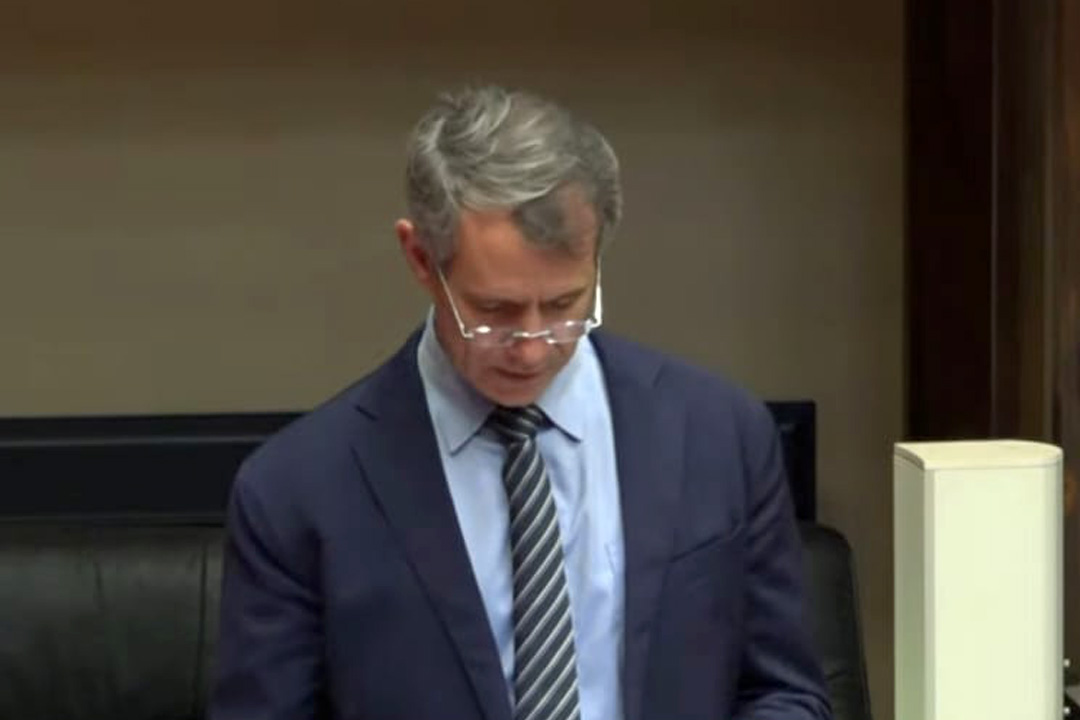
Minister of Finance Neal Rijkenberg said the fund, which has accumulated about E840 million, could be used to assist entities facing financial difficulties once regulations governing its operations are amended.
Rijkenberg said the fund was currently restricted from directly lending money to entities because the existing regulations only allowed it to guarantee loans obtained from commercial banks.
He was responding to Chairman of the Finance Portfolio Committee MP Marwick Khumalo during the Second Reading of the International Bank for Reconstruction and Development (Eswatini Post and Telecommunications Corporation) Loan Guarantee Bill, Bill No. 13 of 2026; the International Development Association (Digital Eswatini Project under the Inclusive Digitalization in Eastern and Southern Africa Multiphase Programmatic Approach Programme) Loan Bill, Bill No. 14 of 2026; and the International Bank for Reconstruction and Development (Digital Eswatini Project under the Inclusive Digitalization in Eastern and Southern Africa Multiphase Programmatic Approach Programme) Loan Bill, Bill No. 15 of 2026.

Khumalo had questioned why government could not borrow from the PEU fund to provide emergency financing to Micro-Projects which is currently experiencing cash-flow challenges.
He noted that the fund was internally held by government and had accumulated more than E800 million, suggesting that it could be used to alleviate some of the immediate financial pressures facing micro-projects.
Responding, Rijkenberg confirmed that the fund had approximately E840 million.
“At the moment, there is a loan guarantee. It’s called a loan guarantee fund, is what we have under PEU. I think the last I heard, there’s about E840 million sitting in this fund,” Rijkenberg said.
He explained that the money was invested and continued to grow through contributions from parastatals and interest earned on the investments.
However, the minister said the existing regulations prevented government from using the fund to directly lend money to entities in distress.
“The regulations do not allow loans to be made from the fund. It only allows the fund to guarantee to a bank, and the bank loans money,” he said.
Rijkenberg further explained that there were strict limitations on the amount that could be guaranteed to an individual entity.
According to the minister, the maximum guarantee was E50 million per entity.
This means that under the current framework, an entity seeking assistance through the PEU fund cannot simply receive a direct loan from the fund. Instead, the fund provides a guarantee to a commercial bank, which then advances the loan.
The minister said government had identified the need to change this arrangement to enable the fund to directly support distressed entities.
He said the proposed reforms would allow the fund to move beyond its current role as a guarantor and provide loans directly where necessary.
“What we need to do is we need to change those regulations so that the fund itself can loan money now directly to entities that are in distress,” Rijkenberg said.
He identified the Eswatini Electricity Company (EEC) and Eswatini Bank among entities that government hoped could benefit from the proposed changes.
The minister said the regulatory amendment process had taken longer than initially anticipated, as the regulations had to undergo several stages of consideration.
He said the revised regulations had gone through the Attorney General’s Office and Cabinet before being gazetted.
Rijkenberg said he intended to table the regulations before Parliament to pave the way for the fund to directly assist distressed entities.
“I’ll table the regulations so that we can have regulations that can allow us to do exactly that,” he said.
The minister said the proposed mechanism could also assist micro-projects facing cash-flow constraints, although he stressed that their situation was different from entities experiencing deeper financial distress.
He described the problem facing micro-projects as primarily a cash-flow issue rather than a fundamental lack of financial viability.
Rijkenberg, however, cautioned that any assistance from the fund would be short-term in nature.
He said the proposed intervention could provide temporary relief, potentially for a period of about six months.
The discussion came against the backdrop of concerns raised by Members of Parliament over government’s cash-flow constraints and the inability to settle outstanding payments to micro-projects.
Rijkenberg acknowledged that the cash-flow situation affecting micro-projects was a critical concern, saying it was a more immediate crisis than some of the other financial pressures being discussed.
He also explained that government was pursuing budget-support loans from institutions such as the African Development Bank and the World Bank to help address broader financial gaps.
However, he said securing such loans was a lengthy process because lenders imposed conditions, including reforms to government financial management systems.
Among the reforms is the move from cash accounting to accrual accounting, which the minister said would provide government with greater visibility of its future financial obligations.
#Eswatini #Finance #PEU #LoanGuaranteeFund #NealRijkenberg #MarwickKhumalo #Government #PublicEnterprises #MicroProjects
(Courtesy Pic)