


…Correctional Services tops government with 75%
…PM orders stronger monitoring, accountability and faster implementation
BY SIFISO NHLABATSI
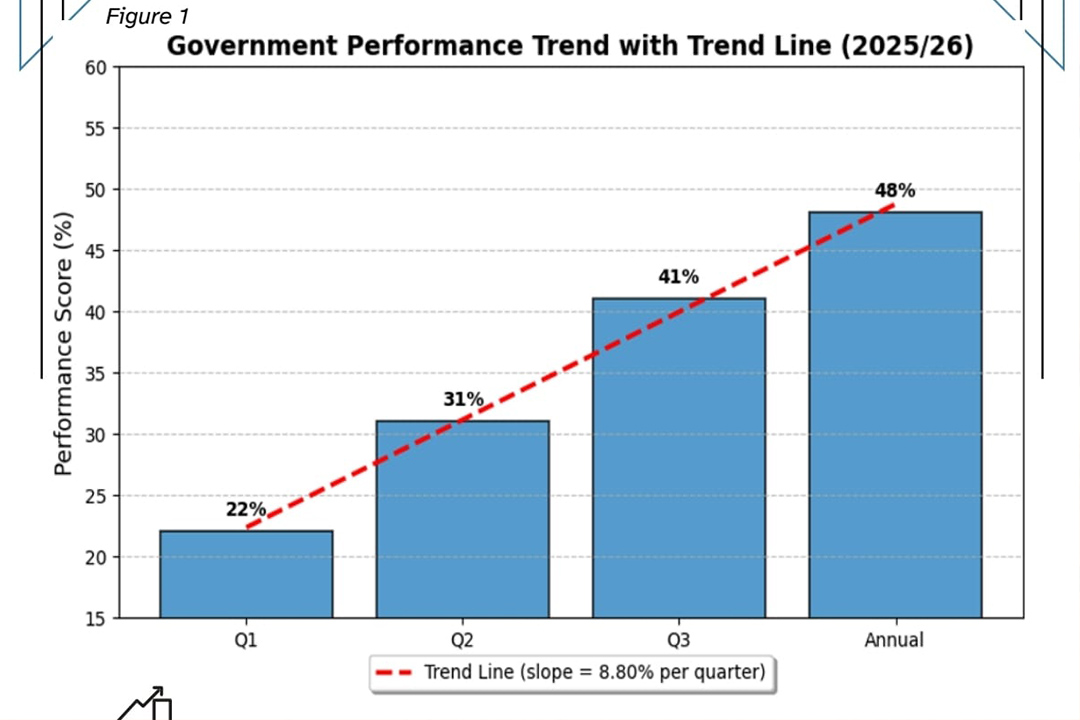
MBABANE– Government has recorded a significant improvement in the implementation of its national development programme, with its overall annual performance rising from just 22% in the first quarter to 48% at the end of the 2025/26 financial year.
Prime Minister Russell Mmiso Dlamini revealed the figures on Tuesday when presenting the 2025/26 Government Performance Report, an assessment of how ministries and departments are delivering on commitments made under the Nkwe Programme of Action.

While the 48% score shows that Government still has considerable ground to cover to achieve its ambitious development targets, the Prime Minister said the steady improvement during the year demonstrated that ministries had begun accelerating implementation.
The report effectively puts Government’s own performance under the microscope, measuring not only whether projects and programmes were implemented, but also the quality of delivery and whether ministries were reporting their progress on time.
For ordinary emaSwati, the figures go beyond percentages. They relate to how quickly Government delivers services such as healthcare, education, social protection, food security, infrastructure and economic opportunities.
Dlamini said the assessment was part of Government’s commitment to accountability and keeping the nation informed about progress on promises made to the people.
The report was prepared by the Policy and Programme Coordination Unit (PPCU) and assesses Government performance during the 2025/26 financial year, while also measuring progress towards Eswatini’s 2029 development targets.
Government institutions were assessed using three pillars, with the actual execution of plans carrying 80% of the score, quality of execution accounting for 15%, while timeliness of reporting contributed 5%.
This means ministries could not simply report activities as achievements. The assessment considered whether planned work was actually carried out and how effectively it was implemented.
CORRECTIONAL SERVICES LEADS GOVERNMENT
Among ministries and departments, His Majesty’s Correctional Services emerged as the strongest performer with an overall score of 75%.
It was followed by the Ministry of Sports, Culture and Youth Affairs at 60%, while the Ministry of Health scored 58%.
The Prime Minister’s Office recorded 56%, placing it among institutions that performed above the national Government average of 48%.
According to the Prime Minister, the performance of these institutions demonstrates the difference that planning, leadership and disciplined implementation can make even when Government is operating within financial and administrative constraints.
The results also provide Government with examples that could potentially be replicated by ministries that are struggling to meet their targets.
SOCIAL PROTECTION LEADS SIX PRIORITIES
The assessment went further by examining Government’s performance against the six major objectives of the Programme of Action.
Social Protection and Security emerged as the best-performing objective at 56%, indicating relatively stronger progress in programmes aimed at supporting vulnerable citizens and strengthening security.
It was followed closely by Food Sovereignty and Sustainable Development at 55%, an important priority as Eswatini seeks to improve domestic food production, strengthen agriculture and reduce vulnerability to food insecurity.
Economic Growth recorded 50%, placing it third among the major national priorities.
However, Human Capital Development, which includes critical areas such as education and health, recorded the lowest performance at 37%.
The result has placed renewed attention on the need to accelerate implementation in sectors that directly affect the development and wellbeing of emaSwati.
GOVERNMENT IDENTIFIES ITS OWN WEAKNESSES
The report does not shy away from the obstacles slowing Government delivery.
Among the major challenges identified are delayed budget releases, procurement bottlenecks, inter-ministerial coordination problems, legislative delays, dependence on external funding partners and weaknesses in planning and reporting systems.
These challenges contributed to delays in implementing a number of programmes planned by different ministries.
Reporting discipline has also emerged as a concern.
Only six ministries submitted their annual performance reports within the required period, while 16 submitted after the deadline.
Government acknowledged that late reporting makes it difficult to monitor projects in real time and can delay corrective action when programmes fall behind schedule.
For the Prime Minister, strengthening accountability will therefore form an important part of Government’s response to the findings.
PM ORDERS REFORMS
Rather than treating the 48% result as the end of the assessment process, Dlamini said Government had accepted the recommendations contained in the report and would embark on reforms aimed at improving delivery.
Among the measures will be the faster implementation of resolutions adopted during the 2026 Cabinet Retreat, prioritisation of high-impact Programme of Action targets and the ring-fencing of resources for strategic projects.
Government will also strengthen quarterly performance monitoring and improve coordination between ministries whose projects depend on one another.
Significantly, the Prime Minister said Government would strengthen consequence management, with strong performers recognised while underperformance is addressed.
Reporting systems are also expected to be tightened through mandatory performance-reporting workshops and greater use of SMART planning, where Government targets are expected to be specific, measurable and time-bound.
The intention is to identify implementation problems early rather than wait until the end of a financial year before discovering that programmes have fallen behind.
48% A FOUNDATION FOR FASTER DELIVERY
The Prime Minister acknowledged that the overall performance score remains a call for greater urgency, particularly with 2029 national targets drawing closer.
However, Government believes lessons emerging from the assessment provide an opportunity to improve the way public programmes are planned, funded, coordinated and implemented.
Successful approaches used by high-performing institutions are expected to be scaled up, while ministries will be pushed to begin implementation earlier in the financial year instead of losing valuable time.
Dlamini said improving coordination and strengthening accountability would be central to Government’s efforts to translate plans into measurable improvements in service delivery.
The annual assessment therefore provides both an encouraging sign of progress and a clear reminder of the work that remains.
From a first-quarter position of 22% to an annual score of 48%, Government has demonstrated an upward trajectory, but the next challenge will be to convert that momentum into faster delivery that emaSwati can see and experience in their daily lives.
The Prime Minister said the ultimate objective was not merely to improve Government’s percentage score, but to ensure that national development commitments translate into tangible benefits for citizens.
His Majesty’s Government, he said, remained committed to improving implementation and ensuring that public programmes result in real improvements in the lives of emaSwati.
The findings will now influence future planning, allocation of resources and performance management as Government works towards delivering national development priorities with greater speed, discipline and impact.