


- Shabangu outlines legal pressures facing Eswatini’s media
BY MBONO MDLULI
EZULWINI – Renowned lawyer Zweli Shabangu has raised concern over the growing pressure that lawsuits place on media institutions, warning that excessive litigation risks undermining press freedom and discouraging public interest reporting.
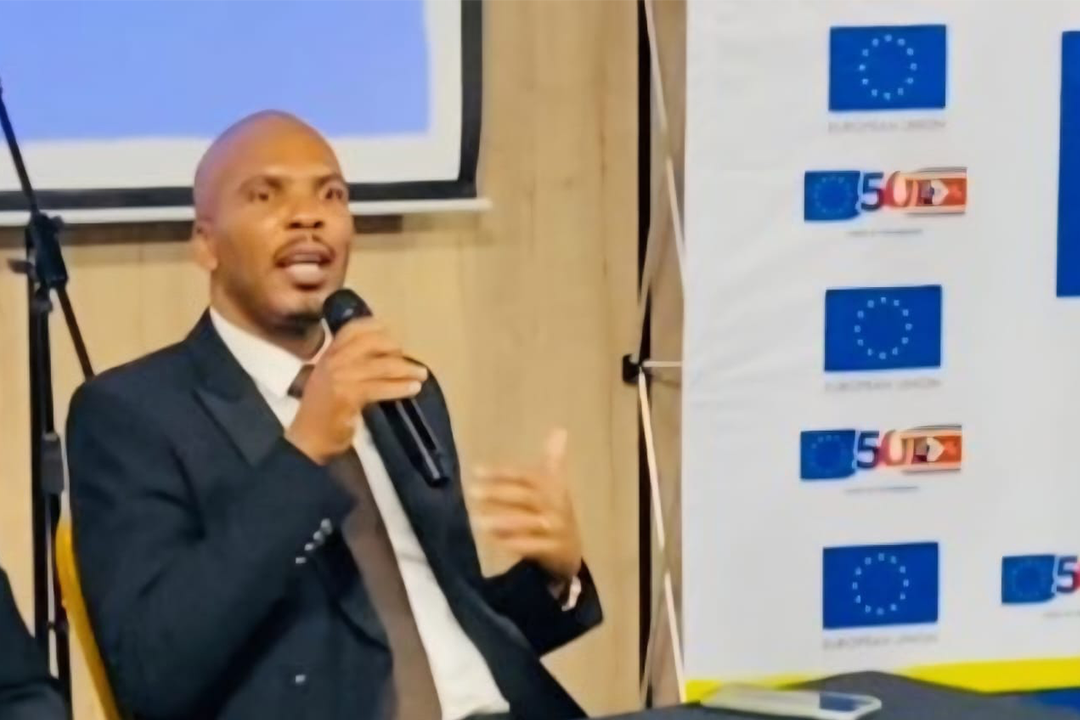
Shabangu made these remarks on 30 April 2026 during the commemoration of World Press Freedom Day held at Happy Valley Hotel. The event was organised by the Eswatini Editors Forum in partnership with the European Union (EU) in Eswatini and brought together journalists, legal practitioners, students and civil society.
Lawsuits driving self-censorship in newsrooms
In a candid address, Shabangu highlighted what he described as a growing trend where legal action is increasingly used in ways that discourage robust journalism.

“Media freedom is sometimes stifled by lawsuits, which tend to undermine media freedom, which cause the media houses to censor themselves and stop pursuing stories of public interest,” he said.
He explained that this environment creates hesitation within newsrooms, where editors and reporters may choose not to publish certain stories for fear of costly legal consequences.
“So, that mindset is what then triggers the media to pursue censorship,” he added.
Shabangu noted that a common perception among the public is that media houses generate substantial revenue, which in turn fuels litigation.
“Many people are of the view that the media makes a lot of money… so by the mere reporting on an article, the person whom the article is about feels the opportunity for enrichment, if I can put it that way,” he said.
Financial penalties seen as major threat
A central concern raised by the legal expert was the scale of financial penalties imposed in defamation cases, which he described as excessive and counterproductive.
“The imposition of penalties… tends to be too harsh and punitive and counterproductive to the entrenched right in a democratic society,” he said.
He warned that such penalties could have a chilling effect on journalism, particularly in a small market like Eswatini.
“The threat is that, in the future, we would have media houses who are maybe publishing adverts, obituaries, and the like,” he said, suggesting that fear of litigation could push media outlets away from investigative reporting.
Shabangu further illustrated the dilemma faced by journalists:
“What is the thing to do then? It is simply not to publish… as far as I’m concerned, I’ve obtained so many adverts, and that is the way to go.”
Balancing truth, error and public interest
Shabangu also addressed the complexities of truth in journalism, noting that the law does not necessarily require absolute accuracy in every instance, but rather recognises what is known as “substantive truth”.
“In media law, when we talk about truthfulness, we do not refer to absolute truth… but we are speaking about substantive truth,” he explained.
He emphasised that honest errors can occur in reporting and should not automatically result in severe penalties, especially when journalists act responsibly.
The lawyer referenced the landmark South African case of the National Media Ltd v Bogoshi (1998) ruling, in which the South African Supreme Court introduced the principle of reasonable publication.
This legal standard allows journalists to publish information in the public interest, even if it later proves to be inaccurate, provided they took reasonable steps to verify the information.
“It does not require the story to be true. It recognises that there is room for error,” Shabangu said.
Judiciary and training key to future progress
Shabangu pointed to the need for ongoing training within the legal system to ensure that courts are equipped to interpret media-related cases in line with modern developments.
“What happens in the modern-day sphere wherein the world has progressed?” he asked, noting that legal practitioners often rely on outdated frameworks that may not fully reflect the realities of today’s digital media landscape.
He stressed that a more informed and balanced judicial approach would help protect both individual rights and the role of the media.
Constitutional protection remains strong foundation
Despite the challenges, Shabangu expressed confidence in Eswatini’s constitutional framework, which guarantees freedom of expression and the media’s role in disseminating information.
“The Constitution… recognises freedom of the media, including the right of the media to disseminate information… and that the public has an equivalent right to receive such information,” he said.
He emphasised that this provision provides a solid legal foundation for defending media freedom, provided it is interpreted correctly and applied fairly.
Stakeholders unite for stronger media environment
The event also featured participation from the Eswatini National Association of Journalists, the Press Club of Eswatini, as well as students and academics from the University of Eswatini and Limkokwing University of Creative Technology.
Participants engaged in discussions on how to strengthen ethical journalism, navigate legal risks and promote a more supportive environment for media practitioners.
A call for balance and collaboration
Shabangu concluded by calling for a balanced approach that protects both reputational rights and press freedom, while ensuring that the media can continue to fulfil its watchdog role.
“If we shut out the media with these lawsuits… we are basically driving the media to a corner,” he warned.
His remarks underscored the importance of collaboration between the legal fraternity, media practitioners and policymakers in building a resilient, informed and responsible media sector in Eswatini.