


• Minister Neal Rijkenberg said Montigny has no interest or intention of entering the health sector
• Rijkenberg said the Ministry of Finance does not deliberately delay budget releases.
• The minister said the Dis-Chem private sector option was explored but never materialised.
• Rijkenberg said he resigned from The Luke Commission board when he became a minister.
BY SIFISO NHLABATSI
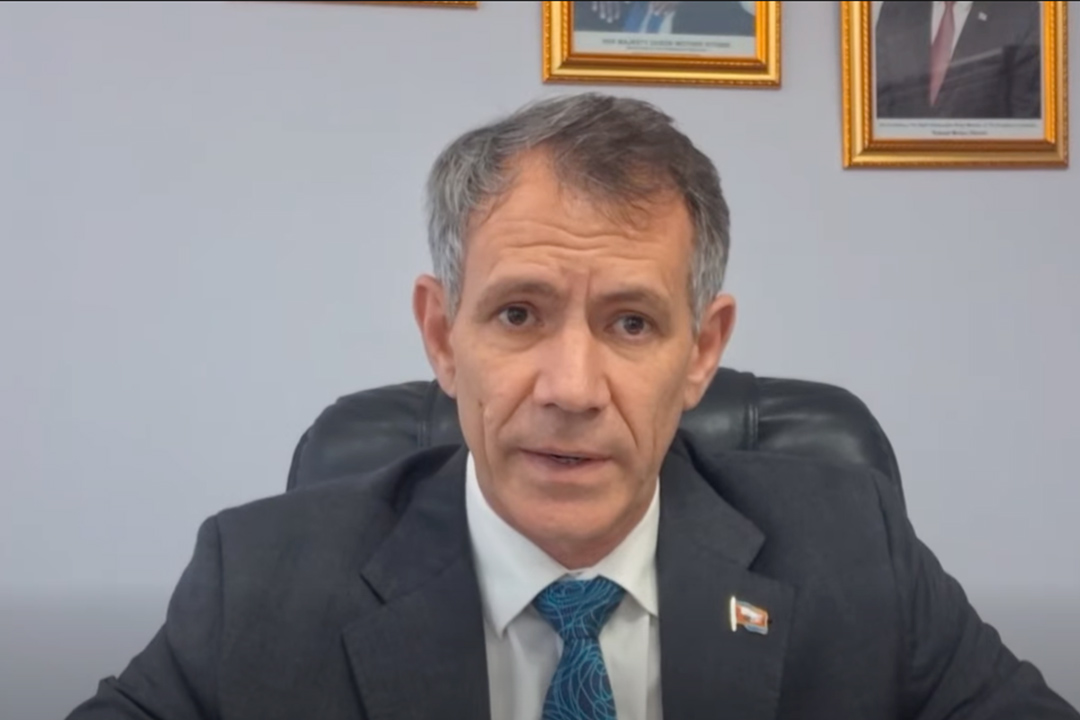
MBABANE– Minister of Finance Neal Rijkenberg has moved to clear allegations surrounding his alleged personal and business interests in the health sector, saying Montigny has “zero knowledge or intent” of becoming involved in the industry.
Rijkenberg said recent accusations and renewed discussions around health sector matters had prompted him to clarify the position of the Ministry of Finance and address claims suggesting that he or companies associated with him were influencing developments in the sector.
The minister said Montigny, which operates in the forestry industry, had no interest in entering the health sector.

“Just to declare for the record, Montigny would never want to get involved in the health space. In forestry, they do that very well. They’ve got zero knowledge or intent of anything in the health space,” Rijkenberg said.
He said accusations sometimes became personal, with suggestions that Montigny or individuals connected to the company were attempting to influence developments in the health sector.
Rijkenberg said such claims were part of a tendency to look for someone to blame whenever challenges emerged within government.
“It’s amazing when you’re in government, when things go wrong, everybody wants someone to blame, and there’s always some kind of conspiracy going on behind the scenes,” he said.
The minister said the Ministry of Finance did not operate on personal agendas and that its role was to support other ministries, including the Ministry of Health, within established government processes.
He also addressed accusations that the Ministry of Finance delays the release of budgets, including claims relating to funding for the Ministry of Health.
Rijkenberg said budget releases were processed regularly, with ministries submitting requests to utilise approved budgets. He said the ministry’s budget department assessed the requests, including whether sufficient cash was available, before preparing releases for his approval.
He said the process was generally handled on a weekly basis.
“I’ve been a minister for eight years, and we do, I think, almost every week, what you call budget releases. There’s a pack that comes in, which means ministries are applying to use the budget. Our budget department analyses that, looks if there’s enough cash available, looks at a few things, and then brings a budget release for me to sign,” he said.
According to Rijkenberg, he had not taken longer than 24 hours to sign budget releases during his eight years as minister.
“I don’t think in my eight years I’ve taken longer than 24 hours to sign the budget releases. We really keep this fast. We know that there’s pressure out there to be able to have the budgets released, meaning the ministries can now go to tender, they can sign orders based on the budget releases. So there’s no delays here,” he said.
He said where claims had been made that a budget was released to the Ministry of Health at a later stage, such as in September 2022, this could have been because the request reached the Ministry of Finance at that time or because there were complications with the request.
“If it was released in September, it means the request only came through around that time, or it means that there was some complication with the request,” he said.
Rijkenberg said the Ministry of Finance would not deliberately delay a ministry’s budget release or create difficulties for another government department.
“We would never, as a Ministry of Finance, delay or have some kind of strange reason to cause trouble in a ministry,” he said.
He explained that delays often associated with government spending could instead arise from the procurement process, which he described as lengthy and intentional.
The minister said government procurement involved several procedures aimed at ensuring that public funds were spent correctly, transparently and without overpricing or misappropriation.
“What maybe needs to be clear is the procurement process is a long process, and it is very intentional. As governments, there’s a lot of bureaucracy in governments. It’s really to make sure that us civil servants don’t steal money or misappropriate monies, to do things as transparently as possible,” he said.
He said the procedures could take time because government purchases had to go through various checks and processes.
“So when we buy stuff as government, it’s a long process one has to go through, really, to ensure that this money is spent right, that the money is spent transparently, and that it is not overpriced,” he said.
Rijkenberg said government was nevertheless looking at ways of improving the procurement system, including the possible use of e-procurement.
He said the intention was to increase transparency while also making the process more efficient.
“In fact, we’re looking at the legislation now to see what can we do to use e-procurement, maybe more transparent, but trying to speed that up, to try and get that to be a whole lot more efficient. So as I speak, we’re busy working on that,” he said.
On the Ministry of Health specifically, Rijkenberg said the Ministry of Finance had supported emergency spending requests because of the urgent nature of some health requirements.
He said such requests were approved despite the complications that emergency spending could sometimes create.
“Whenever they request an emergency spend, for instance, we’ve always assisted and we’ve approved that, even though we don’t really like it because sometimes it creates complications. But we always approve that,” he said.
The minister said the Ministry of Health also entered into multi-year supply contracts, allowing it to receive goods under tenders that remained valid for several years.
He said the Ministry of Finance tried to make the process as simple as possible, while acknowledging the complexity of managing the broad range of medicines and health-related requirements.
“We absolutely try to support and to try and assist,” Rijkenberg said.
He also addressed allegations that he had sought to bring a private sector player, including Dis-Chem, into government health services.
Rijkenberg said there had been discussions within government about whether private sector participation could be considered as one of several options.
He said he had at one stage approached Dis-Chem, but the company was not interested in pursuing the possibility with government.
“I do recall that at some point we were considering as government, as Cabinet, to say, do we consider bringing a private sector in. I think I reached out to Dis-Chem and they weren’t interested in looking at doing this for the government,” he said.
He said the option was explored as part of government’s consideration of different models, but it did not proceed.
“But absolutely, sometimes private sector can help, and sometimes it’s not a good idea. So as government, sometimes we will consider doing that. That’s why we often open these parastatals, because in that private sector space, things can sometimes be done a lot more efficiently than government can,” he said.
Rijkenberg said the proposal involving Dis-Chem was ultimately not pursued.
“We looked at that option, the option didn’t make sense, and it just died a death right there,” he said.
The finance minister further addressed questions relating to his previous involvement with The Luke Commission.
Rijkenberg confirmed that he had previously served on the organisation’s board in a pro bono capacity, meaning he did not receive a sitting fee or allowance for the position.
He said his involvement was motivated by a desire to assist an organisation whose work he believed had benefited emaSwati, particularly through rural health clinics.
“I definitely was on the board of The Luke Commission before. It was a pro bono position, which means that you sit on the board, you don’t even get a sitting fee or an allowance for being there. It really is just to try and help,” he said.
He said he had personally visited one or two of the organisation’s rural clinics and had been impressed by the assistance provided to communities.
“I went on one or two of them myself just to have a look, and I was super impressed with how much help people would get from The Luke Commission,” he said.
Rijkenberg said he resigned from the board when he became a minister in order to separate his previous role from his government responsibilities.
“When I became a minister, I then resigned from The Luke Commission, just to be able to declare, and then from then onwards, now as government, one will obviously always look at all the different options we have and trying to make the right financial decisions,” he said.
He maintained that his engagements and decisions as minister were not motivated by personal gain or personal interests.
“One’s often engaging on the different fronts, but definitely for no personal gain or personal interest. That clearly would not, would never be on the table here,” he said.
Rijkenberg said he had decided to address the allegations publicly because, as minister, he believed it was necessary to protect the Ministry of Finance from perceptions that government departments operated on personal agendas.
“As a minister, to protect the ministry, I do believe sometimes things must be said so that the people don’t think out there that these ministries run on personal agendas. It’s definitely not the case,” he said.
#Eswatini #NealRijkenberg #MinistryOfFinance #Montigny #HealthSector #TheLukeCommission #Government #BudgetReleases #PublicProcurement #HealthServices #Transparency #EswatiniPositiveNews
(Courtesy Pic)