



…Eswatini, Mozambique and South Africa secure E116 million funding from GEF
…Three countries co-finance project with E3.65 billion
…Tripartite project commissioned, to run 72 months
BY THEMBA ZWANE
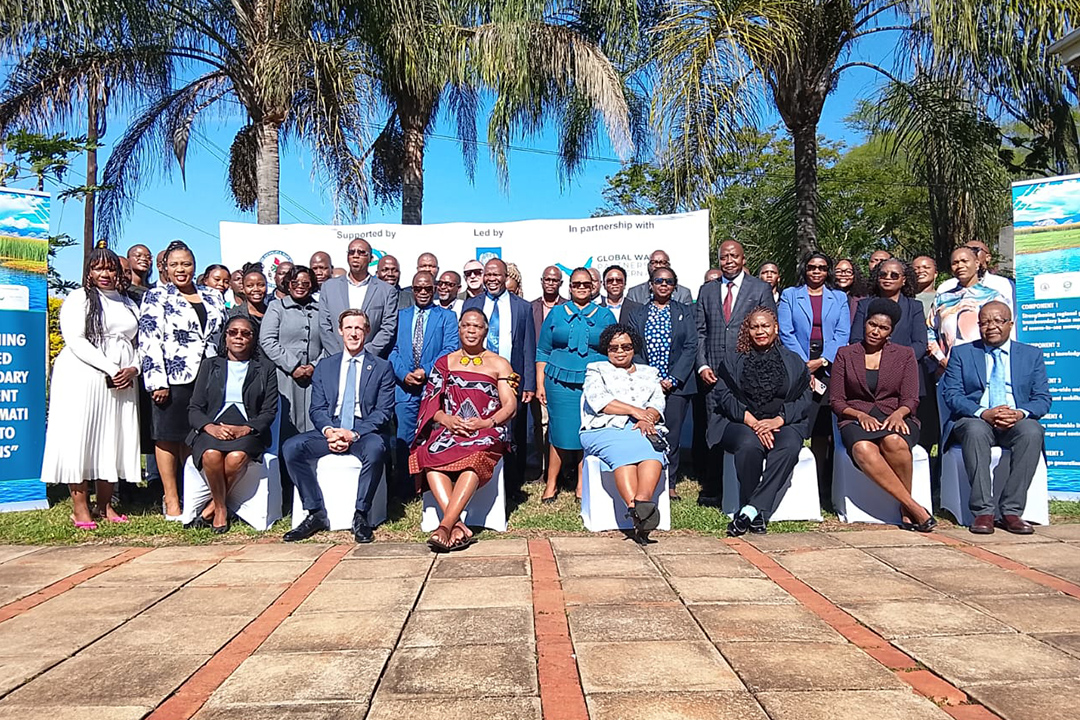
EZULWINI– Government, through the Minister of Natural Resources and Energy, Prince Lonkhokhela and Minister of Tourism and Environmental Affairs, Jane Mkhonta, have officially launched an over E3.76 billion worth Incomati & Maputo Watercourse Commission, Global Environmental Facility (GEF) 8 project.
The objective overview of the project is to promote integrated source-to-sea management of the Incomati and Maputo River basins, Lubombo Transfrontier Conservation Area and coastal zones-ensuring environmental security and inclusive livelihoods.
UNDP Resident Representative, Henrik Franklin, said it was an honour and a privilege to witness the official launch of the GEF-8 INMACOM Project: Strengthening Integrated Transboundary Management of the Incomati and Maputo River Basins.
“Allow me on the outset to express sincere appreciation to the Government of the Kingdom of Eswatini for hosting this important occasion, and to congratulate the Incomati Maputo Watercourse Commission (INMACOM), with its three partner states, for reaching this significant milestone,” he said.
He said on the day, it was not simply the launch of another regional project. It was the reaffirmation of a shared vision — that the future of the Incomati and Maputo River Basins must be shaped through cooperation, solidarity, and collective stewardship.
Shared Challenges and Solutions
The resident representative noted that water does not recognise national borders. Climate shocks do not stop at checkpoints. Droughts, floods, ecosystem degradation and growing water demand increasingly bind nations futures together, and because these challenges are shared, the solutions must also be shared.
“The Incomati and Maputo basin is one of the most strategically important transboundary water systems in Southern Africa. It sustains millions of people across South Africa, Mozambique, and Eswatini. It underpins agriculture, energy generation, biodiversity, tourism, industry and livelihoods. It is central to food security, economic stability and climate resilience across the region. Yet today, the basin faces mounting pressures,” said Franklin.
Catchment Challenges
He disclosed that climate variability was intensifying. Water demand increasing. Catchment degradation continues to threaten ecosystem health. Communities remain vulnerable to floods, droughts and water insecurity.
He said the reality before them was clear: business-as-usual approaches are no longer sufficient. This was precisely why this project matters.
“The GEF-8 INMACOM Project represents an important shift — from fragmented management toward integrated basin governance; from reactive responses toward long-term resilience; and from country-centric approaches toward genuine regional cooperation,” he said.
Franklin added that this project was also important because it embraces a true “source-to-sea” approach to regional water governance. From the upper catchments and mountain ecosystems of the basin, through rivers, wetlands and productive landscapes, all the way to downstream coastal and marine environments, the project recognises that these systems are interconnected and must be managed as one living ecological and economic system.
He said What happened upstream affects communities, ecosystems and economies downstream. Land degradation in one area affects water quality elsewhere. Unsustainable abstraction in one part of the basin affects livelihoods and ecosystem health across borders. Floods, pollution and climate impacts move across the entire system.
Regional Cooperation
“This is why integrated basin management is not optional; it is essential. Importantly, I want to emphasise that this initiative is not three separate national projects combined into one regional project. I want to remind you that it is one shared regional project owned collectively by the member states under the spirit of joint governance and shared responsibility.”
He said this distinction matters. The strength of the INMACOM Commission lies precisely in its ability to bring countries together around a common resource, a common vision and a common future.
This project therefore, he said, represents a practical demonstration of regional cooperation in action where planning, governance, data, ecosystem management and resilience-building are approached collectively rather than in isolation.
In many ways, Franklin said, the basin itself becomes the organising principle for cooperation, and that was the spirit upon which sustainable transboundary water governance must be built.
UNDP Partnership
“UNDP is proud to support this initiative as the GEF implementing partner, working alongside the INMACOM Commission, the Governments of Eswatini, Mozambique and South Africa, the Global Water Partnership Southern Africa, communities, technical institutions and many other partners.
He noted that across Southern Africa, climate change was no longer a future threat. It is already reshaping economies, infrastructure systems, agricultural productivity and patterns of human vulnerability.
“However, this project is not only about responding to risk. It is also about unlocking opportunity. Healthy river basins are economic assets. When managed sustainably, they support food systems, tourism development, renewable energy, biodiversity conservation, community livelihoods and regional trade. They create the foundation upon which inclusive and resilient economies can grow,” he said.
He mentioned also that UNDP remained fully committed to supporting this journey. He said they see this project not as a standalone intervention, but as part of a broader regional transition toward climate resilience, sustainable development and inclusive green growth.
Franklin said as the Honourable Ministers launched this initiative, let all also launch a renewed commitment:
o A commitment to cooperation over competition.
o A commitment to sustainability over short-term exploitation.
o A commitment to regional solidarity over fragmented action.
o And above all, a commitment to securing water, resilience and prosperity for future generations.
“Allow me to conclude by thanking the Global Environment Facility for its continued support to transformative environmental initiatives across the region, and to commend all partners whose dedication and persistence have brought us to this important day. I’d like to extend my heartfelt congratulations to the three member states for securing the grant of USD 7.1 million, which is over E116 million from GEF to implement this project.”
He also congratulated the INMACOM and said they looked forward to their empowerment as SADC’s youngest river basin commission.
#GEF #INMACOM #MaputoBasin #IncomatiWatercourse #Eswatini #Mozambique #SouthAfrica
(Courtesy Pic)