


- SACU vows renewed
- SACU potential not yet fully unleashed
- SACU pays tribute to two late presidents of the union
- Eswatini-launched reimagined SACU takes centre stage at summit
- Industrialisation key to regional growth – Masilela
BY KING’S OFFICE CORRESPONDENTS
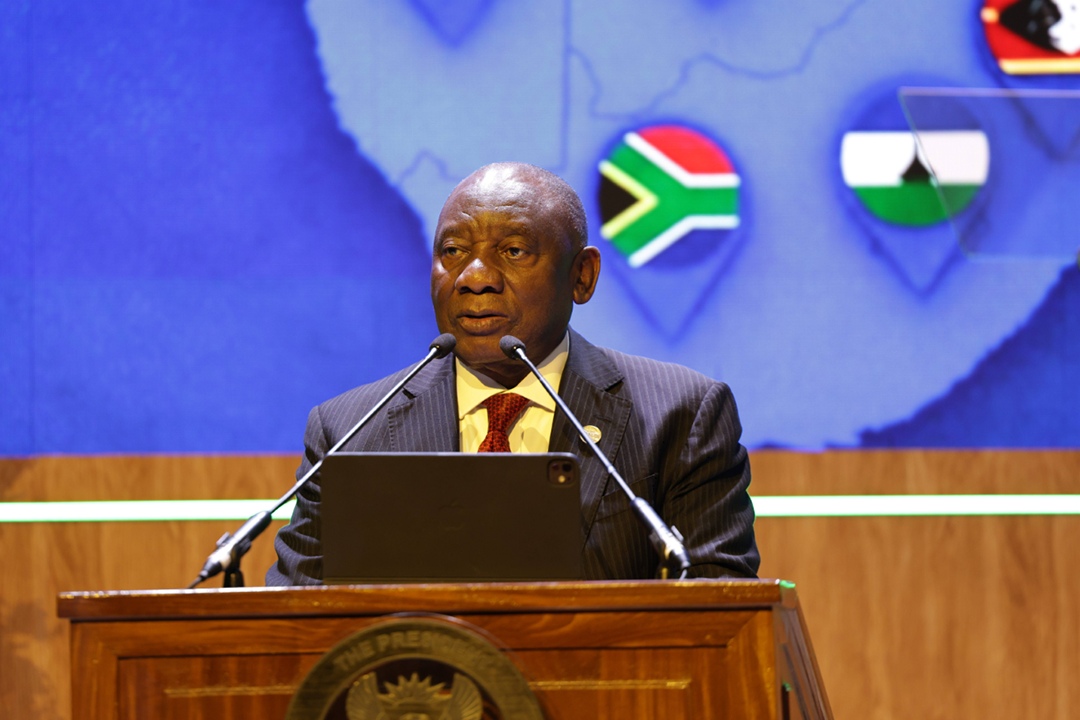
CAPE TOWN – SOUTH AFRICA – South Africa’s President Cyril Ramaphosa has told Southern Africa Customs Union (SACU) leaders that no country, no matter its size can survive the current global economic shifts by itself.
The President made these remarks when he officially opened the 9th Summit of the SACU Heads of State or Government, which was attended by His Majesty King Mswati III, Botswana President Duma Boko, President Dr. Netumbo Nandi-Ndaitwah of Namibia and Prime Minister Samuel Matekane of Lesotho, SACU Council of Ministers, Parliamentarians and senior government officials here.
“We gather today at a moment when the global economy is being reshaped before our eyes. Trade patterns are changing. New technologies are redrawing industrial competitiveness. Supply chains are being reconfigured. Around the world nations are reorganising themselves for a far more uncertain future.
“In such a world, no African country, regardless of size, can prosper alone. Our strength will increasingly depend on the strength of our region,” the President said.

He said it was during the 8th Summit held in the Kingdom of Eswatini under the leadership of His Majesty the King in the wake of COVID-19 they came up with a Re-imagined SACU Agenda to overcome the challenges posed then.
“We agreed on the need for a coordinated response to tackle supply chain disruptions as well as food and energy market volatility. It is at this moment when a Re-imagined SACU Agenda matters. SACU has lived through empire, two world wars, the Great Depression, the struggle against colonialism and apartheid, the birth of independent African states and the transformation of our own region,” he said.
President Ramaphosa said few institutions anywhere in the world have demonstrated such endurance. He said three years on, the global economic environment remains precarious and uncertain. The president stated that it is marked by trade tensions, tariff disputes, supply chain disruptions and growing economic fragmentation.
“In this increasingly contested global trading system, the need for Africa to strengthen its economic resilience has become all the greater. A Re-imagined SACU therefore becomes the vehicle which would enable our region to navigate the turbulent economic environment that the current moment continues to present us wit,” he said.
The President and SACU Chairman said through frameworks such as the African Continental Free Trade Area and mechanisms like SACU, they want to enhance intra-African commerce and trade.
He said they need to build resilience and reduce the economic dependencies that render African economies vulnerable to the whims of international trade. The certainties upon which the international trading system rested for decades are steadily giving way to uncertainty. “The decline in official development assistance has affected members of our Union.
The World Bank estimates that global growth will slow to 2.5 percent this year because of the conflict in the Middle East. The SACU economies have, however, proven to be resilient against external shocks, supported by stronger regional integration, the diversification of export destinations and effective risk-mitigation measures.
It is through regional integration that our region will continue to strengthen economic sovereignty,” the SACU Chairman said.
President Ramaphosa said the overall GDP growth in SACU is expected to grow to 2.64 percent in 2026 and 2.1 percent in 2027.
He said SACU in its 116 years of existence and world’s oldest customs union, established in 1910 has evolved from being an instrument serving colonial interests to one that advances regional economic integration, development and shared prosperity among member states.
“Since the SACU Agreement of 2002, this Union has served as a crucial building block for broader regional integration efforts. At the same time, the revenue transfers support the delivery of public services and infrastructure development,” he said.
SACU VOWS RENEWED
CAPE TOWN , SOUTH AFRICA – After years of uncertainties and revenue sharing tensions, South Africa’s President Cyril Matamela Ramaphosa yesterday affirmed that as the current leadership of the Southern African Customs Union (SACU) they have freely chosen to stand fully behind the union.
He said South Africa affirms its commitment to the objectives of the summit and to the advancement of SACU strategic objectives.
“We are grateful for the collegiality and shared resolve that have always characterised the work of the Customs Union. One hundred and sixteen years ago, the nations of this region were bound together not by choice, but by the instruments of colonial power.
“Today, we choose this Customs Union. We renew it freely. We deepen it deliberately. Because we understand that economic sovereignty and regional solidarity are not mutually exclusive. They complement each other.
One hundred and sixteen years ago, this Union was created to serve an empire. Today it must serve the aspirations of free African nations,” he said.
The President and SACU chairman said the union’s original purpose was to move goods. Its future purpose must be to create opportunity.
“Its past was shaped by history. Its future must be shaped by our choices. We should therefore choose a re-imagined SACU and stronger SACU over fragmentation. We choose industrialisation over dependence.
“We must together work for a shared prosperity over narrow national interest. In the end let history record that this generation of African leaders transformed the world’s oldest customs union into one of its most dynamic engines of regional development,” the president said.
SACU POTENTIAL NOT YET FULLY UNLEASHED
CAPE TOWN, SOUTH AFRICA – SACU Chairman and South Africa’s President Cyril Matamela Ramaphosa has told region’s economic bloc leaders that SACU’s potential has not yet been fully explored.
Speaking when opening the 9th Summit of the SACU Heads of State or Governmen here yesterday, the president stated that SACU has the potential to be more than just a fiscal instrument.
“It must be a catalyst for development. We therefore welcome the progress towards establishing a Regional Development Fund in partnership with the African Development Bank. SACU must be able to adapt its frameworks and instruments to advance industrialisation, strengthen regional value chains, promote economic diversification, attract investment and improve the economic competitiveness of member states,” he said.
He said it was time to move away from the traditional role of SACU as a customs arrangement and move toward being the premier platform for regional economic resilience and self-reliance.
“This is essential because institutions that fail to adapt to changing realities ultimately become custodians of the past rather than architects of the future. Commendable progress has been made in a number of areas. Our ambition must be nothing less than building Southern Africa into one of the world’s most competitive regional production hubs.
“In agriculture, for example, there has been valuable cooperation by farmers across member states on citrus and sugar cane production. There has been important cooperation between South Africa and Botswana on Foot and Mouth vaccines.
“We acknowledge the work of the SACU Task Team on Automotive and Mineral Beneficiation that convened in April in Maseru. Its focus is on the development of the battery value chain and cross-border component manufacturing in the auto and mining sectors.
“Eswatini’s manufacturing base, Lesotho’s textile sector, Namibia’s green hydrogen and uranium processing potential, Botswana’s diamond beneficiation experience and South Africa’s automotive and steel capacity should be harnessed towards a regional industrial ecosystem that can compete in the global economy,” he said.
The president and SACU chairman said industrialisation is the only durable path from commodity dependence to an economy capable of sustaining growing populations.
He said the next chapter in SACU’s history must be written not in customs schedules alone, but in factories that produce, laboratories that innovate, railways that connect our economies and young people whose talents are fully realised.
President Ramaphosa said with Africa holding approximately 30 percent of the world’s mineral reserves, SACU needs to leverage the growing global demand for critical minerals to support our own regional value chains and to fast-track the beneficiation of our raw materials.
“To make use of these opportunities, we must continue to invest in shared infrastructure.
We need roads, railways, ports, energy grids, digital networks and water systems that don’t just serve individual national economies, but that serve an integrated regional economy.
“The Trans-Kalahari Railway, which Botswana and Namibia have been advancing, is precisely the kind of transformative infrastructure that the region needs.
The Lesotho Highlands Water Project is a model of shared infrastructure that has served both Lesotho and South Africa for decades.
“Eswatini’s energy interconnections with South Africa and Mozambique demonstrate the same value,” he said.
The preside t said SACU is launching cross-border special economic zones that will serve as nodal points for regional industrialisation.
He said shared infrastructure requires shared investment.
“We must attract private investment by creating conditions in our region that are conducive to both international and domestic investment. On this great continent lies everything the world needs for the next century of human development. The question is whether we will be the architects of that development or merely suppliers of raw materials. This is the challenge we must address at this Summit,” President Ramaphosa said.
SACU PAYS TRIBUTE TO TWO LATE PRESIDENTS OF THE UNION
CAPE TOWN, SOUTH AFRICA – SACU leaders paid their tribute to two stalwarts of the union in late President Hage Geingob of Namibia and Botswana’s late former President Festus Mogae.
South Africa’s President and SACU chairman Cyril Ramaphosa asked the 9th Summit of the SACU Heads of State or Government to pay their tribute to the departed leaders of the union by obeserving a moment of silence.
“They were both steadfast champions of pan-African solidarity and advocates for regional economic integration. We are comforted by the knowledge that their legacies live on,” he said.
President Geingob passed away whilst in office in 2024 whilst Botswana former President Mogae passed on in May this year.
At the same summit, SACU leaders formerly welcome Botswana President Dr. Duma Boko who was attending the summit for the first time.
President Ramaphosa also thanked Namibia’s President Dr. Netumbo Nandi-Ndaitwah for her stewardship during her term as SACU Chair.
“Due to your leadership, we assume the chairship of a stronger, more resilient SACU,” he said.
ESWATINI-LAUNCHED REIMAGINED SACU TAKES CENTRE STAGE AT SUMMIT
CAPE TOWN, SOUTH AFRICA – The reimagined SACU industrialisation initiative, originally launched at the 2023 Summit hosted by the Kingdom of Eswatini, received renewed attention at the 9th Summit of SACU Heads of State and Government.
The initiative, launched in the Kingdom in August 2023, focuses on key governance issues, industrialisation, a regional export strategy, financing mechanisms, and management of the common external tariff.
In his address to the high-level gathering, which included His Majesty the King, South African President Cyril Ramaphosa as Chairperson, and other Heads of State and Government, SACU Executive Secretary Dumsani Masilela highlighted the initiative’s central role in driving the region’s industrial agenda amid global economic shifts.
While acknowledging that efforts at Council and Commission level have left the region behind schedule on some aspects, Masilela expressed optimism that Heads of State and Government would provide strategic guidance to accelerate implementation.
At the heart of the initiative is the goal of broadening the region’s industrial base to fully exploit opportunities presented by the African Continental Free Trade Area (AfCFTA) and evolving global trade dynamics.
The AfCFTA, a flagship project of ‘The Africa We Want’, targets a massive single market of 55 countries, an estimated 1.4 billion consumers, and a combined GDP exceeding US$3.4 trillion – roughly E56.1 trillion at current exchange rates.
“South Africa has placed the implementation of the AfCFTA high among its priorities,” Masilela said, urging the private sector across the region to seize the moment. He explained that a regional approach to industrialisation would not only expand production capacity but also promote deeper integration and inclusivity, ensuring benefits reach all member states, including Eswatini.
The Summit was informed that significant achievements have been recorded since the adoption of the SACU Strategic Plan in June 2022, which underpins the reimagined initiative. These include the completion of a value-chain mapping exercise and the convening of round tables on priority sectors such as agro-processing, fruits and vegetables, meat and meat products, textiles and clothing, cosmetics, and essential oils.
Ongoing work encompasses a developmental approach in the pharmaceutical sector and value-chain mapping for fertilisers, other chemicals, and seed production. These efforts aim to enhance sustainable agricultural production, strengthen food security, and foster strategic cross-border collaborations among member states.
Recognising the strategic importance of the automotive and critical minerals beneficiation sectors, the SACU Council reportedly agreed in December 2024 to fast-track their advancement through smart specialisation strategies. A broader SACU industrialisation strategy is also being developed to set clear milestones, expected outcomes, and a framework for cross-border value chains.
Complementing these industrialisation efforts, Masilela said the SACU Trade Facilitation and Logistics Programme has delivered notable results in modernising cross-border trade. Key milestones include the interoperability of customs management systems, automated exchange of customs data, and improved visibility of transactions, which have enhanced efficiency and risk management.
The Executive Secretary noted that SACU has conducted successful joint enforcement operations against illicit trade, protecting revenue and consumers, while more than 1,000 traders have been registered under the Authorised Economic Operator Programme. Pilots for mutual recognition arrangements are strengthening supply chain security while facilitating legitimate trade.
Masilela noted that intensified efforts are still required to integrate other government agencies into the trade facilitation agenda. The revised programme adopts a coordinated border management approach, with a strong emphasis on infrastructure development, including one-stop border posts, single-window systems, and the rehabilitation of critical roads.
He said a seamless, non-stop border trade environment is under exploration, with clearer policy direction expected by the end of the 2026/27 financial year.
Furthermore, digital transformation frameworks and tools to address sanitary and phytosanitary measures, technical barriers to trade, and non-tariff barriers are also advancing, aimed at reducing obstacles and improving competitiveness.
Masilela added that a mid-term review of the 2022–2027 Strategic Plan, completed in April, indicates that the region remains broadly on track despite challenges, particularly the availability of financial resources for programmes and infrastructure. To this end, he said, the Council extended the Strategic Plan to 2029 to allow the completion of outstanding work.
Masilela conveyed gratitude to President Ramaphosa and the South African Government for their leadership during the chairmanship and reaffirmed the Secretariat’s commitment to supporting member states.
INDUSTRIALISATION KEY TO REGIONAL GROWTH – MASILELA
CAPE TOWN, SOUTH AFRICA – The Executive Secretary of the Southern African Customs Union (SACU), Dumsani Masilela, has underscored the importance of industrialisation as the cornerstone of the organisation’s strategic agenda.
Addressing the 9th Summit of SACU Heads of State and Government held in Cape Town, South Africa, at the International Convention Centre, Masilela painted a picture of steady progress amid global economic challenges while calling for stronger private sector involvement and accelerated implementation.
“Without the effective participation of the business sector, all these efforts will be meaningless,” he warned, noting that the ongoing paradigm shift in the global trade policy landscape makes private sector engagement more critical than ever.
The high-level summit was preceded by a series of preparatory meetings of SACU institutions held from 21 to 25 June 2026. These included the SACU Ministerial Retreat and meetings of the Council of Ministers, where delegates reviewed progress reports on the implementation of the SACU Strategic Plan approved in June 2022. The foundational plan prioritises industrialisation through regional value chains, investment attraction, and export promotion.
The Eswatini delegation attending the summit comprises Finance Minister Neal Rijkenburg; Commerce, Trade and Industry Minister Manqoba Khumalo; Foreign Affairs and International Cooperation Minister Pholile Shakantu; Eswatini High Commissioner to South Africa Lindiwe Kunene; as well as senior officials from government.